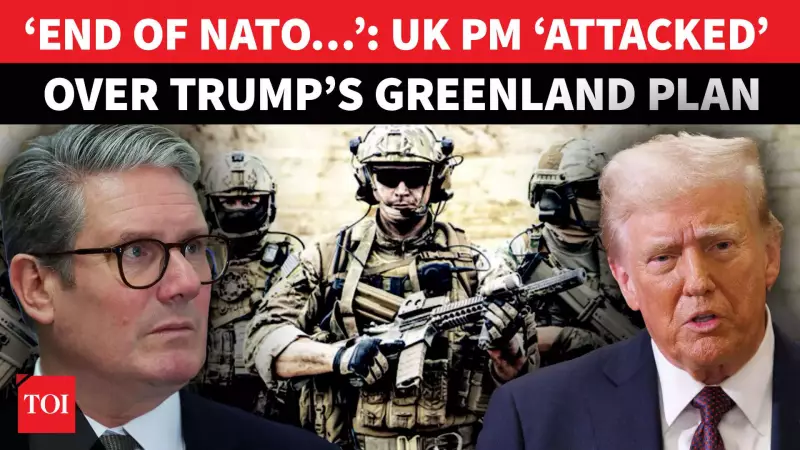
British Prime Minister Keir Starmer found himself at the centre of a political storm in the House of Commons on January 7, 2026, facing a barrage of urgent questions from lawmakers. The intense grilling was triggered by recent rhetoric from US President Donald Trump concerning Greenland, which has sent shockwaves across European capitals and raised existential questions about the future of the North Atlantic Treaty Organization (NATO).
Parliamentary Pressure and the Sovereignty Stand
The session in the UK Parliament saw MPs from across the political spectrum express deep alarm. They warned that President Trump's controversial statements and threats directed at Greenland—an autonomous territory of the Kingdom of Denmark—posed a direct threat to the cohesion of the Western military alliance. The core fear articulated was that such actions could fracture the foundational trust within NATO, testing its very purpose at a time of rising global tensions.
In his response, Prime Minister Starmer took a firm and unambiguous stance. He strongly reaffirmed the United Kingdom's commitment to Denmark's sovereignty over Greenland, leaving no room for ambiguity. He explicitly rejected any suggestions that Britain should distance itself from its closest ally, the United States, in response to the controversy.

A Call for Unity Amidst Rising Tensions
Instead of advocating for division, Starmer used the platform to urge for solidarity and unity among Western allies. He emphasised that the correct response to provocative actions was not fragmentation but a reinforced collective front. This plea for cohesion comes as the future of transatlantic cooperation appears to hang in a delicate balance, with the Greenland issue serving as a flashpoint for broader strategic anxieties.
The Prime Minister's statements highlight the difficult diplomatic tightrope walk facing European leaders. They must navigate maintaining the crucial security partnership with the United States while firmly defending established international norms and the sovereignty of allied nations. The debate in Westminster underscored that Trump's Greenland plan is not viewed as an isolated incident but as a potential catalyst for a wider geopolitical realignment.
Broader Implications for the Western Alliance
The parliamentary exchange reveals the profound unease percolating through European defence and diplomatic circles. The notion of a potential 'End of NATO', as hinted at by some lawmakers, signifies the level of concern that Trump's unilateral approach generates among traditional partners. The alliance, a cornerstone of European security since the Cold War, is facing one of its most public tests of resolve and common purpose.
As global tensions continue to escalate on multiple fronts, the unity advocated by Starmer is being scrutinised as both a necessary principle and a formidable challenge. The outcome of this diplomatic crisis over Greenland could set a significant precedent for how Western nations manage disagreements with Washington while preserving the architecture of their mutual defence and shared values in an increasingly volatile world.