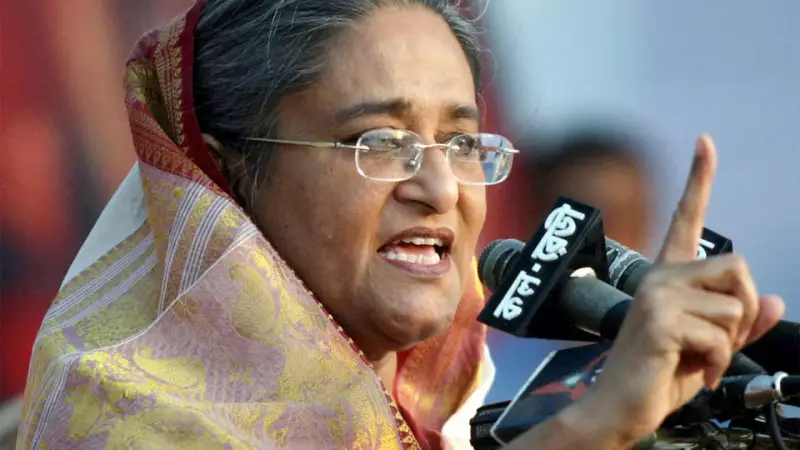
NEW DELHI: In a fiery audio message broadcast from the Foreign Correspondents' Club of South Asia in New Delhi, Bangladesh's exiled former prime minister Sheikh Hasina launched a blistering assault on the interim government led by Nobel laureate Muhammad Yunus. Hasina demanded the immediate overthrow of what she termed a "foreign-serving puppet regime" to restore constitutional democracy in Bangladesh ahead of expected elections early next year.
A Nation in Crisis
Setting a grave tone for her address, Hasina painted a devastating picture of contemporary Bangladesh, linking the current political turmoil directly to her forced removal from office nearly a year and a half ago. "Bangladesh stands today at the edge of an abyss, a nation battered and bleeding, navigating one of the most perilous chapters in its history," she declared, invoking the legacy of the Liberation War and her father, Sheikh Mujibur Rahman.
Hasina alleged that since August 5, 2024, when she was ousted from power following mass protests, democracy had been effectively driven into exile. "The entire country has become a vast prison, an execution ground, a valley of death," she claimed, describing a nation gripped by terror and lawlessness under the current administration.

Direct Accusations Against Yunus
In her most direct attack yet, Hasina targeted interim chief adviser Muhammad Yunus with scathing personal allegations. "The murderous fascist Yunus, a usurer, a money launderer, a plunderer, and a corrupt, power-hungry traitor, has bled our nation dry with his all-consuming paradigms, staining the soul of our motherland," she asserted.
Hasina claimed that Yunus and his "anti-state militant accomplices" had forcibly removed her from power through a "meticulously engineered conspiracy" despite her status as a directly elected people's representative. "From that day forward, the nation has been plunged into an age of terror, merciless, relentless, and suffocating," she added.
Five-Point Demand for National Reconciliation
Outlining a path forward, Hasina revealed that her Awami League party was presenting a comprehensive five-point demand aimed at national reconciliation and democratic revival. These demands represent a clear roadmap for political resolution in the troubled nation.
The specific demands include:
- Immediate removal of what she called the "illegal Yunus administration"
- Complete cessation of violence on Bangladesh's streets
- Ironclad guarantees for the safety of religious minorities, women, girls, and vulnerable groups
- End to politically motivated legal actions against journalists and opposition leaders
- Impartial United Nations investigation into events of the past year
"The Awami League calls for the following actions to help unify Bangladesh and banish the divisive actions of the past twelve months," Hasina explained. "We urge Muhammad Yunus to stop ignoring his own people and do what needs to be done in order to heal our country by following five crucial steps we believe will lead to a better and stronger Bangladesh."
Call to National Unity
In her emotional appeal, Hasina called upon the people of Bangladesh to unite against the current administration, invoking the spirit of the country's Liberation War. "In this grave hour, the entire nation must rise united and galvanized by the spirit of our great Liberation War," she urged.
"To overthrow the foreign-serving puppet regime of this national enemy at any cost, the brave sons and daughters of Bangladesh must defend and restore the Constitution written in the blood of martyrs, reclaim our independence, safeguard our sovereignty, and revive our democracy," Hasina proclaimed with passionate intensity.
Political Context and Upcoming Elections
The political drama unfolds against the backdrop of Bangladesh's scheduled February elections. While the Yunus administration has pledged to conduct free and fair polls, its controversial decision to ban the Awami League has drawn significant criticism and raised serious concerns about political inclusivity in the electoral process.

Historically, Bangladesh's political landscape has been dominated by two major parties: Hasina's Awami League and the Bangladesh Nationalist Party. The current exclusion of the Awami League from the political process represents a significant departure from this established pattern and adds complexity to an already volatile situation.
Hasina's forceful message from exile represents a significant escalation in the political confrontation between Bangladesh's established political forces and the interim administration. Her detailed allegations and specific demands set the stage for intensified political struggle as the country approaches crucial elections that will determine its democratic future.