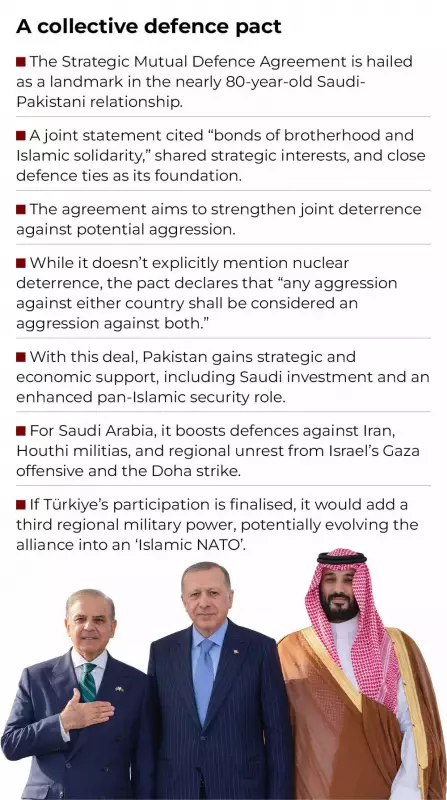
Saudi Arabia, Pakistan, and Turkey Forge New Defense Alliance
In September last year, Saudi Arabia and Pakistan signed a significant security agreement. This pact features a collective defense clause modeled after NATO's Article 5. It clearly states that an attack on one nation will be treated as an attack on both countries.
Regional Tensions Spark Security Moves
The agreement emerged against a tense regional backdrop. An Israeli strike targeting Hamas leaders in Qatar on September 9 angered Arab nations. This event prompted an emergency security meeting in Doha. While the gathering did not produce unified outcomes, it highlighted growing concerns among Arab states.
Discussions revealed unease about the reliability of the United States as a long-term security guarantor. Arab nations are increasingly exploring alternative security arrangements.

Turkey Joins the Strategic Alliance
Four months after the initial Saudi-Pakistan agreement, Turkey is now expected to join. According to Bloomberg reports, Turkey will become part of the Strategic Mutual Defence Agreement (SMDA).
Turkey, a NATO member, has been pursuing greater strategic autonomy. This move comes amid Israel's opposition to Turkey's entry into the US F-35 fighter jet program. Ankara has been diversifying its security partnerships in response.
Defensive Nature and Regional Signals
Saudi and Pakistani officials emphasize the agreement's defensive nature. They state it is not aimed at any specific countries. However, the timing makes it difficult to separate from broader regional dynamics.
The pact sends a clear signal to Israel, the only presumed nuclear power in West Asia. Since October 7, 2023, Israel has conducted military campaigns across multiple territories including Iran, Lebanon, Palestinian areas, Qatar, Syria, and Yemen.
India's Strategic Concerns
India is closely monitoring these developments. The new alliance emerges months after a brief but intense four-day military confrontation between India and Pakistan in May 2025.
Saudi Arabia and Pakistan maintain deep-rooted ties across economic, religious, and strategic domains. Historically, Riyadh reportedly provided financial support for Pakistan's nuclear program. Turkey has recently strengthened defense relations with both nations, creating potential for a trilateral alliance.
Complementary Strengths of Alliance Members
Each member brings unique strengths to the potential alliance. Nihat Ali Ozcan, a strategist at Ankara-based think tank TEPAV, explained the dynamics to Bloomberg.
Saudi Arabia offers substantial financial resources. Pakistan contributes nuclear capability, ballistic missiles, and significant manpower. Turkey provides extensive military experience and a developed defense industry.
Together, these assets could create a more formal and coordinated security bloc than the current bilateral Saudi-Pakistani relationship.
Pakistan's Strategic Alignment
Pakistan's Defence Production Minister Raza Hayat Harraj emphasized this alignment in a BBC Urdu interview. He stated that Turkey, China, Saudi Arabia, and Azerbaijan are close friendly countries of Pakistan. He noted there is a close relationship with them in terms of strategic policy.
Implications for South Asian Balance
Soon after the September pact signing, India responded cautiously. Some analysts warned the agreement could complicate South Asia's balance of power. There were concerns it might draw Saudi Arabia into volatile India-Pakistan dynamics.
Ministry of External Affairs spokesperson Randhir Jaiswal acknowledged the development. He emphasized India's core priorities while stating the government would study implications for national security and regional stability.
Pakistan's Search for Security Guarantees
Observers suggest Pakistan has been seeking formal security guarantees from allies. This search comes amid concerns about India's assertive new stance. The pact with Saudi Arabia represents a culmination of these efforts.

Asfandyar Mir, senior fellow at the Washington DC-based Stimson Center, explained Pakistan's historical context to Al Jazeera. Pakistan previously maintained mutual defense treaties with the US during the Cold War, but these crumbled by the 1970s. Even with China, despite extensive defense cooperation, Pakistan lacks a formal mutual defense pact.
Mir suggested the new agreement with Riyadh offers Islamabad an added security layer. At precisely the moment when Pakistan faces potential Indian military action, it has secured a strong collective defense agreement from Saudi Arabia. This introduces significant complexity to future India-Pakistan dynamics.
Saudi Reassurances to India
Riyadh has reassured New Delhi about the pact's implications. A senior Saudi official told Reuters that Saudi Arabia's relationship with India is more robust than ever. The official stated Saudi Arabia would continue growing this relationship and seek to contribute to regional peace.
Nuclear Dimensions of the Alliance
Pakistan's defense minister Khawaja Mohammad Asif made significant statements about nuclear cooperation. He said Pakistan's nuclear program "will be made available" to Saudi Arabia if needed under the new defense pact.
The prospect of nuclear dimensions to this alliance has long been speculated upon. Historical ties between Riyadh and Islamabad in strategic defense support these speculations. Retired Pakistani Brigadier Feroz Hassan Khan documented Saudi Arabia's "generous financial support" to Pakistan's nuclear weapons program in his authoritative book.
A 2007 US diplomatic cable published by WikiLeaks reveals Pakistani officials floated the idea of Saudi Arabia developing a weapons program in tandem with Pakistan. The cable reports that Pakistani officials understood Saudi Arabia wants to protect itself and the region.
Saudi Nuclear Ambitions and Regional Context
These developments coincide with Saudi Arabia's push for a domestic nuclear energy program. Riyadh has sought American assistance to build civilian nuclear infrastructure. A key sticking point has been securing uranium enrichment rights.
While the stated purpose is peaceful energy production, non-proliferation experts raise alarms. Enriching uranium domestically could potentially pave the way for weaponization.
Crown Prince Mohammed bin Salman has been explicit about Saudi Arabia's strategic posture. He stated the kingdom would seek to acquire nuclear weapons if Iran were to develop them.
Riyadh remains a signatory of the nuclear non-proliferation treaty (NPT). It is not believed to be actively developing nuclear weapons. However, it is widely assumed to possess a domestic ballistic missile program, which could serve as a delivery system if pursued.
Regional Diplomacy and Reassurances
Notably, just before the Saudi-Pakistani agreement was finalized, Iran dispatched Ali Larijani to Riyadh. Larijani serves as secretary of Iran's Supreme National Security Council. There was speculation that Saudi Arabia gave Tehran quiet reassurances regarding the pact.
This would be consistent with the ongoing détente between the two regional powers. China brokered this détente in 2023, marking a significant shift in Middle Eastern diplomacy.
The emerging Saudi-Pakistan-Turkey defense alliance represents a major realignment in regional security architecture. As these nations combine their respective strengths, the implications extend across West Asia and South Asia. India watches these developments closely while maintaining its strategic priorities and regional relationships.