

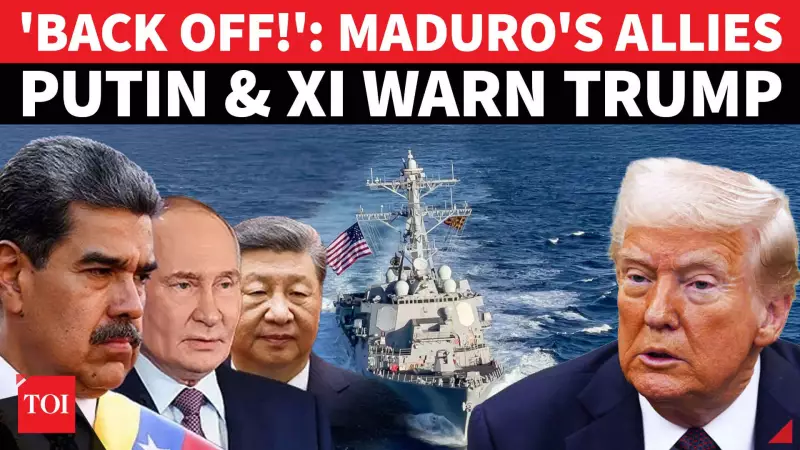
In a significant escalation of tensions, Russia and China have forcefully responded to the United States' decision to impose a naval blockade on sanctioned oil tankers bound for Venezuela. The move, ordered by US President Donald Trump, has triggered a sharp geopolitical rift, drawing strong warnings from Moscow and a formal condemnation from Beijing.
Moscow's Stern Warning and Beijing's Condemnation
Russian President Vladimir Putin issued a stark caution to Washington, labelling the blockade a dangerous provocation that could lead to a "fatal mistake." The Kremlin urged for restraint across Latin America and warned that the US action represents a serious escalation with unpredictable consequences. Following Russia's lead, China, which had remained relatively quiet, has now broken its silence. Beijing openly condemned what it called unilateral pressure and coercive measures against Venezuela, a key partner in its Belt and Road Initiative.
China has thrown its diplomatic weight behind the government of Nicolas Maduro, supporting Venezuela's call for an emergency meeting of the United Nations Security Council to address the crisis. This coordinated pushback from two permanent members of the Security Council sets the stage for a major diplomatic showdown at the world's most powerful multilateral forum.

The Blockade and Its Immediate Fallout
The immediate impact of the US blockade order, dated December 18, 2025, is already visible. Multiple oil tankers are reported to be sitting idle, unable to enter or leave Venezuelan ports. This strangles the lifeblood of Venezuela's crippled economy, which is almost entirely dependent on oil exports. The Trump administration's strategy appears aimed at intensifying maximum pressure on the Maduro regime to force a political change.
However, this tactic has had the simultaneous effect of driving global powers into clearer opposing camps. Russia and China are now closing ranks around Caracas more firmly than before, transforming a regional political standoff into a broader confrontation between major world powers. Analysts suggest the blockade could inadvertently strengthen Maduro's narrative of being under imperialist attack, rallying domestic and international support.
A Widening Geopolitical Fault Line
The situation in Venezuela is rapidly ceasing to be just a Latin American crisis. It is morphing into a proxy arena where US-Russia and US-China tensions are playing out. The consequences, as warned by Moscow, extend far beyond the Caribbean region and could destabilise global energy markets and international diplomatic norms.
The strong reactions highlight a growing trend where actions by the United States are met with coordinated resistance from the Russia-China axis. This incident underscores the fragile state of global diplomacy and the potential for a localised conflict to spark wider instability. The world now watches to see if the UN Security Council meeting will ease tensions or deepen the divide, and whether the US will recalibrate its approach in the face of such direct and powerful opposition.






