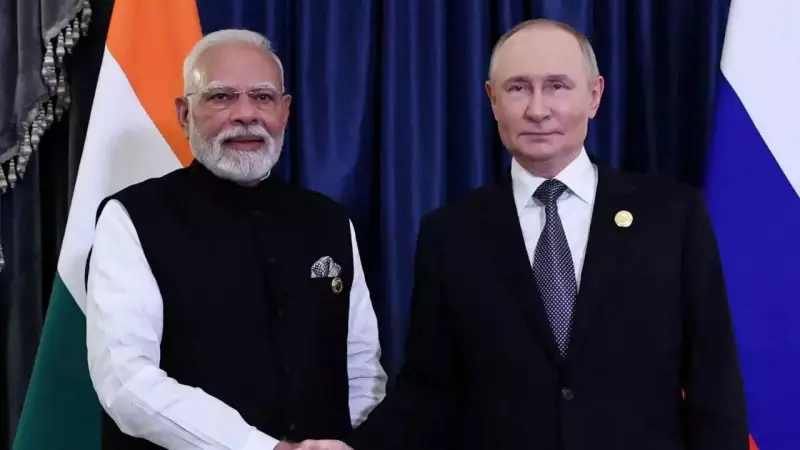
Russian President Vladimir Putin's arrival in New Delhi on December 4 marks a significant diplomatic moment, being his first trip to India since the onset of the Ukraine war in February 2022. The summit with Prime Minister Narendra Modi is poised to reinforce a longstanding partnership, but the agenda is driven by complex strategic and economic necessities rather than mere nostalgia.
Hard Power and Financial Plumbing: The Twin Pillars
The talks will center on two critical bets. The first is a major defense procurement: India intends to request five additional S-400 Triumf air defense missile squadrons from Russia, supplementing the systems acquired under a $5.5 billion deal signed in 2018. This comes after the Indian Air Force successfully tested the S-400 in 'Operation Sindoor' earlier this year, where it reportedly shot down multiple Pakistani drones along the western front.
The second is a financial infrastructure plan. Negotiators aim to secure a political agreement, and potentially a roadmap, to interlink India's RuPay and Russia's Mir payment networks. This move, coupled with efforts to smoothen the rupee-rouble trade mechanism, is designed to insulate bilateral trade from the tightening grip of Western sanctions on Moscow's financial system.

Why the S-400 Remains a Non-Negotiable for India
Despite Western pressure and talks of diversifying defense sources, the S-400 is viewed in Delhi as an irreplaceable capability gap-filler. With China continuously modernizing its air force and Pakistan posing a persistent threat, the long-range, layered radar system is considered a vital component of India's air defense. The platform's proven performance has cemented its 'game-changer' status among Indian planners.
Consequently, the Modi government is not only pursuing more S-400 squadrons but is also considering Moscow's offer for co-production of the Su-57 stealth fighter, which includes promises of deep technology transfer and localization. For India, this represents strategic optionality, demonstrating it is not confined to a single camp for advanced military technology.
However, a fresh S-400 order risks re-igniting tensions under the US CAATSA sanctions law, which punishes major defense deals with Russia. While Washington granted India a waiver in 2022, a new purchase would test the limits of Western tolerance, especially alongside ongoing disputes over India's imports of Russian oil.
Rewiring Trade: The Rupee-Rouble Challenge and RuPay-Mir
Bilateral trade has ballooned to nearly $70 billion in 2024-25, fueled predominantly by discounted Russian crude oil. Yet, sanctions have crippled traditional payment channels, forcing the revival of a rupee-rouble settlement system using Special Rupee Vostro Accounts (SRVAs).
While the Reserve Bank of India has eased rules to allow Russian entities to invest surplus rupees in Indian bonds and stocks, the system remains cumbersome. Indian exporters face payment delays as banks fear secondary sanctions. The proposed integration of RuPay and Mir card networks seeks to build an alternative financial pipeline. In practice, it could allow Indian tourists in Russia to use RuPay cards directly, and Russian tourists in Goa or Kerala to use Mir, gradually moving transactions away from dollar-dependent systems.
Oil, Sanctions, and the Tightrope Walk
The surge in trade rests on a crude reality: Russia, which supplied minimal oil to India pre-2022, now accounts for 35-40% of India's crude imports. The steep discounts have saved Delhi billions, helping control inflation. However, a new wave of US-EU-UK sanctions targeting Russian oil giants like Rosneft is biting hard.
Data indicates a stark contrast: while Indian imports of Russian crude jumped to about 1.85 million barrels per day in November 2024, they are projected to plummet to roughly 600,000-650,000 barrels per day in December, the lowest in three years, as sanctions take effect. Refiners like Reliance have already halted Russian crude imports for their export-focused units.

Every Indian move to safeguard payments—be it RuPay-Mir or rupee-rouble tweaks—will now be scrutinized by Western capitals through the lens of these energy sanctions. The question for them is whether it constitutes smart hedging or enables sanction evasion.
Strategic Autonomy or Strategic Isolation?
India officially maintains its stance of being 'against the war' while upholding the UN Charter. However, External Affairs Minister S. Jaishankar has consistently asserted India's right to choose its energy and defense partners. Delhi terms this multi-alignment or 'strategic autonomy.'
Yet, patience in Western capitals is wearing thin. India's posture is increasingly viewed as opportunistic at a time when the US and Europe frame the Ukraine conflict as an existential struggle. While a full-blown crisis is unlikely—given India's pivotal role in the US Indo-Pacific strategy to counter China—each new S-400 battery and each step in financial de-coupling adds weight to an already delicate balance.
The summit will ultimately underscore India's determination to act in its national interest. The outcomes—more S-400s, progress on RuPay-Mir, and sustained energy ties—will raise the stakes higher. The underlying narrative remains: Can India sustainably partner with a sanctioned Russia without fracturing its ties with a wary West? The answer will define its geopolitical maneuverability in the years ahead.