Putin Sets $1 Billion Condition for Russia's Participation in Trump's Board of Peace Initiative
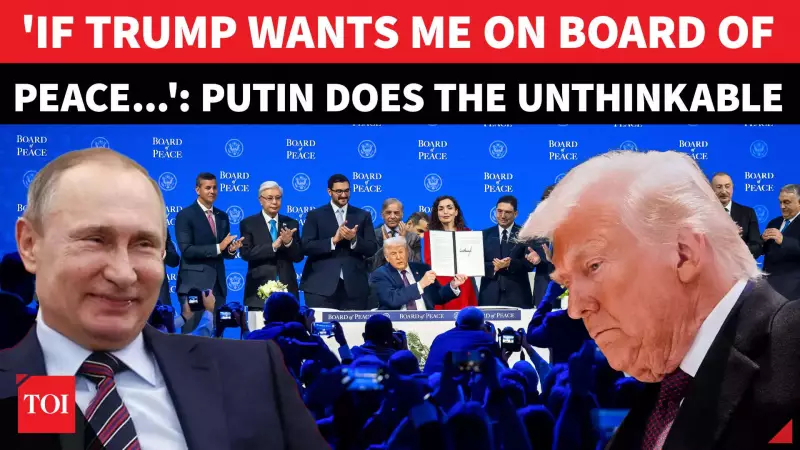
In a dramatic development at the World Economic Forum in Davos, Russian President Vladimir Putin has presented a bold counterproposal to U.S. President Donald Trump's newly launched Board of Peace initiative. The Russian leader has explicitly stated that Moscow would consider joining the peace board only if the United States releases $1 billion from frozen Russian assets held in American financial institutions.
The Humanitarian Framework of Putin's Proposal
President Putin has strategically framed this financial demand within a humanitarian context, proposing that the released funds would be specifically allocated for rebuilding Gaza and supporting the Palestinian people. This positioning creates a complex diplomatic scenario where Russia presents itself as advocating for humanitarian causes while simultaneously seeking the release of its frozen assets.
The proposal represents a significant escalation in the diplomatic maneuvering between the two global powers, coming at a time when U.S. envoys are scheduled to arrive in Moscow for high-stakes discussions covering multiple critical issues including the Ukraine conflict, Gaza situation, and broader global security concerns.

Contradicting Trump's Claims of Russian Agreement
This development directly contradicts President Trump's earlier assertions that Russia had already agreed to participate in the Board of Peace initiative. The Russian counterproposal transforms what was presented as a settled matter into a negotiation with specific financial conditions, fundamentally altering the diplomatic landscape surrounding the peace initiative.
The timing of this announcement is particularly significant, occurring during the high-profile World Economic Forum where global leaders and policymakers are gathered. This ensures maximum international visibility for Russia's position and creates additional pressure on the United States to respond to what Putin has characterized as a humanitarian proposal.
Transforming Frozen Assets into Peace Funding
Perhaps the most revolutionary aspect of Putin's proposal is the conceptual shift it represents regarding frozen assets. The Russian president's suggestion moves the discussion of using these immobilized funds for peace initiatives from theoretical possibility to active diplomatic negotiation. This represents a potential precedent that could influence how frozen assets are viewed and utilized in future international conflicts and peace processes.
The proposal raises several critical questions that will need to be addressed by both nations and the international community:
- The legal and procedural mechanisms for releasing frozen assets for specific humanitarian purposes
- The precedent this would set for future international negotiations involving frozen state assets
- The verification and oversight mechanisms for ensuring funds are used as intended for Gaza reconstruction
- The broader implications for international financial systems and sanctions regimes
Broader Implications for International Diplomacy
This diplomatic standoff highlights how the Board of Peace initiative has become an unexpected nexus connecting geopolitical rivals through a single framework. The initiative now serves as both a potential platform for cooperation and a battleground for competing interests and diplomatic strategies.
The situation underscores the complex interplay between humanitarian objectives, financial leverage, and geopolitical positioning in contemporary international relations. As negotiations proceed, the outcome will likely establish important precedents for how frozen assets can be utilized in peace processes and humanitarian efforts, potentially reshaping aspects of international law and diplomatic practice.
With both leaders having staked significant political capital on their respective positions, the coming weeks will reveal whether this proposal leads to breakthrough negotiations or further diplomatic escalation between two of the world's most powerful nations.