Historic Gathering at Christianity's Birthplace
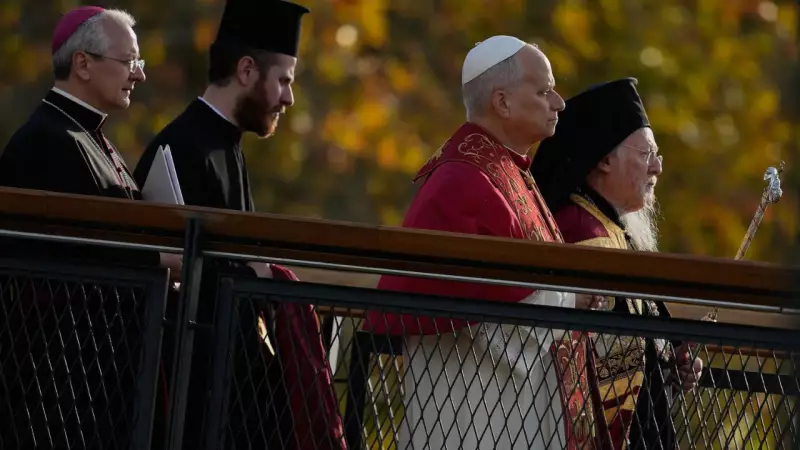
In a powerful display of ecumenical solidarity, Pope Leo XIV stood shoulder-to-shoulder with Ecumenical Patriarch Bartholomew I and other Christian leaders on Friday at the shores of Turkey's Lake Iznik. This sacred ground, where the landmark Council of Nicaea convened in A.D. 325, witnessed an unprecedented prayer service aimed at healing centuries-old divisions within Christianity.
The Creed That Unites Millions
Standing over the recently uncovered ruins of what archaeologists believe hosted the original council, the spiritual leaders recited the Nicene Creed - the foundational statement of faith that continues to be recited by millions of Christians worldwide. Pope Leo described the creed as being "of fundamental importance in the journey that Christians are making toward full communion."
The pontiff emphasized the urgent need to overcome what he called "the scandal of the divisions that unfortunately still exist" while nurturing the desire for unity that Jesus Christ prayed for during his lifetime. This prayer service marked the centerpiece of Pope Leo's visit to Turkey and represented the primary purpose of his trip - his first international journey since assuming the papacy.

A Symbolic Location with Deep Historical Roots
The choice of location carried profound symbolic weight. The original Council of Nicaea occurred when Eastern and Western churches remained united, nearly 700 years before the Great Schism of 1054 divided Christianity. Remarkably, despite subsequent divisions, the Nicene Creed continues to be accepted by Catholic, Orthodox, and most historic Protestant denominations, making it Christianity's most widely embraced creed.
Ecumenical Patriarch Bartholomew I, spiritual leader of the world's Orthodox Christians, captured the moment's significance by stating: "The Nicene Creed acts like a seed for the whole of our Christian existence. It is a symbol not of a bare minimum; it is a symbol of the whole."
The commemorative service took place at the archaeological excavations of the ancient Basilica of Saint Neophytos, where receding lake waters have recently revealed stone foundations believed to mark the exact location where bishops gathered 1,700 years ago.
Interfaith Dynamics and Local Reactions
While the event represented a historic moment for Christian unity, it also highlighted the complex interfaith dynamics in predominantly Sunni Muslim Turkey. Approximately 20 members of the New Welfare Party staged a brief protest before the pope's arrival, claiming the gathering threatened Turkey's sovereignty and national identity.
Local residents expressed mixed reactions. Thirty-five-year-old Iznik resident Suleyman Bulut acknowledged his town's deep Christian significance, stating: "Muslims should go and visit places that belong to us in the rest of the world, in Europe." However, shopkeeper Hasan Maral, 41, confessed feeling uncomfortable with the visit, saying it felt "contradictory to my faith."
Strengthening Turkey's Catholic Community
Earlier in his visit, Pope Leo encouraged Turkey's small Catholic community, numbering approximately 33,000 among 85 million people, to find strength in their modest numbers. During a vibrant welcome at Istanbul's Cathedral of the Holy Spirit, where congregants shouted "Papa Leo" and "Viva il Papa," the pontiff delivered an inspiring message.
"The logic of littleness is the church's true strength," Pope Leo told the gathered faithful in English. He also highlighted the importance of welcoming migrants and refugees, describing this as a crucial challenge facing the church in Turkey.
The pope's visit included meetings with nuns from the Little Sisters of the Poor, who operate a nursing home in Istanbul. Sister Margret described the encounter as profoundly moving, noting "He was so simple. We just felt he was at home."

Looking Forward: Continuing the Ecumenical Mission
The historic gathering at Lake Iznik represents a significant milestone in the centuries-long quest for Christian unity. As Patriarch Bartholomew emphasized during the service, they gathered not merely to remember the past but to "bear living witness to the same faith expressed by the fathers of Nicaea."
Pope Leo used the occasion to deliver a strong message against religious extremism, urging all Christians to firmly reject using religion to justify "war, violence or any form of fundamentalism or fanaticism." Instead, he championed the paths of "fraternal encounter, dialogue and cooperation" as the way forward.
The participation extended beyond Catholic and Orthodox leaders, including priests, patriarchs and bishops from Greek, Syrian, Coptic, Malankarese, Armenian, Protestant and Anglican churches - representing a broad spectrum of Christian traditions united by their shared Nicene heritage.
As Pope Leo continues his visit with meetings at the Blue Mosque and a Mass at Istanbul's Volkswagen Arena before heading to Lebanon, the images from Lake Iznik will undoubtedly resonate through Christian communities worldwide, offering hope for greater unity and understanding in a divided world.