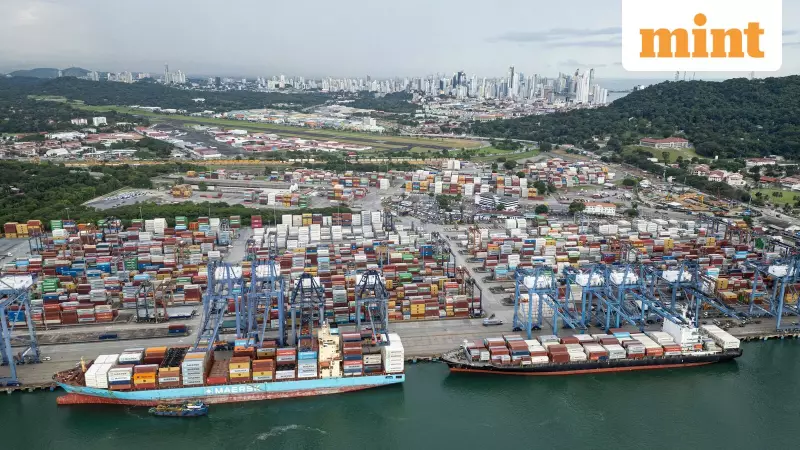
Panama's Supreme Court Nears Crucial Verdict on Canal Ports
The Supreme Court of Panama is finalizing its deliberations in a landmark case. This decision will determine whether Hong Kong-based CK Hutchison can continue operating two vital ports at both ends of the Panama Canal. Observers in Washington and Beijing are watching closely, as the ruling carries significant weight in the ongoing geopolitical competition between the United States and China.
Geopolitical Stakes and Historical Context
President Donald Trump has publicly expressed a desire to regain control over the canal, which the U.S. constructed in the early 20th century and transferred to Panama in late 1999. Meanwhile, China has actively obstructed the proposed sale of these canal ports and other assets operated by CK Hutchison. The intended buyers are a consortium led by BlackRock and Mediterranean Shipping Co.
A ruling from the Panamanian court is anticipated imminently. For the justices, the political pressure is enormous. Allowing Hutchison to retain its license risks angering the Trump administration. It also highlights the vulnerability of this small Central American nation, which uses the U.S. dollar and owes its 1903 independence to American intervention against Colombia.

Legal Challenges and Financial Allegations
Private lawyers and Panama's comptroller filed lawsuits with the Supreme Court against Hutchison. They allege the company violated Panama's constitution by acting against the interests of the government and its taxpayers. A government audit reportedly revealed up to $1.3 billion in lost state revenue since Hutchison's arrival in the late 1990s.
The company originally outbid firms like U.S.-based Bechtel to secure a 25-year license. This license was renewed for another 25 years in 2021. "Hutchison's relationship with Panamanian society over the past decades has been very tense and difficult," stated Panama's Finance Minister, Felipe Chapman, in a recent interview in Panama City.
Government Preparedness and Corporate Stance
Chapman and other senior officials confirmed they are ready to implement the Supreme Court's ruling if it orders the termination of Hutchison's license. A top priority would be ensuring uninterrupted port operations. This would involve recruiting a temporary management company for the terminals until the government launches a new bidding process with revised license terms. Officials suggested possibly separating the two ports to maximize their value.
Panamanian President José Raúl Mulino said he would await and comply with the court's decision. However, last year he indicated the current situation was unsustainable. "I don't see the continuation of the Panama Ports contract at the moment, amended or not," Mulino remarked in July following the comptroller's lawsuits.
A source close to Hutchison said the company views the complaint as politically motivated but is awaiting the ruling. The same source indicated that if the court rules against them, Hutchison would pursue the case in international arbitration panels to protect its investment.
Broader Regional Implications and Economic Impact
China's foreign ministry expressed hope for a fair and nondiscriminatory environment for all companies. If Hutchison loses its license, Beijing would likely seek ways to retaliate. Following a recent U.S. military raid in Venezuela, China is reportedly forming a Latin America task force to study how to protect its regional interests.
The court could also impose fines and remedial measures on Hutchison while allowing it to continue operations. The company cannot appeal a Supreme Court verdict but can request clarifications, potentially delaying implementation.
At least 5% of global trade passes through the Panama Canal, a key factor in the nation's prosperity compared to its neighbors. Panamanian officials assert they have assessed various scenarios linked to the court ruling to prevent disruptions in the port system. "The continuity of operations is fundamental for the transshipment industry worldwide," emphasized Alberto Alemán, former Panama Canal administrator and current advisor to the Mulino administration.

The Blocked Sale and Rising Tensions
Amid increasing U.S. pressure, CK Hutchison agreed to sell over 40 ports globally to BlackRock and MSC for nearly $23 billion. The two Panama container terminals—Balboa on the Pacific and Cristóbal on the Atlantic—were considered the crown jewels of this deal.
China's government opposed the transaction, demanding that the state-run shipping company Cosco hold a majority stake and veto power in the firm managing the global assets. This deal is now in jeopardy. In Panama City, the Mulino administration watched the negotiations with astonishment. Licenses granted by Panama do not permit participation by foreign state-owned firms.
Officials noted that neither Chinese government representatives nor Hutchison executives approached the administration to provide information or seek Panama's consent. Panamanian officials had long expressed dissatisfaction with the terms of the CK Hutchison deal. President Trump's complaints further accelerated this simmering dispute.
Hutchison had secured favorable terms from previous administrations even as global trade surged and Panama evolved into a major global transshipment hub for container cargo. "There has been a lot of criticism and a flood of lawsuits with the high court since then," said Alemán, referring to the 2021 license renewal. "Hutchison has large, latent liabilities."
Regional Trend and Panama's Transformation
Other countries in the region are also implementing barriers against Chinese companies to avoid tensions with the U.S. For instance, Mexico's government has sought to curb the rapid expansion of China's BYD, the world's largest electric-vehicle manufacturer. It imposed 50% import tariffs on Chinese-made vehicles and blocked BYD's plans to open an assembly plant in Mexico.
Panama invested billions in new, larger canal locks as the infrastructure handed over by the U.S. over two decades ago became nearly obsolete. It developed a state-of-the-art passageway that transformed global shipping, accommodating ever-larger supertankers and containerships.
The canal connects North Asian ports with U.S. East Coast markets importing goods from China or Japan. Tankers move oil, petroleum products, and liquefied natural gas from the U.S. Gulf Coast through the canal. Containerships transport products like Chilean wines or Ecuadorean bananas to major markets such as New York.
Alongside the canal expansion, Panama built a platform for container transshipment. Its port system now handles as many containers as the New York and New Jersey terminals combined. Hutchison entered the country during the early stages of this transformation. Panama currently handles over nine million containers annually, a dramatic increase from roughly 100,000 containers more than two decades ago.