

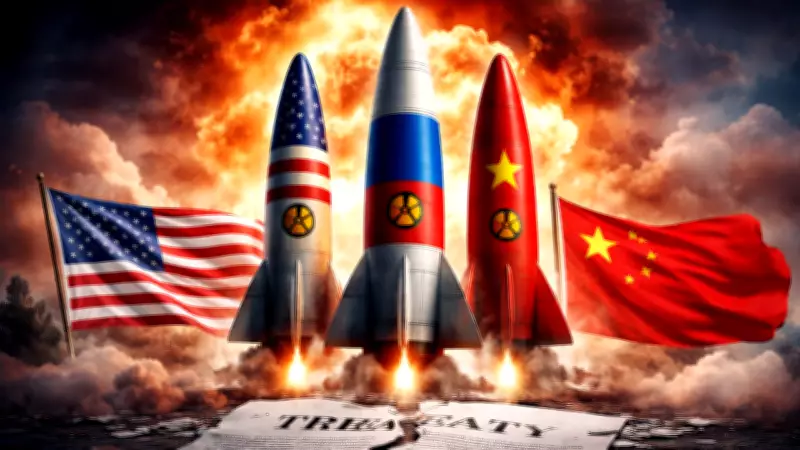
New START Treaty Expires, Ending Decades of US-Russia Nuclear Limits
The formal expiration of the New START treaty on Thursday has plunged the world into uncharted nuclear territory, marking the first time in over five decades that the United States and Russia operate without any binding limits on their strategic arsenals. This development has ignited immediate fears of a renewed global arms race, even as both nuclear superpowers signal an urgent need for fresh negotiations.
An Era of Nuclear Arms Control Comes to a Close
Signed in 2010 by then US President Barack Obama and Russian President Dmitry Medvedev, the New START treaty imposed critical caps on deployed nuclear capabilities. It limited each nation to 1,550 deployed nuclear warheads and 700 deployed missiles and bombers. The agreement also established a framework for mutual inspections and data exchanges, vital mechanisms designed to reduce the risk of catastrophic miscalculation.
With its expiration following a single five-year extension, these formal constraints have vanished. Russian President Vladimir Putin had previously proposed a one-year mutual extension of the treaty's limits, but no such agreement was reached before the deadline, leaving a significant void in international security architecture.

Kremlin and Washington Agree: Talks Are Imperative
Despite the lapse, diplomatic channels remain active. Kremlin spokesman Dmitry Peskov confirmed on Friday that Russian and US negotiators, meeting in Abu Dhabi, reached a crucial understanding. "There is an understanding... that both parties will take responsible positions and both parties realize the need to start talks on the issue as soon as possible," Peskov stated.
He firmly dismissed speculation about any informal, short-term extension of the treaty's limits, emphasizing the gravity of the situation. In a parallel development, the US and Russia agreed to restore high-level military-to-military dialogue, a channel suspended since 2021 amid escalating tensions prior to the Ukraine conflict.
US Shifts Focus, Demands China's Inclusion in Future Pact
The landscape of nuclear diplomacy is undergoing a fundamental shift. The United States is now explicitly framing any future arms control agreement as a trilateral necessity, insisting that China must be a party. US Secretary of State Marco Rubio articulated this position, warning that a bilateral US-Russia deal is no longer sufficient.
"An arms control arrangement that does not account for China’s build-up, which Russia is supporting, will undoubtedly leave the United States and our allies less safe," Rubio asserted. He highlighted China's rapid nuclear expansion, noting its stockpile has grown from the low 200s in 2020 to over 600 warheads today, with projections exceeding 1,000 by 2030.
Washington Accuses Beijing of Covert Nuclear Testing
The US stance hardened with direct allegations against China. Thomas DiNanno, US Under Secretary for Arms Control, used a speech in Geneva to accuse Beijing of violating its testing moratorium. "Today, I can reveal that the U.S. Government is aware that China has conducted nuclear explosive tests, including preparing for tests with designated yields in the hundreds of tons," DiNanno declared.
He alleged that China's People's Liberation Army attempted to conceal these tests by obfuscating seismic signals, citing a specific test on June 22, 2020. DiNanno framed the New START expiry as a turning point, arguing the old treaty failed to address modern threats like China's unconstrained arsenal and Russia's new nuclear systems.
China Rejects Allegations and Refuses to Join Talks
China responded with forceful denials. Ambassador Shen Jian labeled the US accusations as "false narratives and unfounded accusations." He reaffirmed China's commitment to its testing moratorium and accused Washington of seeking excuses for "nuclear hegemony" by shifting blame for its own disarmament obligations.
Shen reiterated China's firm refusal to participate in nuclear disarmament talks at this stage, arguing its arsenal remains far smaller than those of the US and Russia. He expressed regret over New START's expiration and urged Washington to accept Moscow's earlier offer for a mutual extension and resume bilateral negotiations.

Analysts Warn of Unprecedented Uncertainty and Risk
Security analysts are sounding alarms, warning that the collapse of New START ends a foundational pillar of global stability that has endured since the Cold War. The absence of formal limits, combined with deep mistrust, allegations of violations, and the contentious issue of China's role, creates a perfect storm for an unconstrained arms race.
While both Washington and Moscow profess a desire for new talks, the path forward is fraught with geopolitical tensions. The expiration of New START has undeniably ushered in a new, multipolar era of nuclear uncertainty, where future arms control must account for a world no longer defined by a simple US-Russia balance of power.





