Nepal's Central Bank Revives Border Dispute With New Currency Design
Nepal's central bank has triggered fresh diplomatic tensions with India by introducing newly designed 100 rupee currency notes that prominently feature a revised national map including territories that India has consistently claimed as its own. The Nepal Rastra Bank officially unveiled the updated banknotes on Thursday, incorporating the controversial map that shows Kalapani, Lipulekh, and Limpiyadhura regions within Nepal's borders.
Details of the Redesigned Currency Note
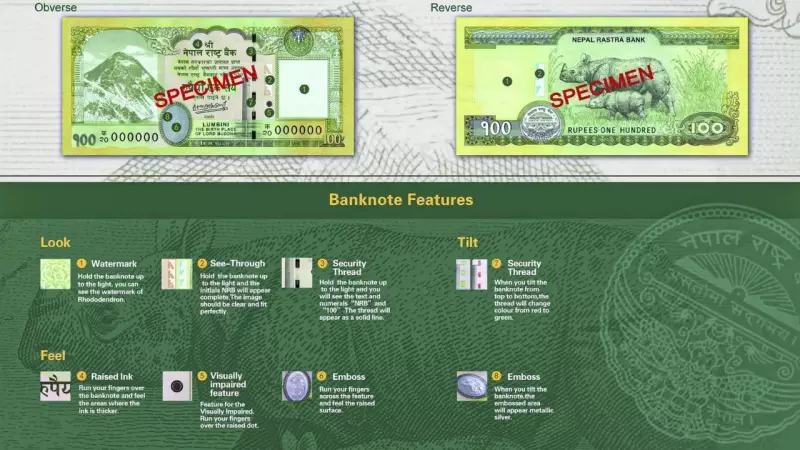
The newly issued Rs 100 note carries significant symbolic elements beyond the disputed map. The currency bears the signature of former governor Maha Prasad Adhikari and displays the issuance year as 2081 BS, which corresponds to 2024 in the Gregorian calendar. The design maintains several traditional Nepali symbols while introducing the contentious cartographic changes.
On the front side of the note, Mount Everest appears on the left side, while the national flower, the rhododendron, serves as a watermark on the right. The center background features a faint green outline of Nepal's updated national map, positioned alongside the Ashok Pillar with text identifying Lumbini as the birthplace of Lord Buddha.

The reverse side of the currency showcases an image of the endangered one-horned rhino, along with specialized features including a security thread and an embossed black dot designed to assist visually impaired users in identifying the denomination.
Historical Context and Political Backdrop
This currency revision represents the latest development in a long-standing boundary disagreement between the neighboring nations. The map controversy originally escalated in May 2020 when the government led by then Prime Minister K P Sharma Oli secured parliamentary approval to adopt the revised national map including the three disputed territories.
India had previously condemned Nepal's 2020 map update as a "unilateral act" and warned against what it described as an "artificial enlargement" of territorial claims. The Lipulekh Pass, which lies in the far-western region near Kalapani, remains a particularly sensitive area in the dispute, with both countries asserting historical claims to the territory.
India administers Kalapani as part of Uttarakhand's Pithoragarh district, while Nepal maintains it rightfully belongs to its Dharchula district. The two countries share an extensive border stretching more than 1,850 kilometers across five Indian states: Sikkim, West Bengal, Bihar, Uttar Pradesh, and Uttarakhand.
Official Response and Implementation Details
When questioned about the currency revision, a spokesperson for Nepal Rastra Bank provided clarification that the national map had already appeared on previous versions of the Rs 100 notes. The current update simply aligns the currency design with the government's official map directive adopted in 2020.
Interestingly, among Nepal's various currency denominations including Rs 10, Rs 50, Rs 500, and Rs 1,000 notes, only the Rs 100 denomination carries the national map, while other notes do not feature this cartographic element.
The introduction of these revised banknotes comes at a time when India-Nepal relations have been navigating various diplomatic challenges. The currency redesign is likely to reignite discussions about border management and territorial sovereignty between the two nations, potentially affecting bilateral cooperation in other areas.
This development represents another chapter in the complex territorial dialogue between the South Asian neighbors, with both countries maintaining their respective positions based on historical documents and treaties. The currency update ensures that the map dispute remains visually present in everyday economic transactions within Nepal.