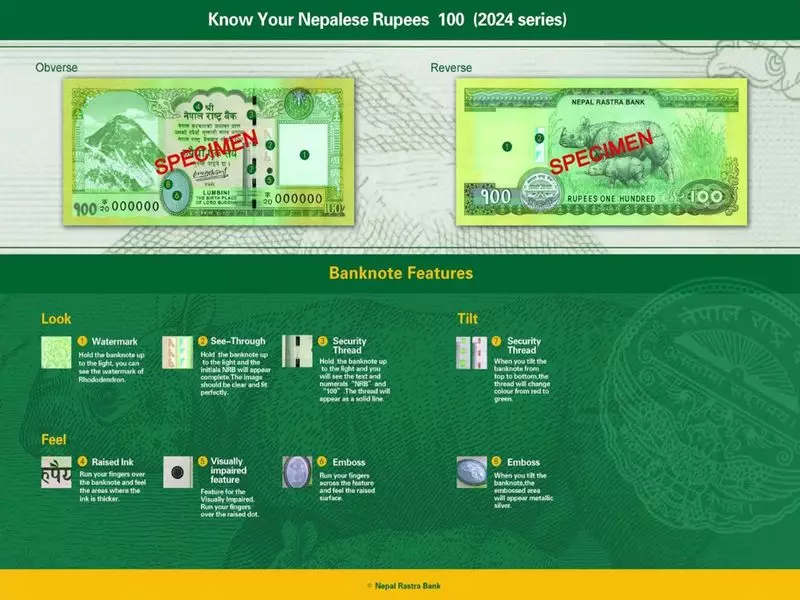
In a significant move that has drawn regional attention, Nepal has officially introduced a new 100-rupee banknote that prominently features the country's updated map including territories currently disputed with India. The Nepal Rastra Bank, the nation's central banking authority, made this announcement on Friday, marking a pivotal moment in the ongoing border discussions between the two neighboring countries.
The New Banknote Design and Features
The freshly minted currency note incorporates Nepal's revised official map that shows the regions of Lipulekh, Kalapani, and Limpiyadhura as integral parts of Nepalese territory. This cartographic representation aligns with the constitutional amendment Nepal passed in 2020, which formally adopted these contested areas into its national map.
According to the central bank's statement, the new 100-rupee note will circulate alongside existing currency notes of the same denomination. The design maintains similar security features and color schemes as previous versions but with the crucial addition of the updated map that has been at the center of diplomatic tensions between Kathmandu and New Delhi.

Historical Context of the Border Dispute
The territorial disagreement between India and Nepal centers around approximately 370 square kilometers of land in the strategically important western Himalayan region. The dispute gained significant momentum in 2019 when India published a new political map following the reorganization of Jammu and Kashmir, which showed the contested territories within Indian borders.
Nepal's parliament responded in June 2020 by unanimously passing a constitutional amendment that officially incorporated the disputed areas into the country's national emblem. This legislative action represented Nepal's most assertive position on the border issue in decades, setting the stage for the recent currency development.
The timing of the new banknote's release is particularly noteworthy as it comes during a period of ongoing diplomatic efforts to resolve the boundary issues through dialogue and established bilateral mechanisms.
Regional Implications and Responses
The introduction of the new currency note has significant implications for India-Nepal relations, which have experienced strains over the border issue in recent years. The visual representation of the disputed territories on a national symbol like currency represents a substantial escalation in Nepal's approach to asserting its territorial claims.
Regional analysts suggest that this move could potentially impact the ongoing diplomatic negotiations between the two countries. The banknote release demonstrates Nepal's commitment to its official position on the border issue, while also serving as a domestic political statement about national sovereignty and territorial integrity.
The development occurs against the backdrop of established bilateral mechanisms designed to address border concerns. Both nations have historically maintained open borders and deep cultural, economic, and people-to-people ties, making the resolution of this territorial matter crucial for regional stability.
As of now, the Indian government has not issued an official statement regarding Nepal's new banknote. The Ministry of External Affairs typically addresses such matters through diplomatic channels, emphasizing the importance of peaceful resolution and mutual understanding in border disputes.
Future Prospects and Diplomatic Considerations
The circulation of the new currency note raises important questions about the future trajectory of India-Nepal relations. While the banknote represents a firm stance from Kathmandu, it also presents an opportunity for renewed dialogue and diplomatic engagement between the neighboring nations.
International observers will be monitoring how this development influences the ongoing border talks and whether it might lead to new initiatives for conflict resolution. The situation underscores the complex nature of border disputes in South Asia and the delicate balance between asserting national sovereignty and maintaining regional harmony.

As both countries navigate this latest development, the focus remains on finding a mutually acceptable solution through peaceful means and diplomatic channels, preserving the longstanding friendship between the people of India and Nepal while addressing legitimate territorial concerns.