Navy Chief Admiral Tripathi in Ranchi: Operation Sindoor Continues Against Terror Infrastructure
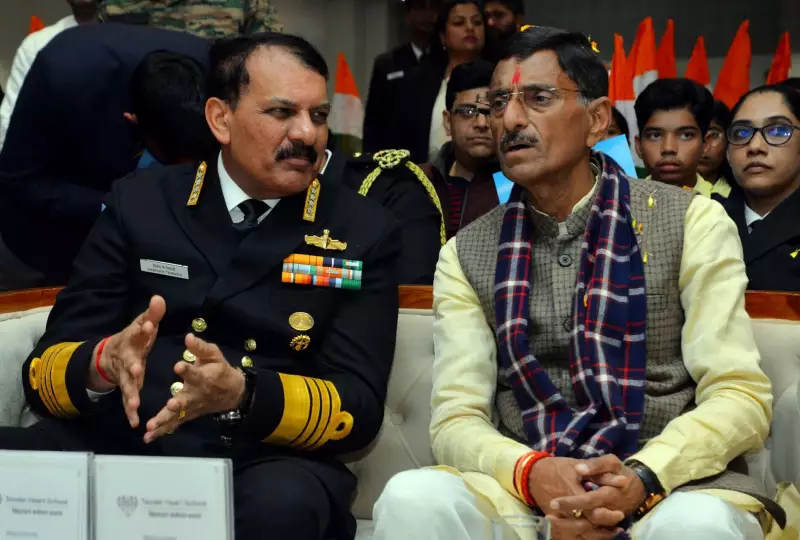
During a two-day visit to Ranchi, the Chief of Naval Staff, Admiral Dinesh Kumar Tripathi, made significant revelations about India's ongoing military operations. Addressing students at the Central Coalfield Limited headquarters, Admiral Tripathi stated that Operation Sindoor, India's strike against terrorist infrastructure in Pakistan and Pakistan-occupied Kashmir, is still active and has only paused temporarily.
Operation Sindoor: A Challenging and Proud Experience
Responding to a query from NCC cadet Nitya Singh, the Navy chief described Operation Sindoor as one of the most challenging and learning experiences of his career. "Challenges are an integral part of life. For me, professionally, Operation Sindoor is undoubtedly one of the most challenging, as well as a learning experience. It was a matter of pride, too, where I could use the expertise gathered in the last four decades of service," Admiral Tripathi said.
He emphasized that the operation is not yet concluded, indicating that challenges persist in the fight against terrorism. When asked by Divyanshi of the Army Public School for details, the Navy chief refrained from specifics but highlighted the Navy's preparedness. "The Navy demonstrated its utmost strength during the operation to deter the opponent and was ready for war, if needed. But the opponent was in a state of fear and did not come out of their harbour, giving us no chance of fighting," he explained.

Lessons Learned and Technological Integration
Admiral Tripathi further revealed that Operation Sindoor provided valuable lessons in terms of equipment and strategies, prompting the Navy to immediately start working on improvements. When questioned by DAV Public School student Shitanshu Kumar Singh about the role of AI, cyber warfare, and indigenous weapons, the Navy chief confirmed that the force is already utilizing these new-age technologies in its warfare capabilities.
"In today's world, technology is changing at the speed of thought. By the time someone thinks of a technology, someone else in some part of the globe is already developing it. Undoubtedly, technology is playing a great role in war, and the Navy is also keeping up its pace with the changing world," Admiral Tripathi stated, underscoring the importance of technological advancement in modern defense.
Youth's Crucial Role in Realizing Viksit Bharat by 2047
Turning his attention to the nation's future, Admiral Tripathi addressed the youth, urging them to prioritize skill acquisition alongside conventional education. He emphasized that this is essential for actively contributing to India's development and helping realize the vision of a Viksit Bharat by 2047.
"India eyes to become a 30-trillion dollar economy, achieve 100% literacy rate, and emerge as a global hub in the innovation sector by 2047. The journey of a developed India lies in the vision of becoming self-reliant from dependency, transforming import to innovation and weakness to resilience. But to realize this vision, our youth have to play a crucial role," the Navy chief asserted.
He outlined specific areas where youth need to develop expertise:
- New-age technologies
- Critical thinking abilities
- Problem-solving skills
- Effective communication skills
Admiral Tripathi stressed that being educated alone is insufficient in today's era. "Only the skilled youths will take the country to the path of development. The youths must be honest, disciplined and have a high degree of work ethics and civic sense to contribute to the country in a true sense," he added, highlighting the importance of character alongside capability.
Maritime Importance for India's Development
Emphasizing the strategic significance of naval forces, Admiral Tripathi provided compelling statistics about maritime trade:

- 90% of world's trade occurs through sea routes
- 95% of India's trade is conducted via sea
- 88% of India's energy requirements come through maritime channels
He termed India's journey toward becoming a developed nation as a "maritime voyage," noting that "a little inconvenience caused in the sea can lead to a heavy financial burden on the public exchequer. The country's commerce, connectivity and trade highly depend on the sea route. The Navy plays a significant role in safeguarding the commerce of the country and will continue to do so in the future."
The Navy chief's visit to Ranchi thus served as both a revelation about ongoing military operations and a clarion call for youth empowerment, positioning maritime security and skilled human resources as twin pillars supporting India's ambitious development goals for 2047.