Elon Musk's Davos Wordplay Sparks Diplomatic Debate on Trump's Peace Initiative
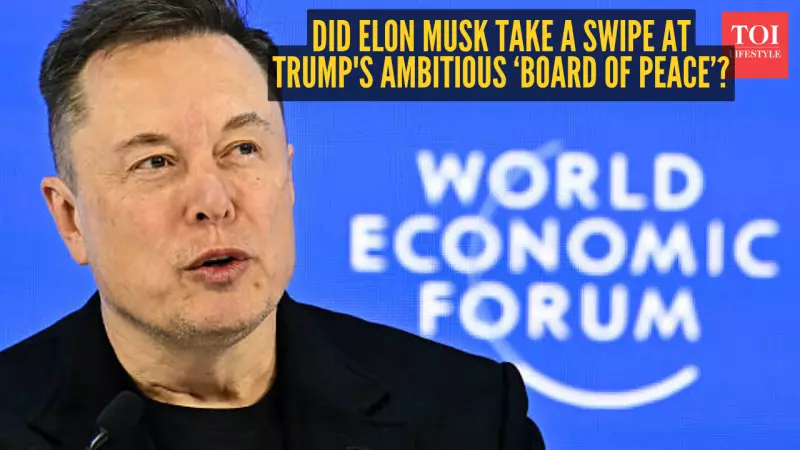
During a high-profile panel discussion at the World Economic Forum in Davos, Elon Musk, seated among global financiers and influential power brokers, delivered a remark that would send ripples far beyond the alpine calm of the Swiss resort. Speaking alongside BlackRock CEO Larry Fink, Musk took a pointed swipe at US President Donald Trump's newly announced "Board of Peace," pausing to question its true intent with a clever linguistic twist.
The Punning Remark That Captured Global Attention
"I heard about the formation of the Peace Summit and I thought, is that piece or... a little piece of Greenland, a little piece of Venezuela," Musk quipped, drawing restrained laughter from the assembled audience. He added with apparent irony, "All we want is peace." This moment represented classic Musk behavior—flippant, elliptical, and designed to sound offhand while landing squarely in the center of the global news cycle.
However, unpacking this seemingly simple pun reveals a much deeper political context, one firmly rooted in recent global diplomacy and President Trump's own public statements regarding territorial ambitions. The wordplay directly riffs on the tension between what a leader professes to want and how their actions are perceived internationally.

Contextualizing the Critique: Trump's Territorial Ambitions
On the surface, Trump's Board of Peace is positioned as a diplomatic initiative aimed at resolving the Gaza conflict and promoting global stability. Yet, in the months since its announcement, international skepticism has grown regarding its scope, strategy, and underlying message. This skepticism intensified after Trump revived public interest in expanding US influence over territories like Greenland.
President Trump has repeatedly expressed interest in bringing Greenland under US control, first during his initial presidency and again more recently. While he has insisted that military force would not be employed to pursue such a move, the proposal itself—unprecedented in the modern diplomatic era—has unsettled allies and drawn skepticism from seasoned diplomats. Critics point to Trump's history of abrupt policy reversals and impulsive decision-making as reasons for caution.
The Deeper Meaning Behind Musk's Linguistic Play
This background is essential to fully comprehend Musk's pun. By suggesting that Trump's "Board of Peace" could just as easily be interpreted as a "Board of Piece," Musk was subtly alluding to how expansionist ambitions are often dressed in the language of diplomacy and peacekeeping. The specific references to "a little piece of Greenland" and "a little piece of Venezuela" directly echoed Trump's past rhetoric, playing on the idea that territorial ambition, when couched as peace, can sound more like acquisition than conciliation.
This is not merely a similarity in sound; it is a pointed commentary on how public statements and actual policy can diverge in both tone and interpretation, particularly with leaders known for unpredictable political decisions. Musk's remark transforms a rhetorical flourish into a subtle critique, questioning not just a name but how international diplomacy is perceived when political motives appear ambiguous.
Historical Echoes: From Mel Brooks to Modern Diplomacy
Those familiar with cinematic satire will recognize Musk's pun as echoing a memorable scene from Mel Brooks' 1983 film To Be or Not to Be. In a musical number performed by Frederick Bronski as Hitler within the fictional troupe "Naughty Nazis," the lyrics proclaim:
"I don't want war. All I want is peace. Peace. Peace! A little piece of Poland, a little piece of France, a little piece of Portugal, and Austria perchance, a little slice of Turkey, and all that that entails, and then a piece of England, Scotland, Ireland, and Wales..."
In that scene, the humor derives from the stark contradiction between the proclaimed desire for peace and the action of taking pieces of other nations. The joke brutally exposes how the language of peace can be weaponized to disguise expansionist intent, how conquest can be softened through strategic euphemism. The humor resonates because the contradiction is laid bare: peace is promised, but partition is delivered.

Musk's wordplay at Davos, whether intentional or not, tapped into this same enduring contradiction. By blurring the terms peace and piece, he highlighted a critical diplomatic concern that transcends any single administration.
The Ambiguous Reception of Trump's Peace Initiative
Trump's Board of Peace has been pitched as a conflict-resolution mechanism for the war-torn Gaza region and as a platform for broader international mediation. However, its reception has been notably uneven. Fewer than two dozen countries have publicly backed the initiative thus far, with conspicuous absences including major European powers such as France, the United Kingdom, Sweden, and Norway. Meanwhile, global players like India, China, Germany, Russia, and the European Union have so far opted to observe from the sidelines, adopting a wait-and-watch approach.
Musk's wordplay neatly skewered this very ambiguity. By reframing "peace" as "piece," he tapped into long-running critiques of Trump's foreign policy instincts, particularly the president's past musings about acquiring Greenland or exerting influence over neighboring regions. The joke did not attack the policy directly; rather, it questioned the fundamental intent behind it. Or, as some social media commentators have cheekily reframed it, the remark highlighted that in international politics, what is presented as peace can sometimes feel suspiciously like territorial negotiation cleverly rebranded.
Ultimately, Musk's brief, pun-laden intervention at Davos served as a microcosm of larger global anxieties. It underscored the delicate dance between diplomatic rhetoric and geopolitical reality, reminding the world that in the high-stakes arena of international relations, words matter—and sometimes, the space between "peace" and "piece" is where the most significant debates truly reside.