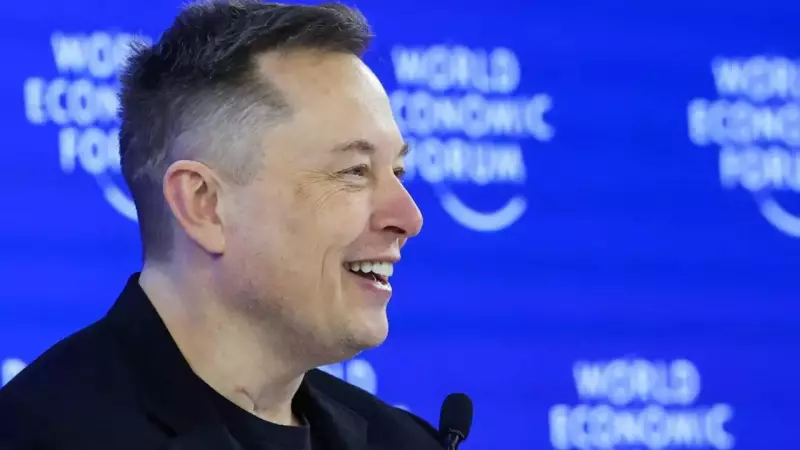
During the prestigious World Economic Forum in Davos, a brief yet sharp remark from billionaire entrepreneur Elon Musk managed to cut through hours of formal speeches and meticulously crafted policy discussions. Speaking before an audience packed with global political leaders and top corporate executives, the Tesla and SpaceX chief delivered a clever play on words that instantly drew attention to one of US President Donald Trump's newest foreign policy initiatives.
The Remark That Sparked Laughter and Scrutiny
"I heard about the formation of the peace summit, and I was like, is that p-i-e-c-e?" Musk quipped, according to multiple accounts from the event. He followed this with, "You know, a little piece of Greenland, a little piece of Venezuela," before adding with apparent irony, "All we want is peace."
The room responded with laughter and quiet chuckles, a notable reaction in Davos where remarks are typically carefully calibrated and diplomatic. In this environment of measured discourse, Musk's comment stood out prominently. Observers widely interpreted it as a public dig at Trump's newly announced Board of Peace, delivered on one of the world's most visible global stages.

Understanding Trump's Board of Peace Initiative
During his own speech at Davos, President Trump officially introduced the Board of Peace as a new platform designed to resolve international conflicts and engage in diplomacy worldwide. Supporters have hailed it as a bold and innovative approach to international relations, while critics have questioned how it would coordinate with existing global institutions.
Concerns About Structure and Credibility
Analysts and diplomats have expressed significant concerns about the board's operational framework and governance structure. With Trump expected to wield considerable influence over how the body functions, questions have emerged regarding its independence and long-term credibility as a diplomatic entity.
The Controversial Membership Model
Particular attention has focused on the proposed membership framework. According to media reports and preliminary descriptions, countries might be offered limited-term membership, while permanent status could potentially be tied to substantial financial contributions—possibly reaching hundreds of millions or even up to $1 billion.
While the administration has not released detailed rules, critics argue that such a model risks making the body appear exclusive rather than genuinely multilateral. Some commentators have further noted that several countries expected to show interest in the initiative are governed by authoritarian systems, adding to concerns about the board's legitimacy and alignment with democratic values.
Why Musk's Comment Carries Significant Weight
Elon Musk is far from a detached observer in Trump's political sphere. Their relationship has been unusually close, complicated, and highly public. Reports indicate that Musk was one of Trump's largest individual donors during the 2024 presidential campaign, contributing more than $230 million. He also leveraged his social media platform X to amplify Trump's campaign messaging extensively.
From Government Role to Public Tensions
After Trump returned to office, Musk was appointed to lead the Department of Government Efficiency (DOGE). His tenure concluded in May 2025 when his status as a special government employee expired. Even during his official role, clear signs of tension emerged, including a public dispute with Trump's trade adviser Peter Navarro and disagreements over economic policy directions.
Following Musk's departure from DOGE, the relationship deteriorated further. Musk openly criticized Trump's tax and spending legislation, triggering sharp exchanges between them. By mid-2025, their conflict had escalated into a public feud, with Trump suggesting that Musk's immigration status could be scrutinized and hinting at potential government investigations into contracts and subsidies related to Musk's companies.
A Fragile Truce Emerges
By late 2025, relations showed signs of improvement. Musk attended a high-profile White House dinner honoring the Saudi crown prince, where Trump greeted him warmly in public view. Since then, political observers have characterized their relationship as a fragile truce rather than a complete reconciliation.

Despite their past clashes, Musk has indicated he might again provide significant financial backing to Republican candidates ahead of the 2026 midterm elections. This context adds considerable weight to any public comment he makes about Trump or his administration's initiatives.
Davos as a Stage for Political Signaling
The World Economic Forum in Davos has long functioned as a venue where power is exercised through suggestion and symbolism as much as through formal policy announcements. In this environment, a single sentence can shape international headlines and influence global perceptions significantly.
Against this backdrop, Musk's "Peace" versus "Piece" wordplay represented more than just a humorous aside. It served as a pointed reminder that his alignment with Trump remains conditional and potentially unstable. By publicly poking at the Board of Peace concept, Musk signaled that even Trump's flagship foreign policy ideas remain open to scrutiny and criticism from influential figures within his own sphere of support.
The exchange underscores how Davos continues to serve as a critical platform where business, politics, and diplomacy intersect, with carefully chosen words carrying implications that resonate far beyond the conference halls of the Swiss Alps.