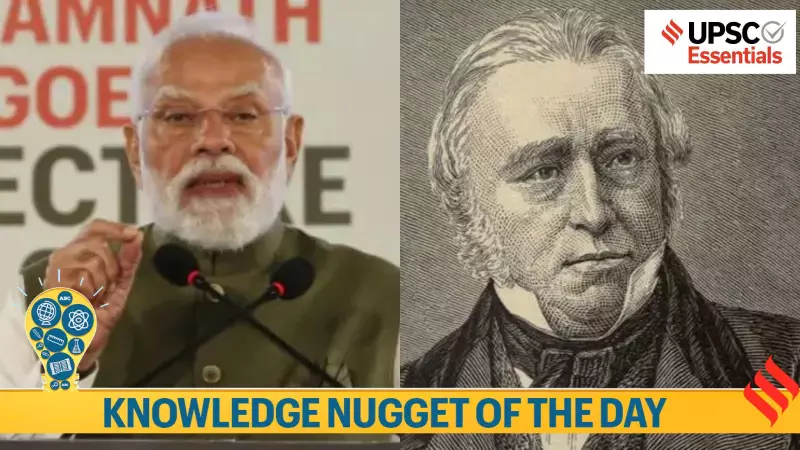
Prime Minister Narendra Modi has launched an ambitious decade-long mission to dismantle what he describes as the colonial mindset embedded in India's education system since 1835. Speaking at the sixth Ramnath Goenka Lecture, the Prime Minister set a clear timeline leading up to the 200th anniversary of Thomas Macaulay's controversial education reforms to reverse this historical legacy.
The Colonial Education Transformation
Before British rule, India's educational landscape was dominated by the ancient Gurukul system, which emphasized traditional knowledge and spiritual development. However, this system had significant limitations, particularly in its exclusion of women, lower castes, and underprivileged communities from educational opportunities.
French traveler Francois Bernier offered a critical perspective in the 17th century, describing educational institutions in Varanasi as lacking proper university structures. Yet, Scottish missionary William Adam presented a more balanced view in the 1830s, noting that while patshalas had limited resources, they effectively served contemporary educational needs.

British Intervention and Macaulay's Role
The East India Company initially showed minimal interest in Indian education until 18th-century Orientalists like Warren Hastings, William Jones, and Jonathan Duncan developed fascination with Sanskrit and Persian cultures. Their efforts led to establishing madrasas, colleges, and the pioneering Asiatic Society of Calcutta.
The turning point came in 1813 when the British Parliament allocated one lakh rupees annually for literature revival and scientific knowledge promotion in India. Christian missionaries further transformed the landscape by establishing convent schools that introduced modern educational standards.
Thomas Babington Macaulay, appointed as the first Law Member of the Governor-General's Council in 1834, became the architect of India's educational transformation. The debate between Orientalists advocating traditional vernacular education and Anglicists pushing for Western English education reached its climax during his tenure.
Macaulay's Minute and Its Lasting Impact
Macaulay firmly sided with the Anglicists, envisioning the creation of a class of Indians who would be Indian in blood and color but English in taste, opinions, morals, and intellect. His controversial Downward Filtration Theory proposed educating a small elite who would then disseminate knowledge to the masses.
The English Education Act of 1835 institutionalized this vision, though it faced criticism even among British officials. Following the 1857 revolt, Viceroy Lord Mayo condemned the policy for creating a small class of educated Babus without effectively spreading knowledge to millions.
Ironically, the Western-educated class that Macaulay intended to create for British administrative purposes eventually became the vanguard of India's independence movement, turning colonial education policy into an unintended catalyst for national liberation.
Beyond Education: Macaulay and Civil Services
Macaulay's influence extended beyond education into the Indian Civil Service (ICS). The Macaulay Committee of 1855 introduced merit-based recruitment, replacing the patronage system with competitive examinations. However, the system heavily favored European classics and disadvantaged Indian aspirants, with the first ICS competitive examinations held in London in 1855.
Prime Minister Modi's call for decolonizing Indian education comes as the nation prepares to confront this complex historical legacy. The ten-year timeframe signals a determined effort to reclaim India's educational sovereignty and redefine its knowledge systems for the 21st century.