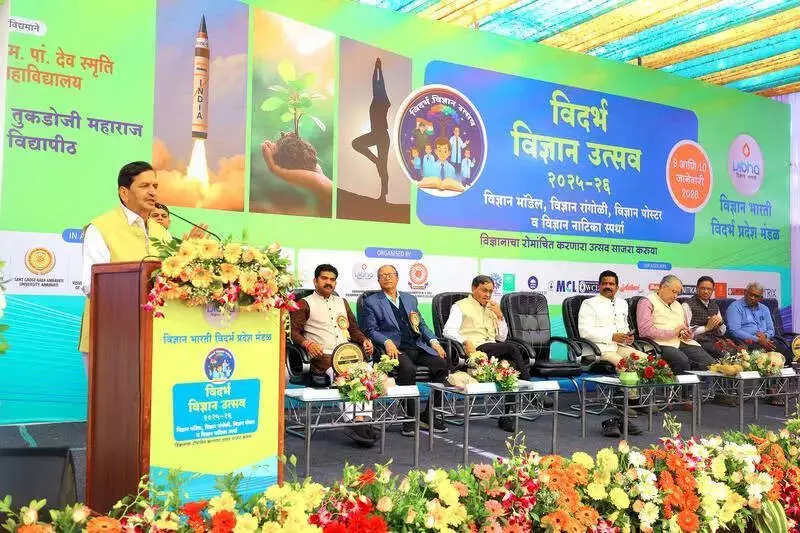
Maharashtra's Skill Development Minister, Mangal Prabhat Lodha, made a striking comparison between modern aviation and ancient Indian wisdom during a public address in Nagpur on Friday. Speaking at the inauguration of the Vidarbha Vigyan Utsav at Dharampeth Science College, the minister asserted that India's ancient knowledge systems, including aviation technology referenced in the Ramayana, remain a profound intellectual treasure for the nation.
Ancient Aviation and the Pushpak Viman
Minister Lodha drew a direct parallel between contemporary aircraft manufacturing and India's mythological past. He pointed out that while the United States boasts of building advanced planes like Boeing, ancient Indian texts like the Ramayana, written thousands of years ago, already described flying vehicles like the Pushpak Viman. This aerial chariot, associated with the demon king Raavan of Lanka, was cited by Lodha as evidence of advanced scientific thinking in ancient Indian civilisation.
"Those who manufacture Boeing today take pride in it, but during the era of the Ramayana, we had already conceptualised flight," Lodha stated. He emphasized that this deep-rooted ancient knowledge forms the core strength and heritage of India, proving its relevance even in the modern technological age.

A Tribute to Unsung Heroes and a Critique of Colonial Legacy
Moving beyond science, the minister also shared his views on India's freedom struggle and education system. He argued that attributing the nation's independence solely to Mahatma Gandhi and Jawaharlal Nehru tells only "half the truth." Lodha stressed that lakhs of unsung heroes—including farmers, labourers, tribals, and ordinary citizens—sacrificed their lives for the country, many of whom will never be known by name.
He posed a reflective question to the audience, asking whether present-day India is the nation those freedom fighters envisioned. Lodha added that if those revolutionaries could see the India of today, decades after independence, they might have questioned the value of their sacrifices.
The minister was particularly critical of the colonial education framework introduced by the British. He labeled it a system designed to create "products" who chase marks rather than individuals who retain knowledge or develop original thinking. "Macaulay's system trained people to score marks, not to become warriors of knowledge. We must set aside that approach and generate genuine interest and awareness in science," he urged.
Nagpur as a Pilgrimage and New Science Day Initiative
Describing Nagpur as a 'punyabhoomi' (holy land) and a spiritual centre for those associated with the Rashtriya Swayamsevak Sangh (RSS), Lodha shared his personal connection to the city. He said visiting the RSS headquarters and Smruti Mandir to pay tribute to founder Dr. Hedgewar and second Sarsanghachalak Guru Golwalkar is like a pilgrimage for him, especially during the state legislature's winter session.
In a significant announcement, Lodha revealed that the state government will soon sign a memorandum of understanding with Vigyan Bharati. As part of this collaboration, February 28, which is observed as National Science Day, will be officially declared as 'Jayantrao Sahasrabuddhe Science Day' in memory of the noted science educator and pioneer of the science movement. A government resolution to this effect will be issued.
Furthermore, Vigyan Bharati will partner with the state to promote scientific awareness among teachers, for which a financial assistance of Rs 5 lakh will be provided. Lodha commended Vigyan Bharati for conducting large-scale science events across 11 districts in Vidarbha, helping bridge India's ancient scientific vision with contemporary understanding.
Concluding his address, the minister clarified that science is not confined to artificial intelligence or information technology. "Science is learning something new from existing knowledge," he remarked, calling on the youth to embrace the true meaning of science and develop a scientific temper.