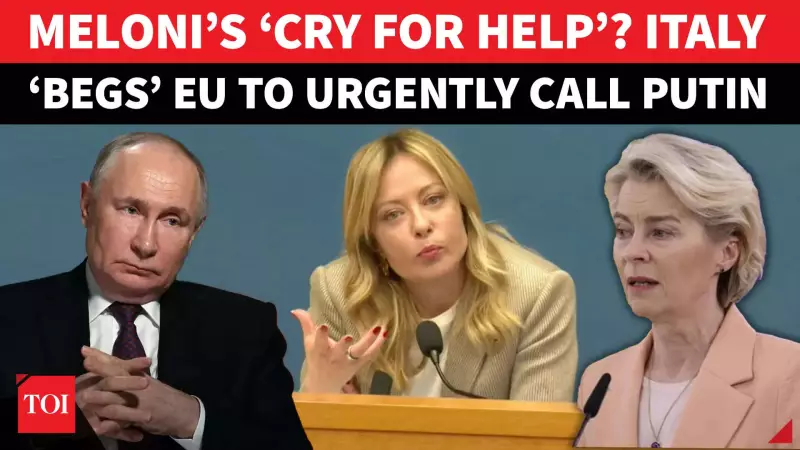
In a significant shift in European diplomatic rhetoric, Italian Prime Minister Giorgia Meloni has aligned herself with French President Emmanuel Macron's push for direct dialogue with Russia, issuing a stark warning about the European Union's waning influence in the Ukraine conflict.
Meloni Echoes Macron's Call for Diplomacy
Speaking at her annual New Year press conference in Rome, the Italian leader explicitly ruled out the deployment of Italian troops to Ukraine, labeling such a move as "unnecessary." Instead, she advocated for a strategic reopening of communication channels with Moscow. Meloni emphasized that President Macron was correct in his approach, stating that Europe confines its role and limits its geopolitical leverage by engaging with only one side of the war.
Her comments arrive at a critical juncture, as Macron himself has recently signaled a renewed readiness to initiate conversations with Russian President Vladimir Putin. This diplomatic maneuvering occurs alongside intensifying debates within Western capitals regarding long-term security architectures and post-ceasefire plans for Ukraine.

A Warning on Europe's Diminishing Role
Meloni's central argument hinges on the risk of strategic irrelevance. She cautioned that by refusing to talk to Moscow, European nations might inadvertently marginalize themselves from the core negotiations that will ultimately shape the region's future. This perspective marks a notable public convergence with the French position, suggesting a potential forming of a bloc within the EU that prioritizes diplomatic engagement over a purely militaristic stance.
The Italian Prime Minister's briefing, held on January 9, 2026, underscores the evolving and often fractious consensus within Europe on how to handle the prolonged war. While military and financial support for Kyiv continues, the voices advocating for a parallel diplomatic track with the Kremlin are gaining audibility, with Meloni now prominently among them.
Implications for EU Unity and Future Strategy
This development poses fresh questions about the unity of the European Union's foreign policy. Meloni's public endorsement of Macron's strategy could encourage other leaders to voice similar opinions, potentially leading to a recalibration of the bloc's collective approach. The focus is subtly shifting from an exclusive discussion on arms deliveries to a more complex equation involving ceasefire scenarios, security guarantees, and the inevitable political negotiations.
By firmly closing the door on Italian troop deployment and simultaneously opening the door for dialogue with Russia, Meloni is charting a distinct course. It is a course that seeks to position Europe, and Italy specifically, as a potential mediator or relevant stakeholder in any future peace process, rather than a party perceived as being entrenched in a single narrative.
The coming months will reveal whether this call for direct talks translates into concrete diplomatic action or remains a rhetorical stance. However, the mere fact that a major European leader has publicly pressured the EU to reconsider its communication blackout with the Kremlin indicates a new phase in the continent's response to the conflict.