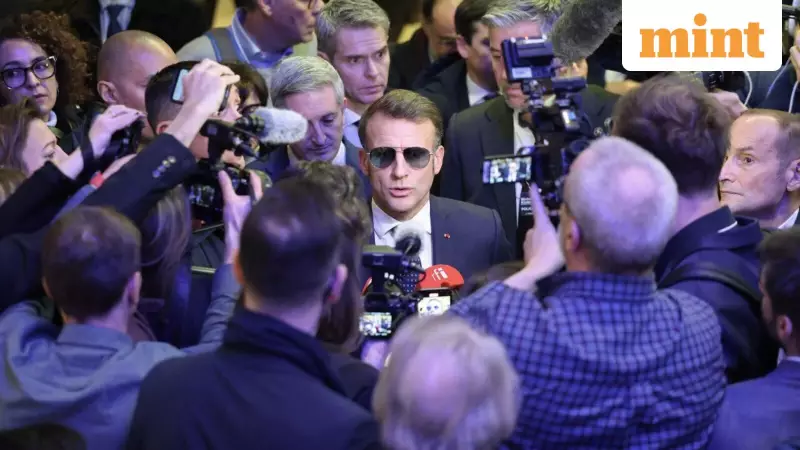
Macron's Sunglasses Overshadow Davos Agenda with Unintended Political Drama
When French President Emmanuel Macron took the stage at the World Economic Forum in Davos wearing a pair of reflective aviator sunglasses, he inadvertently created one of the most discussed moments of the global gathering. The eyewear immediately sparked intense speculation about its political meaning, drawing comparisons to iconic moments in political and pop culture history.
From Medical Necessity to Global Symbol
French officials revealed that the sunglasses served a practical purpose: concealing a burst blood vessel in Macron's eye. However, the striking blue-tinted lenses against the cobalt blue Davos backdrop created such a visually powerful image that it transcended its medical origins. Photographs of the French president in shades dominated front pages worldwide, generating a media frenzy rarely seen for presidential accessories.
The immediate interpretations varied wildly among observers and commentators. Some saw it as a deliberate message of European defiance against former President Donald Trump, evoking Tom Cruise's Maverick character from "Top Gun." Others interpreted it as subtle political commentary, noting the aviator-style sunglasses resembled those favored by President Joe Biden, whom Trump frequently criticized.

Market Impact and Meme Culture Explosion
The commercial consequences were immediate and substantial. Shares of iVision Tech, the Italian company that owns the Henry Jullien brand responsible for Macron's sunglasses, surged on the Milan stock exchange following the Davos appearance. This market reaction demonstrated how political fashion moments can translate directly into financial gains for associated companies.
Across digital platforms, generative AI fueled an explosion of memes and creative interpretations. Macron was depicted as a fighter pilot tracking Trump's Air Force One to the "Top Gun" theme, transformed into Sylvester Stallone's character from "Cobra" wielding machine guns, and reimagined in countless other scenarios that blended politics with pop culture references.
Political Theater in Troubled Times
Political analysts noted that Macron's sunglasses functioned as unintentional political theater for a continent seeking stronger leadership representation. The accessory carried particular symbolic weight because sunglasses worn indoors have historically been associated more with authoritarian figures like Moammar Gadhafi, Augusto Pinochet, and Robert Mugabe than with democratically elected Western leaders.
Remarkably, the sunglasses seemed to project a toughness that even Trump acknowledged. "I watched him yesterday with those beautiful sunglasses. What the hell happened?" Trump commented at Davos. "But I watched him, sort of, be tough." Later that day, U.S. officials retreated from threats of additional tariffs on European nations, though any direct connection to Macron's eyewear remains speculative.
The Brand Behind the Glasses
The sunglasses came from Henry Jullien, a small French brand based near the Swiss border that was nearly defunct just years earlier. After going bankrupt, the company was purchased in 2023 by iVision Tech following encouragement from French authorities hoping to preserve local jobs. The brand's revival took an unexpected turn in 2024 when Macron's assistants specifically requested 100% French-made sunglasses.
iVision CEO Stefano Fulchir initially questioned whether the presidential inquiry was legitimate or spam. The company ultimately selected a laminated gold model with blue-tinted lenses costing over $700, designed to provide maximum protection against camera flashes that frequently confront the president.
Strategic Restraint in Presentation
Despite the sunglasses' dramatic appearance, Macron notably avoided playing "Le Maverick" during his actual speech. He began with a pointed reference to Trump's claims about ending wars, noting that 2024 saw over 60 conflicts worldwide—"an absolute record, even if I understood a few of them were fixed."

With his glasses shimmering under camera lights, Macron then pivoted to advocating for Europe's core values of rule of law and predictability, arguing these principles remain "largely underpriced by the market." Commentators contrasted his handling of the eye condition with former German Chancellor Olaf Scholz's 2023 eye-patch, quipping about national approaches to similar problems.
The episode positions Macron's sunglasses among the most consequential political eyewear since Sarah Palin's 2008 rimless glasses sparked a buying frenzy across American opticians. What began as a medical necessity evolved into a multifaceted phenomenon encompassing political symbolism, market movements, digital culture, and transatlantic diplomacy—all from a single accessory choice at a global forum.