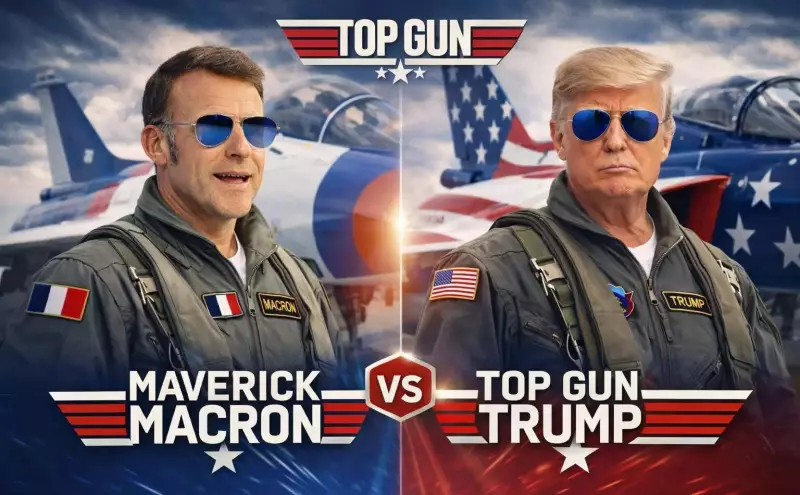
In global politics, sometimes a small detail speaks louder than volumes of policy documents. This week at the World Economic Forum in Davos, it wasn't tariffs, conflicts, or economic data that captured the world's attention. Instead, it was a pair of dark, reflective aviator sunglasses worn by French President Emmanuel Macron.
The Unexpected Fashion Statement
Amid the thin Alpine air and the annual seriousness of the Davos gathering, Macron appeared less like a traditional statesman and more like someone who had stepped off a movie set. The internet responded instantly with memes, transforming Europe's intellectual leader into a Top Gun-style character. Speculation ran wild about his appearance, with rumors circulating about health issues or personal conflicts.
What Actually Happened
Macron was delivering a significant speech on geopolitics as world leaders discussed the renewed international interest in Greenland sparked by Donald Trump. He criticized Washington's approach, defended European sovereignty, and spoke about maintaining strategic balance. Throughout this serious address, he kept his sunglasses on indoors.

This simple choice became the story. Screenshots flooded social media platforms within minutes. Supporters praised the look as confident and unbothered, while critics dismissed it as theatrical posturing. Conspiracy theorists speculated about hidden meanings, and within hours, the sunglasses had completely overshadowed the substantive Greenland debate.
The Official Explanation
The presidential office provided a straightforward medical reason: Macron had developed a burst blood vessel in his eye and wore the sunglasses to protect it from harsh lighting. Medically, this was unremarkable. Politically, it should have been irrelevant.
But in today's visual political landscape, once an image escapes into public consciousness, original intent becomes secondary to public interpretation. The irresistible interpretation emerged: a European leader confronting Trumpian bravado with Hollywood-style confidence.
Why This Resonated So Deeply
Davos represents predictability and convention. The forum typically features dark suits, earnest panel discussions, and carefully calibrated statements designed to avoid controversy. Macron's aviators shattered this visual monotony completely.
Aviator sunglasses carry significant cultural weight. They evoke associations with pilots, dominance, and cool confidence. They automatically reference Top Gun imagery, whether the wearer intends this connection or not. In an era where politics increasingly borrows from cinematic language, the symbolism landed with immediate impact.
Understanding complex EU-US trade disputes wasn't necessary to appreciate the moment. Simply recognizing the visual reference was enough.
The Transatlantic Reaction
Predictably, Donald Trump mocked Macron's sunglasses during his own Davos appearance, transforming a fashion detail into a transatlantic spectacle. Two powerful leaders with substantial egos found themselves sparring not through policy papers but through visual cues and public perception.
This episode illustrates our current political reality: diplomacy as spectacle, statecraft as performance art.
The Commercial Dimension
The sunglasses were quickly identified as coming from heritage French brand Henry Jullien, owned by Italian eyewear group iVision Tech. The company confirmed that Macron had personally purchased the glasses and insisted they be manufactured in France.
The market response was immediate and significant. Website traffic surged, orders increased dramatically, and stock prices rose. A fleeting political moment translated directly into measurable economic value, demonstrating how modern power can monetize imagery in real time.
Macron's Symbolic Politics
This incident fits within Macron's established approach to political symbolism. From his solitary walk through the Louvre on election night to his carefully staged European addresses, the French president has consistently embraced theatrical framing of his leadership.

Critics describe this as vanity, while supporters see it as fluency in contemporary political language. The sunglasses episode sits comfortably within this tradition. While there's no evidence it was planned as a publicity stunt, there's equally no indication that Macron attempted to neutralize its impact. He delivered his speech, made his gestures, and allowed the image to work independently.
In today's political environment, this often constitutes sufficient strategy.
What This Reveals About Davos and Modern Politics
The episode demonstrates how substance struggles without accompanying spectacle. While world leaders debated Greenland's future and Europe's position in an increasingly fragmented global order, the internet focused on eyewear.
This doesn't necessarily indicate public shallowness, but rather reflects how images travel faster than complex arguments. Macron's sunglasses became a versatile shorthand—representing defiance, arrogance, confidence, or political theater depending on one's perspective. They transformed a serious geopolitical moment into a cultural phenomenon.
In an era where authority increasingly manifests visually, this matters profoundly. At Davos, where every participant seeks to be heard, Macron succeeded in being seen. Sometimes, in global politics, visibility constitutes the most powerful statement possible.