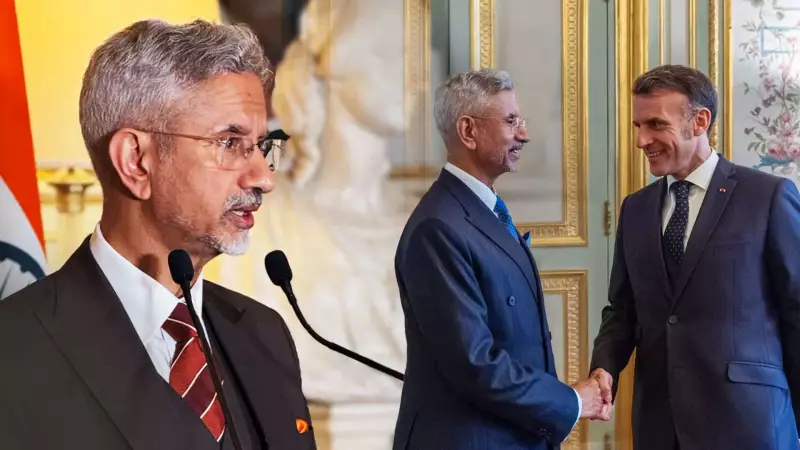
In a significant diplomatic moment, French President Emmanuel Macron has publicly aligned with India's core foreign policy principle of strategic independence. The endorsement came during a high-level meeting with India's External Affairs Minister, Dr. S. Jaishankar, in Paris on January 9, 2026.
A Declaration of Strategic Independence
President Macron's pointed remark that "countries like India do not want to be anybody's vassal" resonated deeply with New Delhi's long-standing position. This statement, made at a time of increasing global polarization, marks a growing international acceptance of India's refusal to be confined to rigid power blocs. The comment was not made in isolation but during substantive discussions with Dr. Jaishankar, highlighting the strength of the bilateral partnership.
Earlier, while addressing the prestigious Ambassadors' Conference in France, Jaishankar had laid the groundwork for this shift. He outlined the rapid transformations occurring in global trade, energy security, technology, and geopolitics. The minister emphasized that the foundation of India-France cooperation is their shared commitment to independence, not alignment politics.

Deepening Ties and a Forthcoming Summit
The meeting yielded a concrete announcement that underscores India's rising global stature. President Macron confirmed his upcoming visit to India for the AI Impact Summit. This decision positions New Delhi as a crucial player in shaping the future norms and governance of critical and emerging technologies on the world stage.
The timing of this reinforced partnership is particularly noteworthy. As Europe contends with the ongoing ripple effects of conflict, energy market shocks, and broader geopolitical uncertainty, India's balanced and principled approach is increasingly viewed as a source of stability. The France-India axis, built on mutual respect and strategic autonomy, is emerging as a key node in the evolving international order.
Implications for a Multipolar World
Macron's statement is more than a diplomatic nicety; it is a recognition of a new geopolitical reality. It signals that major Western powers are beginning to accommodate and even appreciate the foreign policy posture of nations like India, which prioritize national interest and strategic flexibility over bloc-based loyalty.
This development strengthens India's hand as it navigates complex relationships with global powers. The affirmation from a leading European nation and permanent member of the UN Security Council validates India's multi-alignment strategy. It demonstrates that pursuing an independent path can garner respect and build durable, issue-based partnerships in a fragmented world.
The growing synergy between Paris and New Delhi, therefore, represents a pragmatic alliance for the 21st century—one defined not by old camps but by shared interests and a common vision for a multipolar world where strategic autonomy is a respected principle.