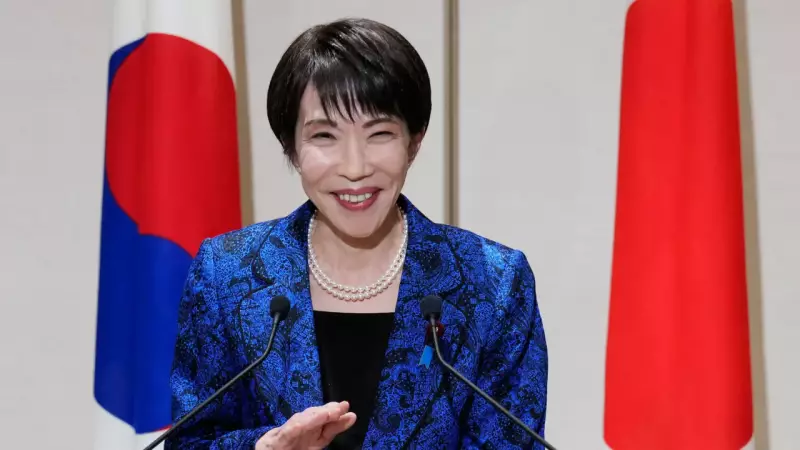
Japanese Prime Minister Sanae Takaichi announced on Monday that she will dissolve parliament this week and hold a snap election on February 8. This bold move could either strengthen her political control or create deeper uncertainty both domestically and internationally.
Election to Test Leadership Directly
Japan's first woman prime minister stated clearly that this election aims to put her leadership directly before the voters. "Is Sanae Takaichi fit to be Prime Minister? I wanted to ask the sovereign people to decide," she declared during a news conference.
Takaichi confirmed that the lower house will dissolve on January 23. Campaigning will then begin on January 27, leading to voting and counting on February 8.

Political Landscape and Poll Numbers
Takaichi became premier in October, and her cabinet currently enjoys strong polling numbers. However, her ruling Liberal Democratic Party continues to struggle with low popularity overall. The LDP has governed Japan almost without interruption for decades, though recent years have seen frequent leadership changes.
The ruling bloc, consisting of the LDP and coalition partner Japan Innovation Party, holds only a slim majority in the powerful lower house. This narrow edge threatens Takaichi's ability to pass important legislation, including plans for proactive fiscal spending and increased defense budgets.
"If the LDP can secure a majority independently in the lower house, that will help her pursue policies without making concessions to other parties," explained Sadafumi Kawato, professor emeritus at the University of Tokyo. A stronger majority would give Takaichi greater freedom to advance her agenda without relying on smaller partners.
Economic Concerns and Budget Pressures
Takaichi's cabinet has approved a record 122.3-trillion-yen budget for the fiscal year beginning in April 2026. She emphasized that swift parliamentary approval is essential to tackle inflation and support the world's fourth-largest economy.
Opposition parties argue that dissolving parliament risks delaying urgent economic measures. Jun Azumi of the main opposition Constitutional Democratic Party of Japan criticized the move, saying it would "sacrifice livelihoods."
Media reports indicate the LDP is considering a campaign promise to cut taxes on food items. This measure aims to ease pressure from soaring grocery prices that have burdened many households.
Foreign Policy Stakes and China Tensions
The snap election could significantly reshape Japan's foreign policy position, particularly in its increasingly tense relationship with China. Analysts suggest a strong election victory could give Takaichi more leverage by demonstrating solid domestic backing.
Relations between Tokyo and Beijing have deteriorated since November, when Takaichi suggested Japan could intervene militarily if China attacked Taiwan. China claims the self-ruled island as its territory.
However, significant risks accompany this approach. Mikitaka Masuyama, dean of the National Graduate Institute for Policy Studies, warned that an election victory could provoke a harsher response from Beijing. He suggested China might want to send voters "the message that supporting a hawkish leader could lead to pain."
China has recently announced a broad ban on exports to Japan of "dual-use" goods with potential military applications. Reports also indicate restrictions on rare-earth exports vital for industries ranging from electric vehicles to missiles.
According to an Asahi newspaper poll, 60 percent of respondents expressed worry about the economic impact of worsening Japan-China relations.
Opposition Forms United Front
Japan's domestic politics remain volatile. Under Takaichi's predecessor, Shigeru Ishiba, the LDP and its former long-time coalition partner Komeito lost their majority in both chambers during recent national elections. The most recent defeat came in July's upper house vote, leading Ishiba to step down while smaller parties gained ground.
Komeito has now joined forces with the Constitutional Democratic Party to challenge Takaichi. This alliance hopes to attract swing voters dissatisfied with current leadership.

As campaigning begins, the snap election will test whether Takaichi's personal popularity can overcome voter anxiety about inflation, foreign tensions, and political instability. The outcome will determine whether her political gamble delivers the stronger mandate she seeks.