

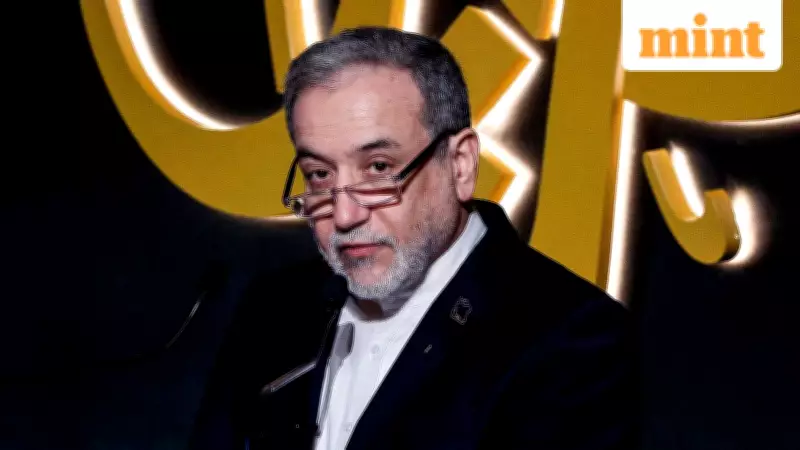
Iran's Foreign Minister Defiantly States: 'Our Strength Is Saying No to Great Powers'
In a bold declaration that underscores Tehran's unwavering stance, Iran's Foreign Minister Abbas Araghchi asserted on Sunday that the Islamic Republic's true power resides in its capacity to "say no to the great powers." This hardline position was articulated during a summit in Tehran, coming directly after discussions with the United States concerning Iran's contentious nuclear program and against the backdrop of widespread domestic protests.
Uranium Enrichment: A Non-Negotiable Right
Araghchi informed diplomats that Iran will steadfastly maintain its position on retaining the right to enrich uranium. This issue remains a central point of conflict with U.S. President Donald Trump, who authorized strikes on Iranian nuclear facilities in June during the brief but intense 12-day Iran-Israel war. "Iran will never surrender the right to enrich uranium, even if war is imposed on us," Araghchi stated defiantly, as reported by AFP, directly challenging pressure from Washington.
He elaborated on the sacrifices made, noting, "Iran has paid a very heavy price for its peaceful nuclear programme and for uranium enrichment." The minister questioned, "Why do we insist so much on enrichment and refuse to give it up even if a war is imposed on us? Because no one has the right to dictate our behaviour." These remarks were delivered just two days after his meeting with U.S. envoy Steve Witkoff in Oman.

The 'Atomic Bomb' as a Rhetorical Device
In a striking rhetorical move, Araghchi explicitly invoked the term "atomic bomb" to frame Iran's diplomatic posture. "I believe the secret of the Islamic Republic of Iran's power lies in its ability to stand against bullying, domination and pressures from others," he proclaimed. "They fear our atomic bomb, while we are not pursuing an atomic bomb. Our atomic bomb is the power to say no to the great powers. The secret of the Islamic Republic's power is in the power to say no to the powers."
This choice of words is particularly significant. While Iran has consistently maintained that its nuclear ambitions are purely peaceful, Western nations and the International Atomic Energy Agency (IAEA) contend that Tehran operated an organized military program aimed at developing a nuclear weapon until 2003. Araghchi's phrasing appears to be a deliberate, symbolic assertion of sovereignty rather than an admission of weaponization.
Contrasting Views on Diplomatic Progress
The diplomatic landscape reveals a complex picture. Iranian President Masoud Pezeshkian, who likely secured Supreme Leader Ali Khamenei's approval before authorizing talks with the Americans, described the recent discussions in Oman as "a step forward." On social media platform X, Pezeshkian wrote, "The Iran-U.S. talks, held through the follow-up efforts of friendly governments in the region, were a step forward. Dialogue has always been our strategy for peaceful resolution. ... The Iranian nation has always responded to respect with respect, but it does not tolerate the language of force."
However, Araghchi's comments highlight the substantial obstacles that persist. He pointedly recalled past negotiations, warning, "If you take a step back (in negotiations), it is not clear up to where it will go." He reminded the audience that during multiple rounds of talks last year, the U.S. "attacked us in the midst of negotiations," a reference that underscores deep-seated mistrust.
U.S. Military Posturing and Iranian Defiance
The United States has significantly bolstered its military presence in the region as a form of pressure. The aircraft carrier USS Abraham Lincoln, accompanied by additional naval vessels and warplanes, has been deployed to the Middle East. This move is dual-purposed: to push Iran toward a negotiated agreement and to ensure the U.S. possesses the military capability to strike if President Trump decides to do so.
During the Friday talks in Oman, U.S. Navy Admiral Brad Cooper, head of Central Command, was present—a likely intentional demonstration of American military readiness. Following the indirect negotiations, Cooper, along with U.S. special envoy Steve Witkoff and Trump's son-in-law Jared Kushner, visited the Abraham Lincoln in the Arabian Sea.

Despite this show of force, Araghchi remained unflinching. "Their military deployment in the region does not scare us," he declared after Witkoff's visit to the carrier. While the foreign minister appears to take the threat of an American military strike seriously, acknowledging the concerns of many Iranians, his public stance is one of resolute defiance.
Uncertain Path Forward
The future of diplomacy remains unclear. Details about a potential second round of talks are scarce. President Trump, commenting after the initial discussions, offered limited insight but remarked, "Iran looks like they want to make a deal very badly — as they should." This statement, coupled with the ongoing military buildup and Iran's uncompromising rhetoric, suggests that while dialogue has been initiated, a breakthrough is far from guaranteed.
The situation encapsulates a high-stakes geopolitical standoff, where Iran's assertion of sovereign rights clashes with international non-proliferation efforts and U.S. strategic interests. As tensions simmer, the world watches to see whether the power to "say no" will lead to renewed conflict or pave the way for a difficult, negotiated peace.





