India's Global Leadership at a Crossroads Amid Trump's Resurgent Aggression
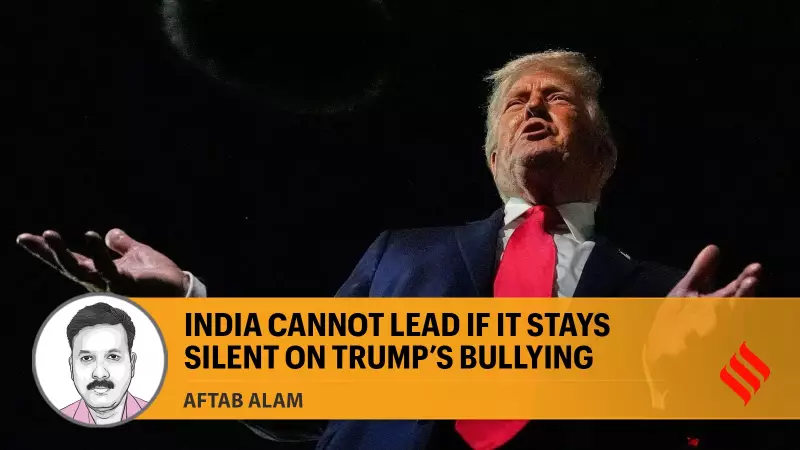
The resurgence of Donald Trump's confrontational and often bullying approach to international relations presents a significant challenge for India's aspirations on the global stage. As a nation that has long positioned itself as a responsible and influential player in world affairs, India now faces a critical test of its diplomatic mettle and strategic vision. The question of how to respond to Trump's tactics is not merely a matter of political expediency but a fundamental issue that could shape India's credibility and leadership role for years to come.
The High Stakes of Strategic Silence in Global Diplomacy
Maintaining silence in the face of aggressive international behavior carries profound implications for any nation seeking global leadership. For India, which has consistently advocated for multilateralism, respect for sovereignty, and rules-based international order, passive observation of Trump's bullying tactics creates a troubling paradox. This strategic silence risks being interpreted as tacit approval or, worse, as weakness by both allies and adversaries alike. The delicate balance between pragmatic diplomacy and principled leadership becomes increasingly difficult to maintain when confronted with behavior that contradicts the very values India claims to champion on the world stage.
International observers and diplomatic analysts are closely watching how India navigates this complex landscape. The country's response—or lack thereof—to Trump's approach will inevitably influence perceptions of India's reliability as a strategic partner and its commitment to the international norms it has helped establish. This moment represents more than just a diplomatic challenge; it is a defining test of India's capacity to translate its economic and military growth into meaningful global influence.

The Credibility Conundrum for Emerging Global Powers
India's remarkable economic progress and growing geopolitical significance have naturally elevated expectations regarding its role in global affairs. However, leadership in the international arena requires more than just economic might or military capability—it demands moral authority and consistent adherence to stated principles. When a nation aspiring to global leadership remains silent in the face of behavior that contradicts its professed values, it risks undermining the very credibility that makes leadership possible.
The specific challenges presented by Trump's approach are particularly acute for India given several factors:
- Historical Advocacy for Multilateralism: India has been a vocal proponent of multilateral institutions and cooperative international frameworks, making silence on unilateral bullying tactics particularly conspicuous.
- Strategic Partnerships: India's carefully cultivated relationships with multiple global powers create complex diplomatic calculations when responding to controversial behavior by any one nation.
- Domestic Political Considerations: Internal political dynamics and public opinion inevitably influence how India positions itself on contentious international issues.
- Economic Interdependence: The interconnected nature of the global economy means that diplomatic positions can have tangible economic consequences.
This credibility conundrum highlights the inherent tension between pragmatic diplomacy and principled leadership that all emerging global powers must navigate. For India, the path forward requires careful calibration of multiple competing interests while maintaining consistency with its long-stated commitment to a fair and equitable international order.
Navigating the Complex Terrain of 21st Century Diplomacy
The contemporary international landscape presents unprecedented challenges for diplomatic navigation, particularly for nations like India that seek to expand their global influence. Trump's aggressive tactics represent just one manifestation of broader shifts in global power dynamics that require sophisticated and nuanced responses. India's approach must account for several interconnected factors that define modern international relations.

First, the digitalization of diplomacy means that positions—or the absence thereof—are instantly communicated and analyzed globally. Second, the increasing multipolarity of world power creates more complex alliance structures and competing interests. Third, domestic political considerations in democratic nations like India inevitably influence foreign policy decisions. Fourth, economic interdependence creates both vulnerabilities and opportunities in diplomatic positioning.
In this context, India's response to Trump's approach will inevitably be scrutinized as an indicator of its broader foreign policy philosophy and strategic priorities. The nation faces the difficult task of balancing several competing objectives:
- Maintaining productive relationships with all major global powers
- Advancing its specific national interests in various international forums
- Upholding the principles it has consistently advocated in global discourse
- Navigating the complex web of regional and global alliances
- Responding to domestic political expectations and public sentiment
This multifaceted challenge requires diplomatic sophistication of the highest order. India's capacity to develop and execute a coherent strategy in response to Trump's tactics will reveal much about its readiness for the global leadership role it seeks.
The Path Forward: Strategic Communication and Principled Engagement
Moving beyond mere reaction to proactive leadership requires India to develop a more nuanced approach to international challenges like those presented by Trump's tactics. Strategic silence may sometimes be necessary, but it cannot become a default position for a nation aspiring to global leadership. Instead, India must cultivate a reputation for thoughtful, principled engagement that advances both its interests and its values.
This approach might involve several key elements:
- Clear Communication of Principles: Consistently articulating India's commitment to multilateralism, sovereignty, and rules-based international order, even when doing so creates diplomatic friction.
- Strategic Coalition Building: Working with like-minded nations to develop coordinated responses to challenges in the international system.
- Creative Diplomatic Initiatives: Proposing constructive alternatives and solutions rather than merely reacting to the actions of others.
- Balanced Engagement: Maintaining productive relationships while clearly communicating positions on matters of principle.
The ultimate test of India's global leadership will not be measured by its economic growth or military capabilities alone, but by its capacity to shape international norms and respond effectively to challenges to those norms. How India addresses the specific challenge presented by Trump's tactics will provide important insights into its broader approach to global leadership in an increasingly complex and contested international environment.