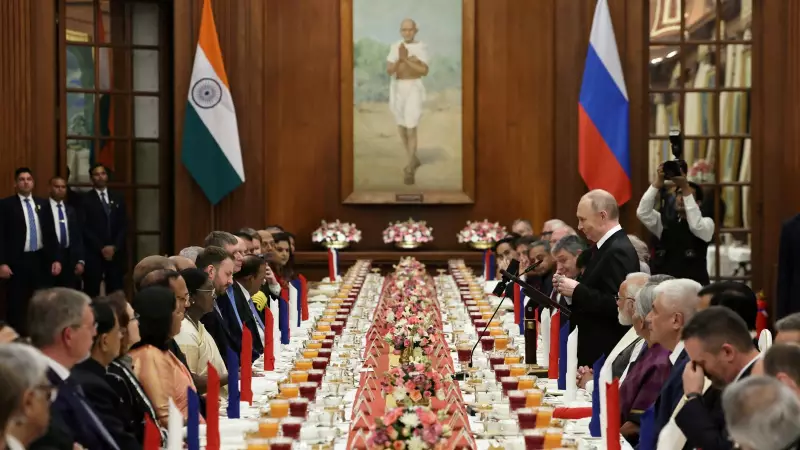
The recent state visit of Russian President Vladimir Putin to India has ignited a fierce debate, transcending diplomatic circles and entering the realm of public conscience. While the Indian government rolled out a red carpet, treating the Russian leader to a ceremonial hero's welcome, a section of voices, including columnist Tavleen Singh, questions the moral cost of such realpolitik.
A Welcome Fit for a Hero, But Is He One?
On December 5, 2025, President Vladimir Putin arrived in New Delhi to a reception typically reserved for the closest allies. Prime Minister Narendra Modi personally greeted him at the airport with an embrace. Troupes of dancers performed, and the two leaders sped away in the same car, signaling a display of deep camaraderie. This visual spectacle, however, unfolded against a global backdrop where Putin remains a pariah in many Western nations for his full-scale invasion of Ukraine in 2022, an act widely condemned as illegal and aggressive.
Tavleen Singh, returning to India from New York, watched the events with a growing sense of unease. In her view, the servile coverage by sections of the Indian media compounded the problem. She points to a fawning interview by a major Indian news channel where no tough questions were asked—specifically, no mention of Alexei Navalny, the Russian opposition leader who died in an Arctic prison in 2024 after surviving a Novichok poisoning attempt widely attributed to state actors.

The Core Conflict: National Interest vs Foundational Values
The Indian government's stance is rooted in pragmatic national interests. India has significantly benefited from purchasing discounted Russian oil since the Ukraine war began, cushioning its economy from global price shocks. Furthermore, a historical dependence on Russian military hardware for national defense creates a complex web of strategic dependencies. Proponents of the government's approach argue this is pure realpolitik—engaging with necessary partners to secure vital resources, irrespective of their international standing.
Singh presents a counter-argument. She asserts that India's identity as the world's largest democracy is its greatest post-colonial achievement, a flame kept alive by founders like Jawaharlal Nehru. By offering a hero's platform to a leader who has crushed domestic opposition, pursued critics abroad, and stands accused of bombing civilian infrastructure in Ukraine, India risks eroding its moral authority. She draws a parallel to Nehru's Non-Aligned Movement, which she argues often ended up legitimizing dictatorships under the guise of anti-colonial solidarity.
"We may have benefitted from buying cheap Russian oil and buying Russian weapons," Singh writes, "but surely these things can be done without welcoming Putin as a hero." The core of her critique is the style of the welcome, not the engagement itself. It is the genuflection, she argues, that betrays India's democratic soul.
A Question of Moral Consistency and Future Reckoning
The columnist frames a poignant hypothetical to underscore her point: if China were to support Pakistan in a forcible takeover of Kashmir, would India not expect democratic nations to stand with it? How can India make that appeal if it refuses to stand with Ukraine, a nation fighting for its democratic sovereignty against an invasion?
She acknowledges the complexity, accepting that India's need for Russian oil made robust support for Ukraine impractical. However, she makes a clear distinction between necessary trade and moral endorsement. Treating a "warmonger like a hero," in her view, crosses a line. The episode, she admits, led to a rare moment where her pride in being Indian was shaken, recalling the early idealism of the post-independence era dedicated to building a democratic nation against all odds.
The Putin visit, therefore, is more than a diplomatic event. It is a mirror held up to India's evolving foreign policy and its ongoing negotiation between the uncompromising demands of geopolitical survival and the foundational values of democracy, secularism, and freedom it professes to hold dear. The debate it has sparked is about what India chooses to project to the world and, ultimately, to its own citizens.