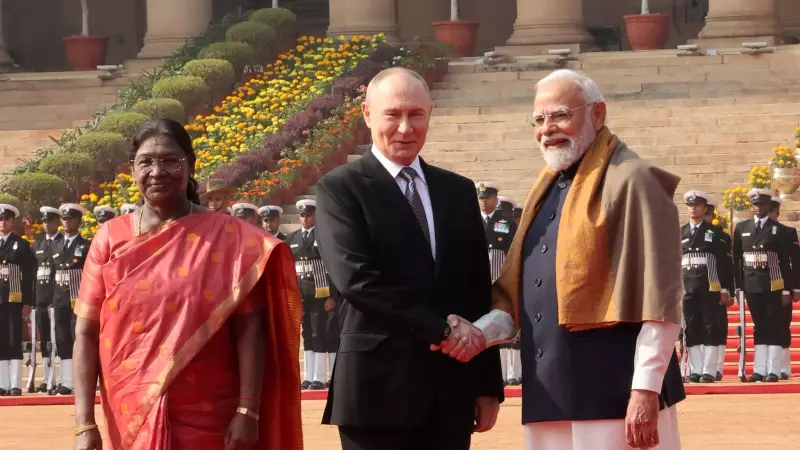
In a significant diplomatic engagement, India rolled out the red carpet for Russian President Vladimir Putin on Friday, culminating in a series of pivotal agreements aimed at deepening the longstanding strategic partnership between the two nations. The visit, President Putin's first to India since the onset of the Ukraine conflict in February 2022, was closely monitored by world capitals.
A Relationship That Has Stood the Test of Time
Following extensive delegation-level talks and a private dinner at Prime Minister Narendra Modi's residence on Thursday, the two leaders underscored the resilience of their ties. Prime Minister Modi remarked that over the past eight decades, the India-Russia friendship has remained "steady like a guiding star," built on mutual respect and deep trust. He personally thanked his "friend" President Putin for his leadership and unwavering commitment to the relationship over the past 25 years.
President Putin echoed the sentiment, describing the talks as constructive and friendly, held in the spirit of the "special and privileged strategic partnership." He highlighted the close working and personal contacts between the two leaders, noting their regular interactions.

Roadmap to 2030: Trade, Energy, and Mobility
The centrepiece of the outcomes was the adoption of a comprehensive Programme for the Development of Russia-India Economic Cooperation until 2030. This blueprint is designed to diversify and sustain trade and investment, with an ambitious goal to increase bilateral trade to USD 100 billion. The current trade volume stands at a record USD 64-65 billion.
A major breakthrough was the signing of a labour mobility pact to facilitate the movement of skilled workers. PM Modi stated this would connect people and create new opportunities, supported by agreements on vocational education and skilling.
In a boost for tourism and people-to-people ties, India announced a free 30-day e-tourist visa and a 30-day group tourist visa for Russian citizens. The leaders also pledged to work towards an early conclusion of a Free Trade Agreement with the Eurasian Economic Union.
On the financial front, a key achievement is the near-complete shift to national currencies, with 96% of bilateral trade now conducted in rupees and rubles, insulating economic ties from external volatility.
Strategic Cooperation: Defence, Nuclear Energy, and Critical Minerals
While the joint statement did not explicitly mention Ukraine, the discussions heavily focused on strengthening traditional pillars of cooperation. Defence and nuclear energy collaboration dominated the agenda. President Putin noted Russia's long-standing role in equipping and modernising the Indian Armed Forces.
The two sides agreed to advance joint manufacturing under the Make-in-India initiative for spare parts and components of Russian-origin defence equipment, with potential for export to third countries.
In the civil nuclear sector, they agreed to broaden cooperation, including life cycle support for the Kudankulam Nuclear Power Plant (KKNPP) and discussions on a second site in India for a new nuclear power plant. Cooperation in critical minerals for secure supply chains in semiconductors and clean energy was also emphasised.
The leaders expressed shared concerns on terrorism, specifically the misuse of digital payment platforms, social media, and drones for terrorist activities.
Connectivity and the Future
Enhancing connectivity emerged as a key priority. Both nations committed to advancing the International North-South Transport Corridor (INSTC), the Northern Sea Route, and the Chennai-Vladivostok Eastern Maritime Corridor. A novel area of cooperation will be the training of Indian seafarers for operations in polar waters, opening new employment avenues and strengthening collaboration in the Arctic.
The summit, which saw the signing of 16 agreements across health, maritime, customs, and media collaboration, reaffirmed that despite global geopolitical shifts, the India-Russia partnership continues to evolve with a forward-looking, multi-faceted agenda firmly in place.