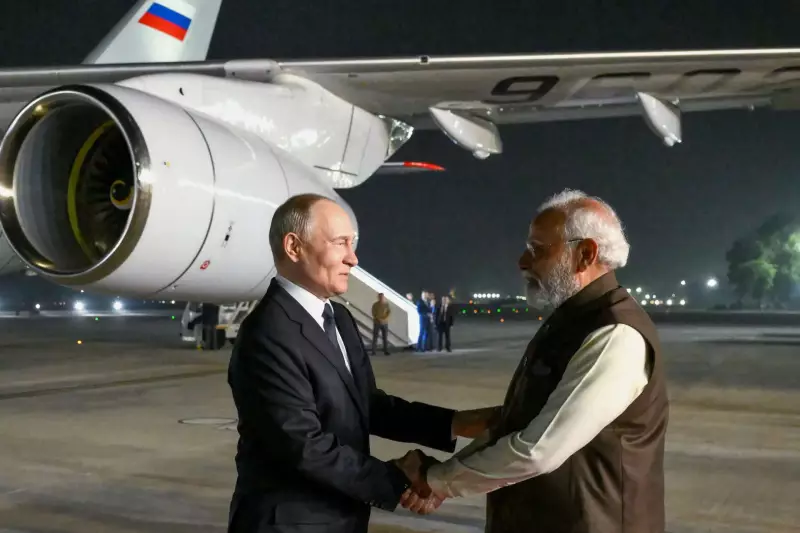
In a significant move to bolster their long-standing strategic partnership, India and Russia on Thursday agreed to further expand their comprehensive defence cooperation. The agreement encompasses collaboration in cutting-edge military technologies and a stronger defence-industrial partnership, ensuring Moscow remains New Delhi's primary arms supplier for the foreseeable future.
Strategic Autonomy and Trust at the Core
The pact was formalised ahead of the upcoming Modi-Putin summit. Defence Minister Rajnath Singh and his Russian counterpart, Andrei Belousov, signed a protocol outlining "ongoing and prospective areas" of defence collaboration. The ministers, co-chairing the 22nd inter-governmental commission on military and military-technical cooperation, emphasised that the relationship is built on "a deep sense of trust, common principles and mutual respect." This meeting underscored India's firm intent to maintain its strategic autonomy, despite increasing pressure from Western nations like the US and the EU to reduce ties with Russia following the Ukraine conflict.
Key Defence Deals and Discussions
The high-level talks covered a wide spectrum of critical defence procurements and joint ventures. Key items on the agenda included:

- Acquiring additional S-400 Triumf air defence squadrons and large quantities of surface-to-air missiles.
- Upgrading the Indian Air Force's (IAF) Sukhoi-30MKI fighter jet fleet and equipping them with advanced long-range air-to-air missiles like the R-37 and RVV-BD.
- Joint production of advanced variants of the BrahMos supersonic cruise missile.
- Procurement of short-range Pantsir and man-portable Verba air defence systems.
An official noted that while Russia has offered its fifth-generation Sukhoi-57 fighters, India is yet to make a decision. The official also stated, "It will be difficult for Russia to supply advanced S-500 air defence systems as of now even if India wants them."
Focus on Self-Reliance and Expedited Deliveries
During the meeting, Rajnath Singh highlighted India's determination to build the capacity of its indigenous defence industry under the 'Atmanirbhar Bharat' (Self-Reliant India) policy, aiming for both local production and exports. In response, Andrei Belousov assured that the Russian defence industry is ready to support India's journey towards self-reliance in defence manufacturing, noting the many years of friendship binding the two nations.
India also pressed Russia to expedite deliveries of crucial military hardware delayed by the Ukraine war. This includes:
- The two remaining squadrons of the five S-400 systems contracted in 2018 for $5.43 billion.
- An advanced Akula-class nuclear attack submarine, leased for 10 years under a $3 billion deal signed in March 2019.
Sources indicated that Russia has committed to delivering the two S-400 squadrons next year, while the submarine is now expected in 2028.
Future Arsenal and Strategic Posture
Looking ahead, India plans to acquire another five S-400 squadrons. The defence ministry has also cleared a procurement worth Rs 10,000 crore for 280 missiles with varying interception ranges (120km to 380km) to replenish stocks used during the May cross-border hostilities with Pakistan and to build reserves.
The IAF's push for R-37 and RVV-BD missiles for its Sukhoi-30MKIs is a direct counter to Pakistan's deployment of Chinese-origin J-10 jets armed with PL-15 long-range missiles, which posed a challenge during Operation Sindoor.
Furthermore, the development of advanced, lighter versions of the BrahMos missile is on the cards. While Sukhoi jets armed with BrahMos executed long-range strikes in the past, the focus now is on the BrahMos-NG (Next Generation), a smaller, air-launched variant that can be carried by lighter fighter aircraft. The BrahMos missile's range has already been extended to 450km and is slated to eventually reach 800km. The total value of deals with the Indo-Russian BrahMos Aerospace joint venture has surpassed Rs 58,000 crore, cementing its status as a prime conventional precision-strike weapon for India's armed forces.