India and Greece Sign Defence Cooperation Pact, Highlight Indigenous Technology
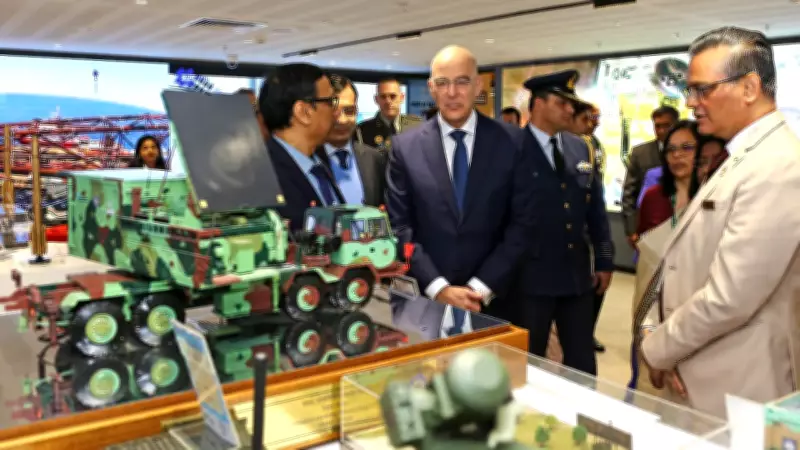
Greek Defence Minister Nikos Dendias visited the Defence Public Sector Undertakings (DPSU) Bhawan in New Delhi on Monday, where he received a comprehensive overview of India's diverse range of indigenous defence equipment. This significant diplomatic engagement culminated in the signing of a joint declaration of intent between India and Greece, aimed at strengthening defence industrial cooperation and setting the stage for a detailed five-year roadmap to enhance technology exchange and joint production initiatives.
High-Level Talks and Industry Interaction
The agreement followed extensive discussions between Indian Defence Minister Rajnath Singh and his Greek counterpart, Nikolaos-Georgios Dendias, in New Delhi. These talks were strategically focused on expanding bilateral defence and strategic engagement between the two nations. During his visit, Minister Dendias actively participated in an industry interaction at DPSU Bhawan, engaging with senior officials from India's defence sector and reviewing the advanced capabilities of several indigenous platforms.
A central highlight of the visit was the detailed presentation on the Akash surface-to-air missile system, which has become a prominent symbol of India's growing self-reliance in advanced defence manufacturing. The Akash system represents one of the cornerstones of India's homegrown military technology, showcasing the nation's technological prowess and strategic autonomy.

Akash Air Defence System: Technical Capabilities and Upgrades
Developed by the Defence Research and Development Organisation (DRDO), the Akash is a sophisticated medium-range, surface-to-air missile system specifically engineered to neutralise a wide array of aerial threats, including fighter jets, drones, and cruise missiles. Currently operational with both the Indian Army and the Indian Air Force, it plays a vital role in India's layered air defence network by providing robust area air defence for critical infrastructure and forward troop formations.
The standard Akash system boasts impressive operational features: it can engage multiple targets simultaneously within a range of approximately 25 kilometres and at altitudes reaching up to 18 kilometres. It utilises the advanced Rajendra fire control radar for precise tracking and guidance of missiles against hostile targets. Mounted on mobile platforms, the system ensures rapid deployment and relocation, enhancing its tactical flexibility. The missile itself is capable of intercepting targets moving at speeds of up to Mach 2.5.
India has continuously advanced the Akash system through several upgraded variants. The Akash Prime, an enhanced version, has successfully engaged and destroyed high-speed unmanned aerial targets during trials in high-altitude conditions, such as in the Ladakh sector, demonstrating its capability to operate effectively above 4,500 meters. Further developments include the Akash-1S, equipped with an indigenous seeker for improved accuracy, and the under-development Akash-NG (Next Generation), which promises an extended interception range of around 70 kilometres. These advancements underscore India's relentless push for technological upgrades and enhanced export competitiveness in the global defence market.
Operational Excellence and Export Success
The Akash system's operational architecture includes automatic launch and abort capabilities, high missile manoeuvrability, resistance to electronic jamming, and an open-architecture design that facilitates seamless integration with other digital command and control networks. Equipped with both multi-function and central acquisition radars, Akash can efficiently track multiple targets while providing real-time three-dimensional measurements of range, azimuth, and elevation.
Beyond domestic deployment, the Akash system has emerged as a promising success story in India's defence export initiatives. Armenia has already inducted the system into its military service, marking a significant milestone. This growing global interest not only validates the system's technical reliability and effectiveness but also highlights India's expanding role as a dependable defence partner and a credible exporter of advanced military technology on the international stage.

The visit by the Greek Defence Minister and the subsequent agreement signify a strategic deepening of India-Greece relations, with indigenous defence innovation, particularly exemplified by the Akash missile system, taking centre stage in this burgeoning partnership.