India and Germany Strengthen Ties with 19 Agreements During Merz Visit
Prime Minister Narendra Modi and German Chancellor Friedrich Merz held extensive bilateral talks in Gandhinagar on Monday. The meeting marked a significant step in the strategic partnership between the two nations. They signed a total of 19 important agreements and made several key announcements.
Visa-Free Transit for Indian Passengers
One of the most notable outcomes is the new visa-free entry regime for Indian passengers transiting through Germany. This means Indian passport holders can now pass through German airports for connecting flights without needing a separate transit visa. The move simplifies travel and reflects growing trust between the countries.
Defence and Security Cooperation Deepens
The leaders emphasized strengthening defence and security ties. They signed a roadmap for defence industrial cooperation. This aims to promote long-term collaboration, including technology partnerships and co-production of defence equipment.

Modi expressed gratitude for Germany's efforts to simplify defence trade processes. He highlighted that growing defence cooperation symbolizes mutual trust and a shared vision. Merz noted that while the two countries don't agree on every issue, their areas of agreement are significant. He stressed the importance of deepening defence industry cooperation to reduce dependencies and strengthen both sides.
The joint statement welcomed continuing cooperation in submarines, helicopter obstacle avoidance systems, and counter-drone technology. It pointed to complementarity: India offers a skilled workforce and competitive costs, while Germany provides high technologies and investment.
Focus on Education and Skilling
A comprehensive roadmap on higher education was signed, which Modi said would give a new direction to the partnership. He invited German universities to open campuses in India. A joint declaration on a global skills partnership aims to facilitate mobility, especially for healthcare professionals.
Both sides committed to expanding the teaching of the German language in India, including in schools and vocational centres. They also established an Indo-German Centre of Excellence for Skilling in Renewable Energy to strengthen curriculum development and industry cooperation.
Economic and Trade Relations
Bilateral trade between India and Germany reached a record high in 2024, surpassing $50 billion. This accounts for over 25% of India's trade with the European Union. The leaders noted strong two-way investments and their positive impact on diversifying global supply chains.
Modi invited German companies to invest in India, citing its economic growth and business-friendly environment. Merz recommended Germany as an attractive destination for Indian companies. They reiterated support for concluding the India-EU Free Trade Agreement as a key outcome of the upcoming EU-India Summit on January 27.
Cooperation in Critical Technologies
The leaders welcomed progress in critical and emerging technologies. This includes semiconductors, critical minerals, digitalisation, and artificial intelligence. They signed a joint declaration on semiconductor ecosystem partnership and another on critical minerals cooperation.
In renewable energy, they decided to establish an India-Germany Centre of Excellence as a platform for knowledge and innovation. Modi mentioned a new mega project in green hydrogen involving companies from both countries, calling it a potential game-changer.
Indo-Pacific and Global Issues
India and Germany reaffirmed their commitment to a free and open Indo-Pacific. They announced a new bilateral Indo-Pacific consultation mechanism. India welcomed Germany's growing engagement in the region.
The leaders discussed Ukraine and Gaza. They expressed concern over the war in Ukraine and support for a just peace. On Gaza, they called for a negotiated two-state solution. They also condemned recent terrorist attacks in Pahalgam and Delhi.

Cultural Exchange and Personal Touch
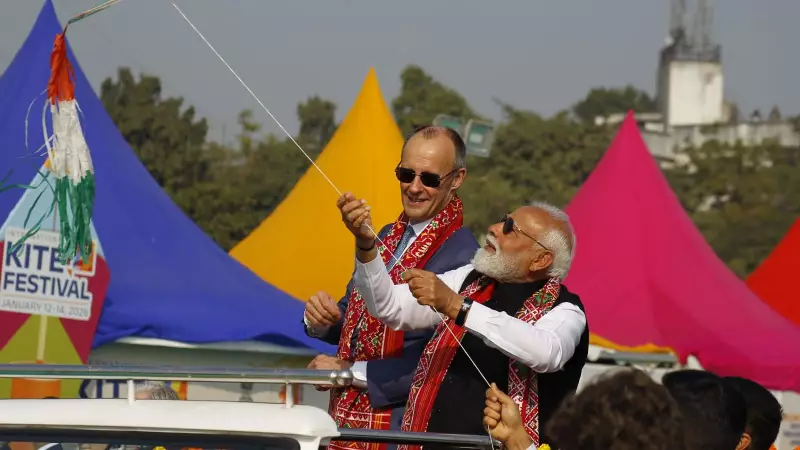
Merz, who arrived early Monday, visited Sabarmati Ashram and flew kites with Modi in Ahmedabad. This cultural exchange highlighted the personal rapport between the leaders. Modi noted that Merz's visit, his first to Asia as Chancellor, underscores the importance Germany places on relations with India.
Modi said, "Chancellor Merz's visit is taking place at a particularly significant time. Last year, we completed 25 years of our strategic partnership, and this year we are celebrating 75 years of diplomatic relations. These milestones are symbols of our shared ambitions and mutual trust."
Merz responded, "India is a preferred partner for Germany. The conditions for our renewed and deepened partnership could hardly be better. We share fundamental values and essential interests."
The meeting sets a positive tone ahead of the EU leaders' visit for Republic Day celebrations and the India-EU Summit. Both leaders expressed optimism about future collaboration across multiple sectors.