India Holds Second Spot in Global Arms Imports Despite Domestic Production Drive
According to a recent report by the Stockholm International Peace Research Institute (SIPRI), India continues to be the world's second-largest importer of major arms, accounting for 8.2% of the global share between 2021 and 2025. This comes despite a slight 4% decline in imports compared to the 2016-2020 period, attributed to the government's emphasis on indigenous weapons under the 'Make-in-India' initiative.
Strategic Shift: Russia's Share Drops as France and Israel Rise
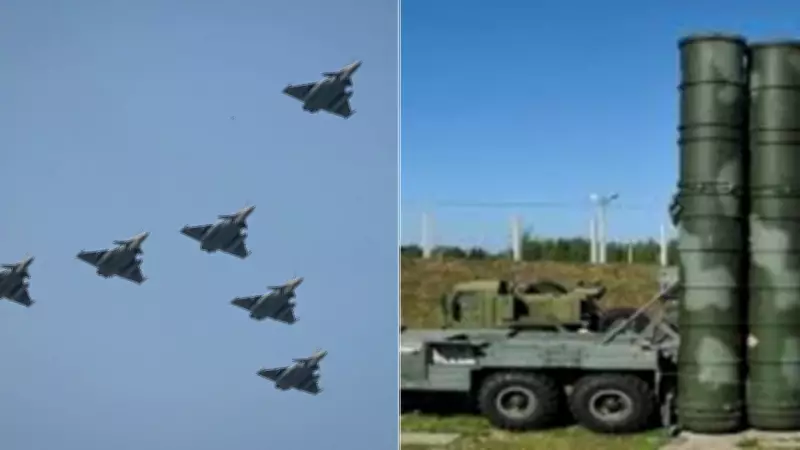
The report highlights a significant transformation in India's decades-long dependence on Russia for arms supplies. Moscow's share has plummeted from 70% in 2011-2015 to 40% in 2021-2025. This decline has been offset by substantial gains from France and Israel, whose respective shares have risen to 29% and 15%.
The decrease in imports can be partly attributed to India's growing ability to design and produce its own weapons, although there are often substantial delays in domestic production, the SIPRI report noted.

Future Deals and Geopolitical Drivers
This trend is expected to persist in the coming years, with several high-value defense agreements with Western nations in the pipeline. Key deals include:
- 114 Rafale fighter jets from France, estimated to cost approximately Rs 3.25 lakh crore
- Six air-independent propulsion (AIP)-equipped conventional submarines from Germany
- Six additional P-8I Poseidon maritime patrol aircraft from the United States
- Multiple agreements on missile defense systems and drones with Israel
The report also referenced Operation Sindoor in May 2025, underscoring that India's military buildup is primarily motivated by the dual threat from China and Pakistan. In South Asia, the high volume of arms that India imports is largely due to the perceived threat from China and to India's long-running conflict with the main recipient of Chinese arms exports, Pakistan, a SIPRI analyst stated. Imported weapons were used in the 2025 clash between India and Pakistan, both nuclear-armed states.
Pakistan's Rising Arms Imports from China
For India's rival Pakistan, the report indicates that nearly 80% of its arms imports are sourced from China. Pakistan climbed to the fifth largest recipient of major arms globally in 2021-2025, up from the 10th position in 2016-2020. Its arms imports surged by 66% between these periods, representing 4.2% of total global arms imports.
Global Arms Trade Overview
Globally, the top five arms importers from 2021 to 2025 were Ukraine, India, Saudi Arabia, Qatar, and Pakistan, collectively accounting for 35% of total arms imports. The report also noted a 9.2% increase in arms trade during this period compared to 2016-2020.
On the export front, the United States maintained its position as the world's largest arms exporter, with a 42% share of global exports. France followed as the second largest exporter at 9.8%, while Russia ranked third with 6.8%. The US exported arms to 99 states, including 35 in Europe, 18 in the Americas, 17 in Africa, 17 in Asia and Oceania, and 12 in West Asia.
Regional Import Trends and Russia's Decline
Europe emerged as the largest regional importer for the first time since the 1960s, driven by the war in Ukraine and escalating security concerns. Europe accounted for 33% of global arms imports, followed by Asia and Oceania at 31%, and West Asia at 26%.
Russia's share of global arms exports experienced a sharp decline, dropping from 21% in 2016-2020 to 6.8% in 2021-2025. This reduction is primarily due to significant decreases in exports to countries such as Algeria, China, and Egypt.