

Highways Forge New Corridors in Bastar as Security Improves
In the heart of Chhattisgarh's Bastar region, a profound transformation is underway. With the Maoist insurgency at its weakest point in decades, the government is rapidly advancing critical highway projects through areas that were, until recently, considered impenetrable no-go zones. This strategic push for connectivity represents a dual-edged sword: while it unlocks unprecedented opportunities for education, healthcare, and economic growth, it also irrevocably changes the fabric of life for local communities.
The Road as a Catalyst for Change
For Chameli Bhandari, the village pradhan of Sonpur in Narayanpur district, the presence of a road was non-negotiable when she arrived as a bride three years ago. "Had it not been for this road, I would not have married him," she declares, with her husband Paras Bhandari standing nearby, holding their newborn daughter. Her statement, met with laughter from onlookers, underscores a simple truth: infrastructure is reshaping personal choices and community dynamics in Abujhmad, the once-formidable Maoist stronghold spanning parts of Narayanpur, Bijapur, and Dantewada districts.
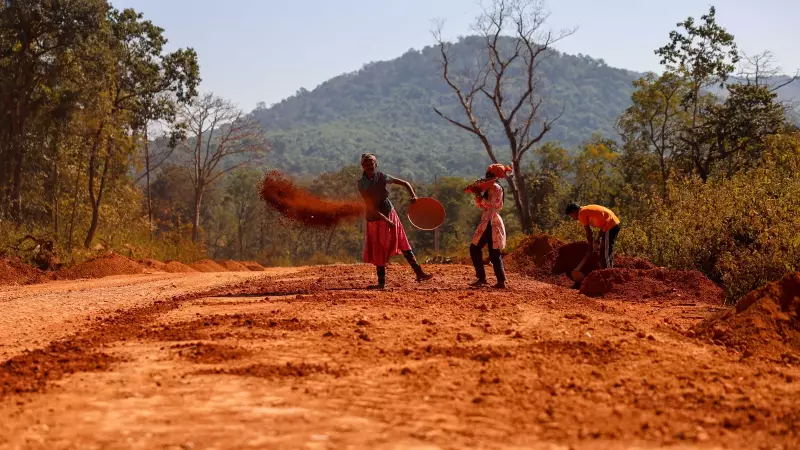
Long paralyzed by cycles of violence between Maoists and security forces, this region is now witnessing a tentative peace. The 78-km Narayanpur-Sonpur-Moroda state highway, sanctioned in 2010 but stalled for years, has gained momentum since 2024. Officials aim to complete it by March 2026, aligning with Union Home Minister Amit Shah's target to eliminate the Maoist movement by that deadline. Along this route, heavy rollers and convoys of trucks laden with construction materials symbolize the state's renewed resolve.

Development as a Two-Way Street
A senior Public Works Department (PWD) official explains the tactical nature of these projects: "Roads are not only for connectivity but to push the Naxals deeper into the forest. Every inch has to be reclaimed by force." This involves dividing projects into multiple packages, with security camps providing protection for workers. The Indian Express traveled 254 km along three state highways—Narayanpur-Sonpur-Moroda, Bijapur-Avapalli-Basaguda-Jagargunda, and Dornapal-Chintalnar-Jagargunda—revealing a complex narrative of progress and loss.
For Isha Parihar, a 20-year-old worker from Maspur village, the road offers hope. Earning Rs 300 a day, she muses, "Maybe we will get schools." Yet, for others like Guddu Ramnureti from Tarobeda, the benefits are already tangible. "Earlier, if someone fell sick, we had to carry the patient on our shoulders for 40 km to the hospital," he recalls, noting that ambulances now reach his village.
Hope and Hesitation in Remote Villages
Aayturam Usaindi of Putwada village embodies the optimism fueled by development. With funds from the Pradhanmantri Gramin Awas Yojana, he and his brothers are building a three-room house. "The biggest relief is that we can reach the hospital easily," he says. However, his joy is tempered by concern: "The Naxals have gone. Now the forests are being cut, and there is no one to stop them." This sentiment echoes across Bastar, where the retreat of Maoists has left a vacuum, raising fears of unchecked exploitation of natural resources.
In Bijapur, the 70-km Bijapur-Avapalli-Basaguda-Jagargunda road stands as a testament to sacrifice. A gate at its entrance bears the names and sketches of CRPF personnel killed during its construction between 2010 and 2022. Mohammed Nayeemuddin, project manager for Keystone Infra Private Limited, recounts the challenges: "We cannot imagine going to the project site without Road Opening Parties." Security threats limited work to 5-6 hours a day, four days a week, with laborers often brought from Bihar, Bengal, and Jharkhand due to local fears.

Education Emerges as a Beacon
Perhaps the most poignant symbol of change is the newly built primary school in Silger village, Bijapur—the first in the area. Teacher Barse Budhra, from the village of slain Maoist commander Hidma, reflects: "The first casualty of Maoist dominance was education." In his classroom, students like Korsa Savita dream of becoming doctors, their hands raised eagerly. Yet, when asked about careers in the police or CRPF, no hands go up, a silent reminder of the region's violent past.
As highways like the cement-concrete spur from Jagargunda to Dornapal near completion, they weave through landscapes scarred by past conflicts—culverts blown up, earthmovers charred. But they also bring markets, like the one in Chintalnar village, where shop owners from Bihar anticipate increased business. The road, in these parts, is more than bitumen; it is a transaction, offering modernity while eroding traditions.
A New Red Corridor Takes Shape
The sun sets on Bastar's dug-up earth, casting it in a new shade of red—a metaphor for a region in flux. With Maoists on the retreat, highways are carving a new Red Corridor, one defined by connectivity rather than conflict. Yet, as Ramdas Aulam, a Biology graduate from Tarrem village, cautions: "The government needs to do more than laying a road." Issues like banking access and land rights remain unresolved, highlighting that development must be holistic to truly transform lives.
In this race against time, Bastar stands at a crossroads. The highways promise a future of schools, hospitals, and economic vitality, but they also demand a delicate balance between progress and preservation. As one CRPF official notes, "We cannot say Maoism has ended, but we are at the elimination stage." The road ahead, both literal and metaphorical, will determine whether this fragile peace blossoms into lasting prosperity for the people of Chhattisgarh's heartland.





