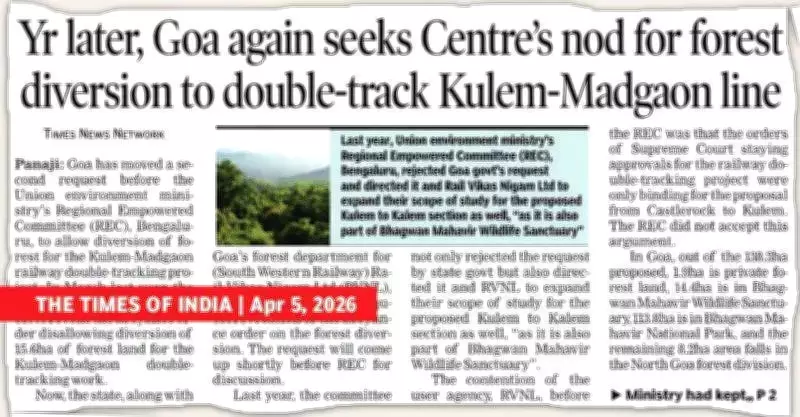
Goa's Double Tracking Proposal Deferred Again Over Insufficient Wildlife Impact Study
The Regional Empowered Committee (REC) of the Union Environment Ministry has once again deferred Goa's request for forest diversion for the Kulem-Madgaon double tracking project, stating that mere recommendations of mitigation measures are insufficient. This marks the second time the committee has rejected Goa's appeal, emphasizing the need for comprehensive environmental analysis.
Inadequate Wildlife Impact Assessment
The REC specifically pointed out that the Wildlife Institute of India's report on the project is limited to proposing mitigation measures and lacks detailed analysis of the project's impact on biodiversity and ecology. The committee stressed that the report must include thorough examination of how the project affects protected areas within the Bhagwan Mahavir Wildlife Sanctuary, with suitable measures recommended to address any adverse impacts.
Procedural Requirements Mandated
In a significant procedural directive, the REC has stated that Rail Vikas Nigam Ltd (RVNL) must first approach either the standing committee of the National Board for Wildlife or the Central Empowered Committee for a decision before seeking the REC's approval. This requirement adds another layer of scrutiny to the already contentious project.

The REC noted that it had previously directed the user agency to expand the scope of the study to include the Kulem-Kalem section, which forms part of the Bhagwan Mahavir Wildlife Sanctuary. This decision was communicated to the state government in a letter dated March 6, 2025, and the committee has now reiterated that the cumulative impact assessment report for this section must be approved by either the standing committee of the National Board for Wildlife or the Central Empowered Committee before submission to the REC.
Historical Context and Legal Challenges
The double tracking proposals for both the Goa and Karnataka portions had initially received recommendations from the standing committee of the National Board for Wildlife in meetings held on December 17, 2019, and January 5, 2021, respectively. However, the project faced significant legal challenges when the Goa Foundation approached the Supreme Court.
The central empowered committee of the court subsequently recommended revocation of permission granted by the standing committee of NBW for doubling of the railway track passing through the ecologically-sensitive Western Ghats. This involved 120.8 hectares of land from Bhagwan Mahavir Wildlife Sanctuary in Goa and 10.45 hectares in Karnataka.
Based on these Supreme Court proceedings, the REC issued directions on May 12, 2022, to keep in abeyance the approval for diversion of 15.6 hectares of forest land for the Kulem-Madgaon double tracking work.
Persistent Efforts and Repeated Rejections
In March of last year, both Goa and RVNL requested revocation of this abeyance before the ministry's regional committee, but their request was rejected by the REC. After a year, the Goa government made its second request for revocation of the abeyance order on forest diversion, which has now been deferred once again.
The committee's consistent position highlights the growing emphasis on comprehensive environmental impact assessments for infrastructure projects passing through ecologically sensitive areas. The requirement for detailed biodiversity analysis reflects increasing scrutiny of development projects in protected wildlife habitats across India.