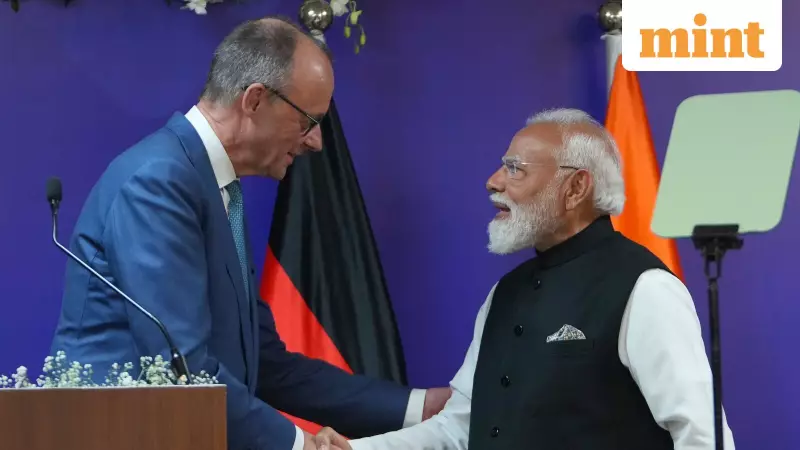
German Chancellor Friedrich Merz has embarked on a significant two-day visit to India, marking his first trip to Asia. The high-profile tour, centered on strengthening economic and strategic partnerships, comes at a time when Europe's largest economy is navigating growing tensions with its primary trading partners, the United States and China.
Strengthening Strategic and Economic Foundations
The core agenda of the visit, which began on Monday in Ahmedabad, Gujarat, is to bolster bilateral cooperation across critical sectors. Chancellor Merz met with Prime Minister Narendra Modi for extensive talks, with both sides poised to sign approximately ten key agreements. These pacts span a diverse range of fields from business cooperation and semiconductor development to defense projects and traditional medicine.
A major focus for Berlin is securing better access to India's reserves of critical minerals. The two nations are expected to sign a memorandum of understanding on this front, as Germany actively works to reduce its supply chain dependency on China for rare earths and other essential raw materials. This move is seen as crucial for Germany's industrial and technological sovereignty.

Furthermore, an agreement to streamline the process for Indian healthcare professionals to work in Germany is on the table. This addresses acute labor shortages in many German economic sectors that are currently hindering growth.
Defense, Trade, and the Russia Factor
Defense collaboration forms a cornerstone of the enhanced partnership. Germany and India are currently finalizing the details of a landmark submarine manufacturing deal worth at least $8 billion. This agreement, potentially the largest defense pact in India's history, involves Germany's Thyssenkrupp Marine Systems GmbH and India's state-owned Mazagon Dock Shipbuilders Ltd., and includes critical technology transfer.
While it is unclear if the deal will be announced during this visit, it represents a strategic opportunity for India to diversify its military suppliers away from Russia and for Germany to gain a stronger foothold in the Indo-Pacific. India's continued reliance on Russian military equipment, especially in light of the Ukraine conflict, is likely a topic of discussion between the leaders.
On the trade front, Chancellor Merz is expected to push for accelerated negotiations on the long-pending European Union-India free-trade agreement. With EU President Ursula von der Leyen scheduled to visit India later in January, there is a renewed push to resolve sticking points, particularly concerning steel and automobiles, to finalize a deal.
A Delegation of Economic Powerhouses
The Chancellor's delegation underscores the economic weight of this mission. He is accompanied by top executives from German corporate giants including Siemens, DHL Group, Infineon Technologies, Uniper, and Airbus Defence and Space. The delegation also features leaders from the famed German Mittelstand—small and medium-sized enterprises that form the backbone of the country's manufacturing sector—as well as senior managers from Boehringer Ingelheim and ThyssenKrupp Marine Systems.
This visit underscores India's rising importance as Germany's key economic partner in the Indo-Pacific. With bilateral trade nearing $50 billion, Germany stands as India's most crucial partner within the European Union. Over 2,000 German firms operate in India, while more than 700 Indian companies have investments in Germany.
Before their official talks, Merz and Modi shared a symbolic moment at the Sabarmati Ashram, the former home of Mahatma Gandhi. Reflecting on the visit, Merz wrote in the guest book, "This human legacy unites Indians and Germans as friends in a world that may more than ever be in need of Gandhi’s teachings." On his second day, the Chancellor will travel to Bangalore to visit a Bosch facility, highlighting the deep industrial and technological synergy between the two nations.