

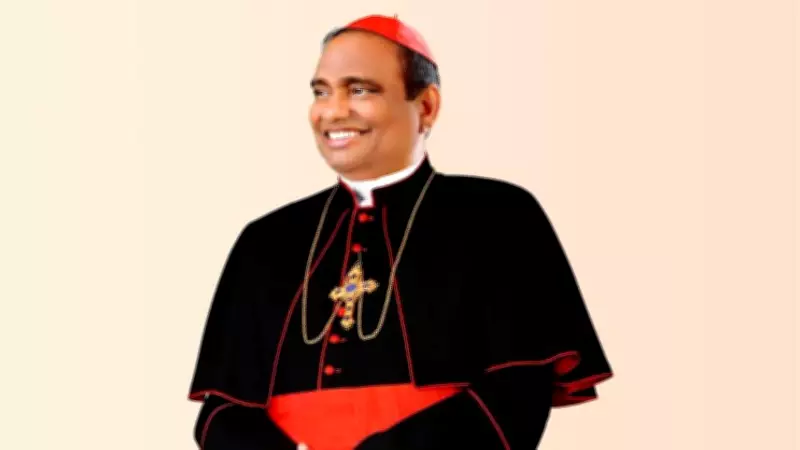
Historic Election: Cardinal Poola Anthony Becomes First Dalit President of India's Catholic Bishops Conference
In a landmark development for India's Catholic community, Cardinal Poola Anthony has been elected as the new President of the Catholic Bishops' Conference of India (CBCI). The 64-year-old Archbishop of Hyderabad now assumes leadership of the country's approximately 20 million Catholics, marking the first time a Dalit prelate has held this prestigious position.
A Crucial Moment for Indian Catholicism
The election took place during the CBCI's 37th general body meeting held on Saturday, February 7, 2026. Cardinal Anthony succeeds Archbishop Andrews Thazhathu from Kerala, who previously served as CBCI president.
"With his election as President of the CBCI, Cardinal Poola Anthony assumes leadership of the Catholic Church in India at a crucial moment, bringing with him decades of pastoral experience, administrative leadership, and a strong commitment to the Church's mission in service of faith, justice, and human dignity," stated an official press release from the Catholic Bishops' Conference of India.

Addressing Challenges and Leading Minority Rights
Sources close to Cardinal Anthony reveal that the Indian church is currently experiencing "severe distress" due to persecution of pastors and believers by what they describe as "fringe elements." As the new CBCI president, Cardinal Anthony will be responsible for leading church delegations to advocate for minority rights across the country.
This leadership role comes at a particularly significant time for India's Catholic community, which represents one of the country's largest religious minorities. Cardinal Anthony's election is seen as both a symbolic and practical step toward greater inclusion within the church hierarchy.
Cardinal Anthony's Distinguished Journey
Born on November 15, 1961, in Poluru within the Diocese of Kurnool, Cardinal Anthony's religious journey began with his formation at the minor seminary in Nuzvid. He later pursued priestly studies at Saint Peter's Pontifical Seminary in Bengaluru, where he prepared for his life's vocation.
His ordination as a priest occurred on February 20, 1992, after which he was incardinated into the Diocese of Kadapa. The early years of his ministry included several pastoral assignments:
- Parish vicar at Saint Mary's Cathedral (1992-1993)
- Pastoral service in Amagampalli (1993-1994)
- Parish priest in Tekurpet (1994-1995)
- Parish priest in Badvel (1995-2000)
- Parish priest in Veerapalli (2000-2001)
International Education and Expanded Responsibilities
Between 2001 and 2003, Cardinal Anthony pursued higher studies in the United States, where he earned a Master's degree in pastoral care. During this period, he attended a theology course at Loyola University in Chicago while simultaneously offering pastoral ministry at Saint Genevieve Church in the Archdiocese of Chicago.
From 2004 to 2008, he served as Director of the Christian Foundation for Children and Aging. Concurrently, he held several key positions within the Diocese of Kadapa, including diocesan consultor, secretary for education, deputy administrator of diocesan schools, and coordinator of the Sponsorship Programme.
Rising Through the Ecclesiastical Ranks
Cardinal Anthony's appointment as Bishop of Kurnool came on February 8, 2008, with his consecration following on April 19, 2008. His elevation continued when Pope Francis appointed him Metropolitan Archbishop of Hyderabad on November 19, 2020.
The pinnacle of his ecclesiastical recognition arrived on August 27, 2022, when Pope Francis proclaimed him cardinal during a Consistory. He was assigned the titular church of Ss. Protomartiri a Via Aurelia Antica, cementing his position within the global Catholic hierarchy.
A New Chapter for Indian Catholicism
Cardinal Poola Anthony's election as CBCI president represents a historic moment for India's Catholic community, potentially signaling a new era of leadership focused on both spiritual guidance and social justice advocacy. His extensive pastoral experience, combined with his international education and administrative background, positions him uniquely to address the complex challenges facing the church in contemporary India.

As the first Dalit to lead the Catholic Bishops' Conference of India, Cardinal Anthony's presidency carries particular significance for marginalized communities within both the church and broader Indian society. His leadership is expected to emphasize themes of inclusion, justice, and human dignity while navigating the delicate balance between religious practice and minority rights in India's diverse social landscape.





