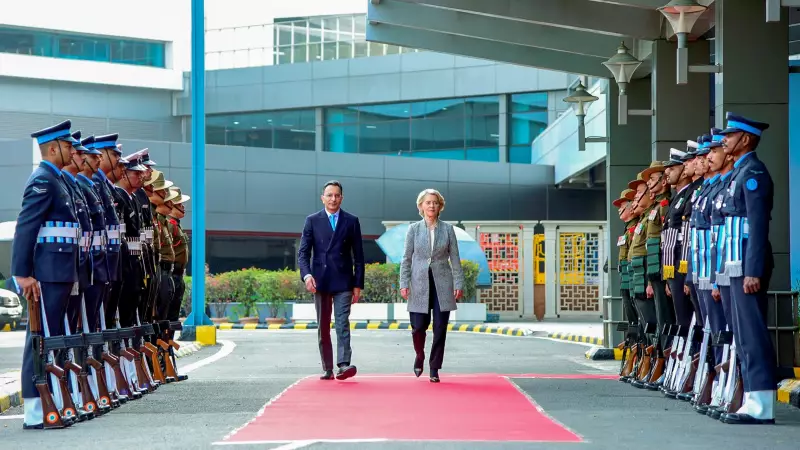
EU Leaders Arrive in New Delhi for High-Stakes Summit and Republic Day Celebrations
European Commission President Ursula von der Leyen and European Council President Antonio Costa have commenced their official visit to India, with Prime Minister Narendra Modi underscoring the significance of upcoming trade and mobility agreements. These pacts are poised to unlock new avenues for India's burgeoning youth population, as the two sides aim to finalize negotiations during this pivotal diplomatic engagement.
Focus on Economic Ties and Strategic Partnerships
Von der Leyen arrived in New Delhi on Saturday, welcomed by Union Minister of State for Commerce and Industry Jitin Prasada, while Costa is scheduled to land on Sunday afternoon. Both leaders will serve as chief guests for the Republic Day celebrations on Monday, symbolizing the deepening ties between India and the European Union. The visit is strategically centered on advancing the India-EU Free Trade Agreement (FTA), a landmark deal often referred to as the "mother of all trade deals" by von der Leyen in a recent social media post.
The India-EU Summit, hosted by Prime Minister Modi on January 27, is expected to launch a comprehensive cooperation framework on mobility. This initiative will facilitate the movement of students, researchers, seasonal workers, and highly skilled professionals, thereby supporting Indian talent seeking opportunities in Europe. Additionally, the summit will focus on enhancing collaboration across multiple domains, including security, defence, clean energy, and people-to-people contacts.
PM Modi's Vision for Youth and Economic Growth
In a parallel address at the government's 18th Rozgar Mela, Prime Minister Modi highlighted the transformative impact of these agreements. "Today, India is one of the youngest countries in the world. It is the continuous effort of our government that new opportunities are created for India's youth power within the country and across the world," he stated. Modi emphasized that trade and mobility pacts with various nations are generating numerous prospects for Indian youth, bolstered by increased foreign direct investment (FDI) and economic resilience.
He noted that India has doubled its GDP in a decade, attracting investments from over a hundred countries, with FDI inflows more than two-and-a-half times higher compared to the decade before 2014. This influx is creating countless employment opportunities, reinforcing the government's commitment to ease of living and doing business. Modi also encouraged newly appointed government employees to embrace technological advancements and uphold the principle of "nagrik devo bhava" (The citizen is God).
Strategic Agenda and Bilateral Outcomes
The EU-India Summit is set to endorse a comprehensive strategic agenda for the next five years, covering economic relations, sustainability, technology, and global challenges. Key deliverables include advancing the FTA negotiations to improve market access and diversify supply chains, as well as signing a security and defence partnership. The EU, as a bloc, remains India's largest trading partner in goods, with total trade valued at approximately US$ 136 billion in the financial year 2024-25.
External Affairs Minister S Jaishankar will meet with von der Leyen on Sunday to chart the future course of the India-EU partnership. The Ministry of External Affairs spokesperson Randhir Jaiswal highlighted the shared values between the world's two largest democracies, rooted in mutual trust. A joint statement and a five-year roadmap outlining cooperation across key sectors are expected to be issued at the summit's conclusion, emphasizing the strategic partnership's role in a shifting global landscape.