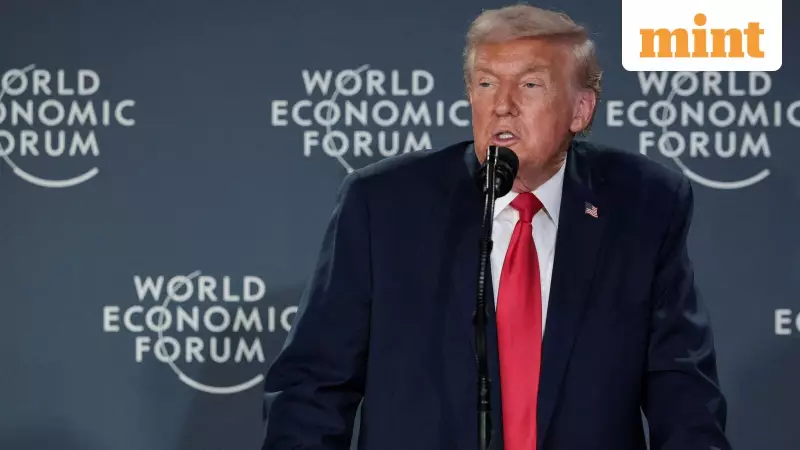
Davos Summit Marks Global Shift as Nations Rebalance Against Trump's America
The World Economic Forum in Davos has become the epicenter of a significant geopolitical transformation, as global leaders openly discuss strategies to counter the increasingly predatory policies of the United States under Donald Trump's second presidency. After a year characterized by flattery, appeasement, and unsuccessful negotiations, the international community appears to have reached a critical inflection point.
The Turning Point in Global Diplomacy
Canadian Prime Minister Mark Carney's speech at Davos crystallized this emerging reality, stating that middle powers must "act together, because if we're not at the table, we're on the menu." This declaration represents a fundamental departure from previous approaches to dealing with the Trump administration, signaling that accommodation has failed and proactive rebalancing has become necessary.
Carney outlined what he termed "variable geometries" of international cooperation, where nations—regardless of their traditional relationships with the United States—are exploring:

- Ad hoc coalitions to pursue specific strategic interests
- New trade agreements to replace commercial links damaged by Trump's policies
- Enhanced cooperation in existing multilateral forums
- Potential new security arrangements and military alliances
Theoretical Foundations of the Global Response
This collective response aligns precisely with international-relations theory, particularly Stephen Walt's 'balance of threat' hypothesis developed at Harvard Kennedy School. According to this framework, states naturally form alliances to counter nations that combine significant power with hostile intentions.
For approximately eight decades, the United States maintained its position as a largely benevolent hegemon, providing global public goods including open trade systems, international law frameworks, and relative stability. Countries from Canada to South Korea viewed America as powerful but protective rather than threatening.
Trump's presidency has dramatically altered this perception, transforming the United States from a protective power into what security experts describe as a "predatory hegemon." Recent actions—from threats of annexation against allied territories to what former national security advisors term "flamboyant violence"—have fundamentally changed how the world views American power.
The Delayed Reaction and Emerging Realignment
The past year presented an intriguing paradox: despite America's increasingly aggressive posture, most nations initially responded with flattery rather than resistance. Leaders from Europe to Asia engaged in various forms of appeasement, including extravagant gifts, Nobel Prize nominations, and diplomatic deference that reached unprecedented levels.
According to Walt, this delayed reaction stemmed from practical considerations: "Reacting against the US as a threat is costly," and the collective-action problem among numerous affected countries initially prevented coordinated response. However, the realization has now dawned that "accommodation isn't working" and "there is no such thing as a lasting deal with a predatory hegemon."
Concrete Manifestations of Global Rebalancing
The Davos discussions revealed multiple dimensions of this emerging rebalancing:

- Security Realignments: Saudi Arabia and Pakistan have recently formed new security pacts, while European and Asian nations are reconsidering their defense procurement strategies and even nuclear deterrence options.
- Trade Diversification: The European Union and Mercosur have accelerated negotiations for a comprehensive trade agreement after decades of stagnation, seeking alternatives to U.S.-centric commercial networks.
- Diplomatic Reorientations: India, previously aligned with Trump, is warming relations with China and other powers. Traditional American allies including Britain, Germany, and South Korea are actively pursuing deeper economic cooperation with Beijing.
- Canadian Leadership: Under Carney's guidance, Canada has pursued strategic partnerships from Europe to India, including a renewed relationship with China despite previous tensions, explicitly aiming to reduce dependence on its southern neighbor.
The Future of American Global Leadership
The most challenging aspect of this rebalancing involves military considerations, given America's overwhelming conventional superiority. While a formal non-U.S. NATO alliance with China remains unlikely, countries are increasingly exploring defense autonomy and questioning the reliability of American security guarantees.
As nations rearm and reconsider their strategic partnerships, the long-term implications become clear: "America First" policies risk transforming into "America Alone" in the global arena. The world, having exhausted diplomatic appeasement, has now embarked on the complex but necessary work of creating alternative structures and alliances.
The Davos discussions represent more than mere diplomatic posturing—they signal a fundamental restructuring of international relations as middle powers and traditional allies alike recognize that the era of American benevolence has given way to a period requiring strategic independence and new partnerships.