

Collective Security in an Era of Great Power Rivalry
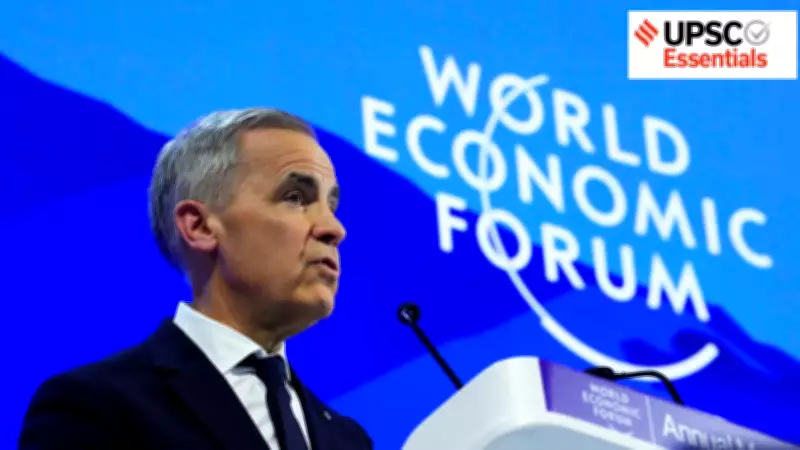
In a world where the rules-based order appears to be fading, the concept of collective security faces profound challenges and potential transformation. Canadian Prime Minister Mark Carney recently invoked Thucydides' ancient aphorism at the World Economic Forum in Davos, stating, "Every day we are reminded that we live in an era of great power rivalry. That the rules-based order is fading. That the strong do what they can, and the weak suffer what they must."
The Middle Power Imperative
Carney argued that middle powers must act together to avoid subordination or isolationism, emphasizing that "if you are not at the table, you are on the menu." He highlighted the need for collective investments to build resilience, particularly as traditional problem-solving architectures like the World Trade Organization, United Nations, and Conference of the Parties have diminished in effectiveness.
The Canadian leader reaffirmed unwavering commitment to Article 5 of the North Atlantic Treaty, which states that an armed attack against one NATO member shall be considered an attack against all members. This principle represents one of the most tangible expressions of collective security in practice today.

Historical Foundations and Failures
The idea of collective security involves legally established mechanisms designed to prevent or suppress aggression by any state against another. One of the earliest experiments was the League of Nations, formed after World War I and grounded in the liberal internationalism of former US President Woodrow Wilson. His 'Fourteen Points' sought to replace balance-of-power politics with law, institutions, and collective restraint.
However, this experiment proved short-lived. The League ultimately failed to prevent World War II, prompting international relations theorist E.H. Carr to label both the organization and its underlying liberalism as 'utopian.'
The United Nations, established in 1945, represented an attempt to create a more robust collective architecture. Unlike its predecessor, it addressed power imbalances through the Security Council and granted veto powers to permanent members to encourage their contribution to international peace and security.
Contemporary Challenges and Regional Alternatives
Recent power projections by great powers in conflicts such as Ukraine, Gaza, and Venezuela have exposed the limits of collective security when major national interests collide. Against this backdrop, regional security mechanisms are gaining prominence as alternatives to universal institutions.
Although NATO is fundamentally a strategic Western alliance rather than a true collective security system, its "one for all and all for one" logic against external aggression has made it a frequent reference point in collective security discussions.
New regional initiatives suggest a shift toward smaller, interest-based coalitions. These include the US-Japan-Republic of Korea Trilateral Pact (2023), Trilateral Security Cooperation in the Western Balkans (2025), and the Strategic Mutual Defence Agreement (2025). Such developments indicate that states are increasingly leaning toward tailored arrangements rather than universal frameworks.
The Critical Question for Global Governance
As the post-war order undergoes significant rupture, the fundamental question remains: Whose vision for global governance will redefine this transformation? Will collective security architecture evolve through strengthened universal institutions, solidify around existing alliances, or fragment into numerous ad-hoc coalitions?
The answer will determine whether the international community can establish effective mechanisms to prevent aggression and maintain peace, or whether power politics will continue to dominate in what Carney described as an "anarchic world order."






