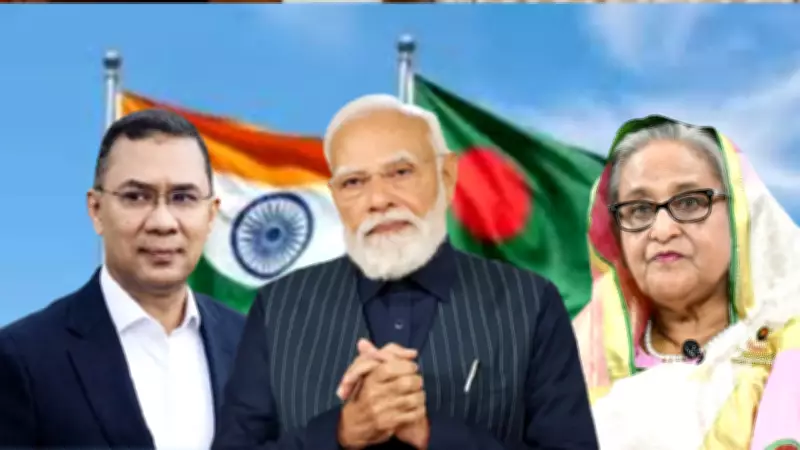
Bangladesh's New Government Intensifies Push for Sheikh Hasina's Extradition from India
The landslide victory of the Bangladesh Nationalist Party (BNP) in the country's first general elections since the 2024 uprising has brought Dhaka's longstanding demand for the extradition of ousted former prime minister Sheikh Hasina from India sharply back into focus. This development sets up a complex diplomatic test for New Delhi, which must now navigate delicate bilateral relations with its neighbor under a new political leadership.
BNP Leadership Reiterates Extradition Demand Following Election Triumph
Soon after the BNP's decisive electoral victory, senior party leader Salahuddin Ahmed publicly reiterated that the newly formed government would actively pursue Hasina's return to Bangladesh to face trial. "The foreign minister has already presented the case for her extradition, and we also support it," Ahmed stated firmly. "We always press for her extradition according to the law. This is between the foreign ministries of the two countries. We also asked the government of India to please send her back to face trial in Bangladesh."
Sheikh Hasina, who has been residing in New Delhi since August 2024 following her political ouster, was sentenced to death in absentia by a special tribunal in November 2025 for crimes against humanity linked to the violent suppression of the 2024 uprising. The former leader faces multiple additional sentences and ongoing legal cases on various charges pressed by Bangladesh's interim regime.

"Bangladesh Before All": BNP's Foreign Policy Reset with India
The BNP's election manifesto, unveiled by party chief Tarique Rahman, outlines a significantly tougher foreign policy stance framed under a "Bangladesh Before All" doctrine and the slogan "Friend Yes, Master No." While India was not explicitly named in the document, the manifesto emphasizes stricter positions on several bilateral issues including:
- Addressing alleged "border killing, push-in, and smuggling" activities
- Securing Bangladesh's "fair share" of waters from common rivers like the Teesta and Padma
- Strengthening the Joint River Commission for better water resource management
Ahmed clarified that Dhaka seeks normal relations with all neighboring countries, including India, but emphasized that such relations must be "on equal terms." "We need a friendly relationship based on mutual respect, equality with all the countries, including India," he explained.
India's Diplomatic Response and Engagement
Prime Minister Narendra Modi congratulated Tarique Rahman soon after his party's electoral victory, affirming that India would continue to support a "democratic, progressive and inclusive Bangladesh." The two leaders subsequently spoke by phone, with India expressing commitment to peace and prosperity for both nations.
Despite historical tensions, Rahman has struck a more pragmatic note in recent remarks. In an interview with The Guardian, he acknowledged that ties with India deteriorated following Hasina's ouster but underscored his preference for "a relationship of mutual respect and mutual understanding." When questioned about whether full normalization of ties was feasible while India continues to host Sheikh Hasina, Rahman responded cautiously: "That depends. It has to be on them too."
Formal Extradition Requests and India's Cautious Stance
Bangladesh's foreign affairs adviser Mohammad Touhid Hossain and the interim regime have consistently called for Hasina's extradition "at the earliest possible time" following her conviction. "I think our bilateral relations won't be stuck on one issue alone," Hossain told reporters in Dhaka. "However, since Hasina is now a declared convict, we expect her repatriation at the earliest possible time."

Dhaka has previously sent both a note verbale and an official letter formally seeking Hasina's extradition. India's Ministry of External Affairs has responded by stating that the request is being "examined." External Affairs Minister S. Jaishankar commented in December last year that Hasina's stay in India was her personal decision influenced by developments in Bangladesh. "As a democratic country... We would like to see the will of the people ascertained. I'm quite confident that whatever comes out... would have a balanced and mature view about the relationship, and hopefully things would improve," the minister stated.
Historical Frictions and Contemporary Challenges
The BNP's previous terms in office (1991–96 and 2001–06) witnessed periodic friction with India, particularly concerning cross-border insurgent activity. Border management remains politically sensitive in Indian states such as West Bengal and Assam, where local dynamics often influence national policy.
The party's manifesto promises a "strict position" to end alleged "border killings" by India's Border Security Force and halt what it describes as "push-ins." Minority safety represents another sensitive bilateral issue, with India having expressed concern over reported incidents targeting minorities in Bangladesh following the 2024 political upheaval.
India's Diplomatic Balancing Act
New Delhi now faces a significant diplomatic balancing act. Acceding to the extradition request would require navigating complex legal processes under existing bilateral arrangements and domestic Indian law. Simultaneously, rejecting or delaying a decision risks creating friction with a newly elected government that has made the issue a central public political commitment.
India has thus far maintained that the extradition request remains under examination while signaling readiness to engage with Dhaka's new leadership. With the BNP's decisive electoral mandate and Hasina's continued presence in India, the extradition question is likely to serve as an early test of how both nations recalibrate their relationship following Bangladesh's significant political transformation.