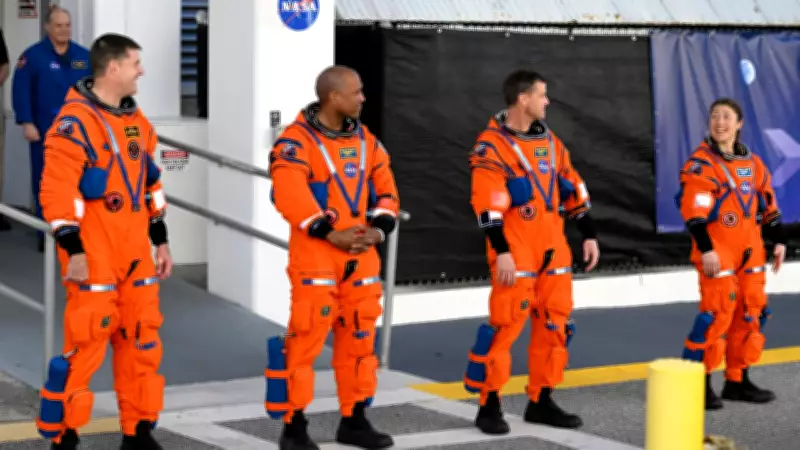
Artemis II Astronauts Enter Moon's Gravitational Sphere, Approach Historic Milestone
The four astronauts aboard NASA's groundbreaking Artemis II mission successfully entered the moon's gravitational sphere of influence in the early hours of Monday morning. This critical maneuver marks a pivotal step forward in the first crewed test flight of NASA's ambitious Artemis program, setting the stage for an unprecedented lunar encounter.
Crew Prepares for Sixth Day in Space with Record-Breaking Flyby Ahead
Having launched from Florida last week aboard the Orion capsule, the international crew is scheduled to awaken around 10:50 AM Eastern Time on Monday for their sixth day in space. Later that same day, they will experience one of the mission's most significant moments as they journey around the far side of the moon.
By 7:05 PM Eastern Time, Artemis II is projected to reach its maximum distance from Earth, approximately 252,757 miles away. This extraordinary positioning will place the crew 4,102 miles farther than the Apollo 13 astronauts traveled, establishing a new record for the farthest distance any humans have ever flown from our home planet.

Unprecedented Views and Scientific Observations Planned
As NASA astronauts Reid Wiseman, Victor Glover, and Christina Koch, along with Canadian Space Agency astronaut Jeremy Hansen, approach this historic milestone, they will be flying approximately 4,000 miles above the moon's darkened far side. From this unique vantage point, they are expected to witness the moon eclipsing a basketball-sized Earth in the distance, creating a breathtaking celestial spectacle.
The official lunar flyby, commencing at 2:34 PM Eastern Time, will span approximately six hours. During this period, the astronauts will pass into darkness and experience brief communications blackouts as the moon obstructs contact with NASA's Deep Space Network. This global system of giant radio antennas is essential for maintaining communication with the spacecraft throughout its journey.
The crew will utilize professional-grade cameras to capture detailed imagery through Orion's windows, including views of the moon in silhouette with sunlight filtering around its edges. This visual phenomenon will effectively appear as a lunar eclipse from their perspective.
Reversed Perspective: Earth Rising Above Lunar Horizon
Additionally, the astronauts are anticipated to photograph a rare and remarkable sight: Earth rising above the lunar horizon as the capsule emerges from the far side of the moon. This represents a complete reversal of the familiar moonrise observed from Earth, offering a perspective never before captured by human explorers.
This moment serves as the climactic point in the nearly ten-day Artemis II mission, which functions as the inaugural crewed test flight within NASA's broader Artemis campaign. The multibillion-dollar program aims to return astronauts to the lunar surface by 2028, establishing a sustained American presence before potential Chinese missions. This long-term lunar presence, potentially including a future moon base, is designed to help prepare for possible crewed missions to Mars in the coming decades.
Ground Team Monitors Mission from Houston Control Center
Back on Earth, dozens of lunar scientists have gathered in the Science Evaluation Room at NASA's Johnson Space Center in Houston to closely monitor the flyby. The astronauts, who underwent extensive training covering various lunar phenomena, are expected to provide real-time descriptions of their observations during this historic passage.
The Artemis II mission represents a monumental leap forward in human space exploration, combining international cooperation with cutting-edge technology to push the boundaries of what's possible beyond Earth's orbit.