The year 2025 proved to be a defining period for the strategic partnership between India and the United States. Despite navigating persistent trade tensions, the bilateral relationship achieved significant milestones across diplomacy, defense, trade, and science, showcasing its resilience and forward momentum.
A New Framework for Strategic Partnership
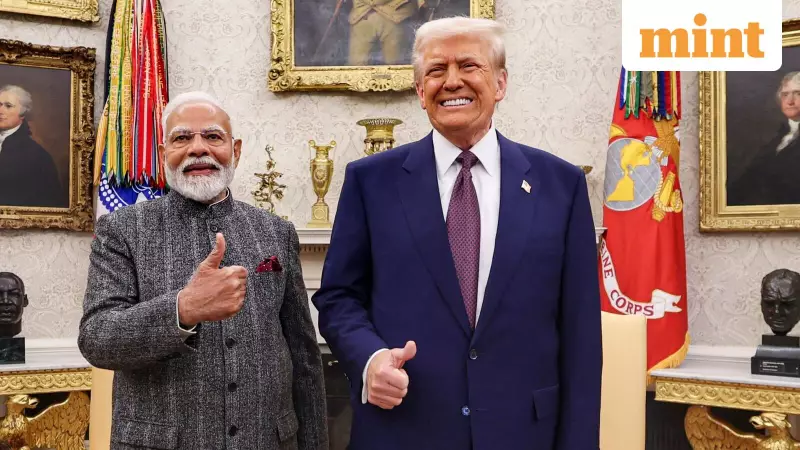
The most significant political event was the meeting between US President Donald Trump and Indian Prime Minister Narendra Modi in Washington on February 13, 2025. This summit resulted in the launch of a major new initiative: the U.S.-India COMPACT. This framework is designed to accelerate cooperation in critical areas including defense, trade, technology, and energy.
On the economic front, the leaders set an extraordinarily ambitious target: $500 billion in bilateral trade by 2030, under a plan dubbed "Mission 500." They also announced intentions to negotiate the initial phase of a Bilateral Trade Agreement by the fall of 2025, focusing on reducing barriers and improving market access.

In defense, discussions centered on working toward a new 10-year framework for the Major Defense Partnership. This includes plans to expand US defense sales and co-production within India, alongside deeper collaboration in emerging domains like space, cyber, and autonomous systems.
High-Level Diplomacy and Defense Consolidation
The strategic dialogue continued throughout the year at various international forums. On September 22, 2025, US Secretary of State Marco Rubio met with India's External Affairs Minister S. Jaishankar during the UN General Assembly. Rubio emphasized that India remains a partner of "critical importance," with both sides pledging to advance shared priorities in the Indo-Pacific, including through the Quad framework.
Defense cooperation received a substantial boost on October 31, 2025, when Defence Minister Rajnath Singh met US Secretary of War Pete Hegseth in Kuala Lumpur. The key outcome was the signing of the Framework for the US–India Major Defence Partnership (2025–2035). This decade-long agreement aims to provide a unified vision for transforming defense ties, strengthening industrial collaboration, technology sharing, and coordination to address common security challenges.
Further underscoring the high-level engagement, US Vice President JD Vance is scheduled for an official visit to India from April 21 to 24, 2025. His itinerary includes meetings with PM Modi in New Delhi, alongside trips to Jaipur and Agra, aimed at reviewing progress on bilateral initiatives.
Landmark Achievements in Science and Technology
A crowning jewel of the year's collaboration was the successful launch of the NISAR satellite on July 30, 2025, from Sriharikota aboard ISRO's GSLV-F16 rocket. Jointly developed by NASA and ISRO, NISAR is the world's first dual-frequency radar imaging satellite, weighing 2,393 kg.
Union Minister Jitendra Singh hailed it as a global benchmark in Indo-US scientific partnership. The satellite, now in a 747-km orbit, will provide all-weather, high-resolution imagery every 12 days. Its data will be crucial for disaster management, climate monitoring, agriculture, and infrastructure planning, with an open-access policy benefiting global scientists and developing nations over its five-year mission.
Enduring Partnership Amidst Challenges
The year also saw Sergio Gor assume the role of US Ambassador to India, concurrently serving as Special Envoy to South and Central Asia, signaling Washington's focused diplomatic attention on the region.
While issues related to trade tariffs and market access created points of friction, the broad trajectory of the relationship in 2025 was overwhelmingly positive. The consistent progress across multiple pillars—from the high-stakes COMPACT agreement and a solidified defense framework to groundbreaking scientific collaboration—demonstrates that the India-US strategic partnership is not only enduring but also dynamically evolving to meet future challenges and opportunities.