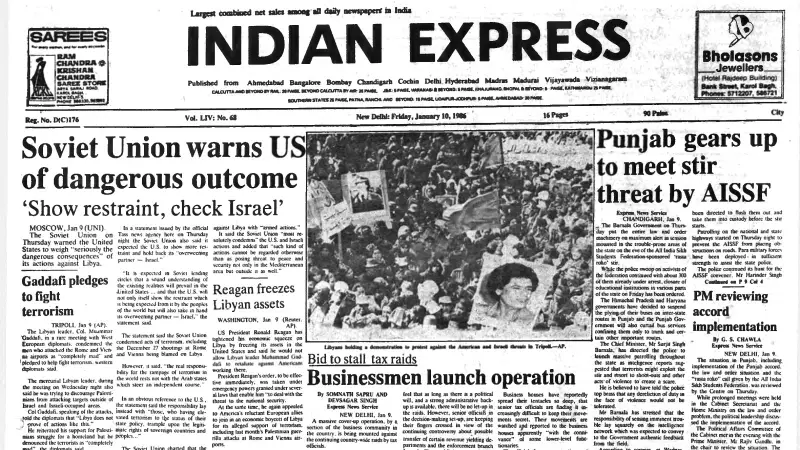
January 10, 1986, was a day of significant geopolitical manoeuvres and regional tensions, capturing a snapshot of a world navigating Cold War rivalries and complex bilateral relationships. Key developments unfolded involving superpower warnings, a potential breakthrough in South Asian trade, and internal security concerns in India.
Soviet Union's Stern Warning to the United States
On this day, the Soviet Union issued a direct and public caution to the United States regarding its actions against Libya. Moscow urged Washington to seriously consider the "dangerous consequences" of its policies. The statement from Soviet leadership circles expressed an expectation that the US would demonstrate greater restraint. Notably, it also called on America to hold back its "overweening partner — Israel." This diplomatic communication highlighted the tense proxy dynamics of the era, where the US-USSR rivalry played out in regional conflicts across the globe.
Gaddafi's Pledge and Regional Diplomacy
In a related development, Libyan leader Colonel Muammar Gaddafi held a rare meeting with West European diplomats. According to Western diplomatic sources, Gaddafi condemned the perpetrators of the attacks on Rome and Vienna airports as "completely mad." He used the forum to pledge his commitment to fighting terrorism. The mercurial leader also claimed he was actively trying to discourage Palestinians from carrying out attacks outside Israel and the Israeli-occupied territories, an assertion viewed with scepticism by many Western observers at the time.
India-Pakistan Trade Negotiations Advance
Shifting focus to South Asia, India and Pakistan made notable progress in resolving a stalemate in their economic relations. Officials from both nations expressed optimism about finalising a trade accord. A senior Indian official indicated that the respective Finance Ministers, V. P. Singh of India and Mahbub ul Haq of Pakistan, were expected to sign an agreed-upon text. Informed sources revealed that the prospective deal would focus on key areas like expanding trade in the public sector and improving cross-border infrastructural facilities, aiming to foster a more stable economic relationship.
Punjab on High Alert Ahead of 'Rasta Roko' Stir
Within India, the state of Punjab was gripped by apprehension. The government led by Chief Minister Surjit Singh Barnala placed the entire law and order machinery on maximum alert. This precaution was taken as tension escalated in trouble-prone areas on the eve of a "rasta roko" (road blockade) agitation sponsored by the All India Sikh Students Federation (AISSF). In a pre-emptive move, police had already arrested approximately 300 federation activists in ongoing raids. To prevent further unrest, the state administration ordered the closure of educational institutions across various regions.
The events of January 10, 1986, illustrate the interconnected threads of global diplomacy, regional cooperation, and domestic security challenges. From the Kremlin's warnings to the corridors of power in New Delhi and Islamabad, and the streets of Punjab, this day remains a fascinating historical cross-section of a world in flux.