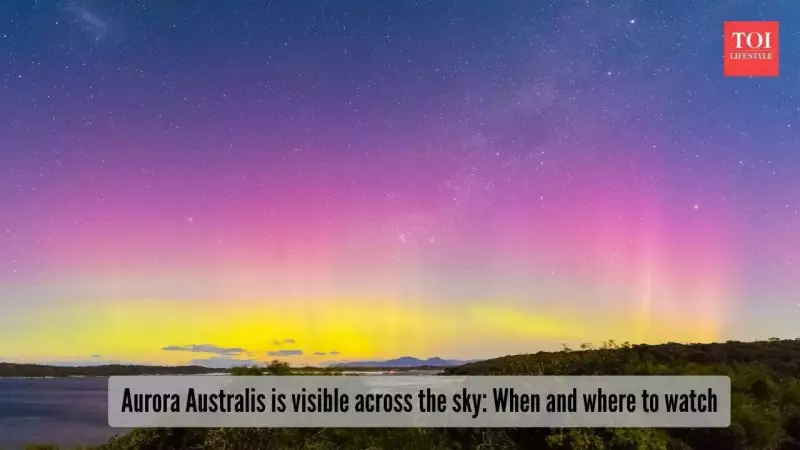
For many, witnessing the celestial dance of auroras is a lifelong dream. While the Northern Lights, or Aurora Borealis, often capture the imagination, its southern counterpart, the Aurora Australis or Southern Lights, paints the skies near the Antarctic with equal, if not more, mystique. This natural spectacle transforms the night into a vibrant canvas of greens, reds, and purples, offering a breathtaking experience for adventurous travellers.
The Science Behind the Southern Lights' Glow
The magic of auroras begins on the sun. Charged particles ejected during solar activity travel across space and collide with Earth's protective magnetic field. These particles are funneled towards the poles, where they interact with gases in our upper atmosphere. When these solar particles excite oxygen atoms, they produce stunning green and red hues. Nitrogen atoms, when energised, contribute shades of blue and purple. This dazzling light show occurs at altitudes ranging from 80 to 250 kilometres above the Earth's surface.
While similar to the Northern Lights, the Aurora Australis often forms unique patterns, appearing as shimmering curtains, dynamic rays, or diffuse glows. These shapes are directly influenced by the complexities of Earth's magnetic field, which is stronger and more uneven in the southern polar region.

Best Places and Time to Witness the Aurora Australis
To maximise your chances of seeing the Southern Lights, you must journey to high southern latitudes. The prime viewing location is Antarctica, due to its proximity to the South Magnetic Pole. For more accessible options, several destinations offer dark skies ideal for aurora hunting.
Tasmania in Australia is a renowned hotspot, with recommended spots including Dove Lake at Cradle Mountain, Carlton Beach, Goat Bluff, Tinderbox, and the summit of kunanyi/Mount Wellington. New Zealand's South Island boasts dark-sky reserves like Aoraki Mackenzie and Stewart Island. In South America, the Patagonia region spanning Chile and Argentina can offer spectacular displays during periods of intense solar storms.
The optimal viewing window is during the southern hemisphere's autumn and winter, from March to September, when nights are longest and darkest. The equinoxes in March and September often increase auroral activity due to favourable alignment of Earth's magnetic field. For the best experience, seek clear, moonless skies far from city light pollution around midnight, and arm yourself with patience, as aurora sightings are never guaranteed.
Can You See the Southern Lights from India?
For skywatchers in India, the prospects of seeing the Aurora Australis are extremely slim. India is located between 8° and 37° north latitude, far from the auroral oval which is centred around 67° south latitude. This vast geographical separation makes direct sightings from the subcontinent virtually impossible under normal conditions.
Furthermore, urban light pollution and atmospheric haze in major Indian cities like Delhi, Mumbai, or Bangalore would wash out even the faintest auroral glow. While historically, extreme geomagnetic storms have occasionally pushed auroral displays toward lower latitudes, such events are exceptionally rare and unpredictable. Experts agree that for residents of India, travelling to the southern polar regions is the only reliable way to experience the Southern Lights.
With solar activity currently peaking, more enthusiasts worldwide are embarking on journeys to catch this elusive natural wonder. The pursuit of the Aurora Australis blends science, adventure, and sheer awe, promising an unforgettable spectacle for those willing to venture to the ends of the Earth.