A Snowy Dream in Lansdowne Shattered by Litter: A Child's Lesson in Civic Sense
I have always harbored a dislike for winters, yet an inexplicable love for snow, inspired largely by the magical depictions in "Harry Potter" and the enchanting scenes of Hogsmeade. The irony, however, lies in the fact that I had never witnessed real snow firsthand—not the pristine, untouched kind seen in movies or Instagram reels, but the authentic, cold, and transformative experience.
The Journey to a Winter Wonderland
Driven by this dreamy fascination, I embarked on a journey from Delhi to Lansdowne in Uttarakhand during peak winter, lured by forecasts of snowfall. After enduring hours of traffic jams, incessant car honks, and bouts of nausea, I finally arrived. The town appeared as if it had paused mid-breath, blanketed in a serene white silence. Snow rested gently on rooftops and clung to tree branches, mirroring the cinematic visuals I had long admired. Roads were covered in a soft white layer, while endless valleys faded into misty greys and whites. The tin roofs of houses, buried deep under snow, seemed smaller, and every step I took produced a satisfying crunching sound.
Taking a deep breath of the clean, unpolluted air—a stark contrast to Delhi's smog—I felt overwhelmed. It was magic, purity, and love at first sight, akin to stepping into Hogwarts itself. This moment was everything I had imagined and more.

The Harsh Reality Beneath the Snow
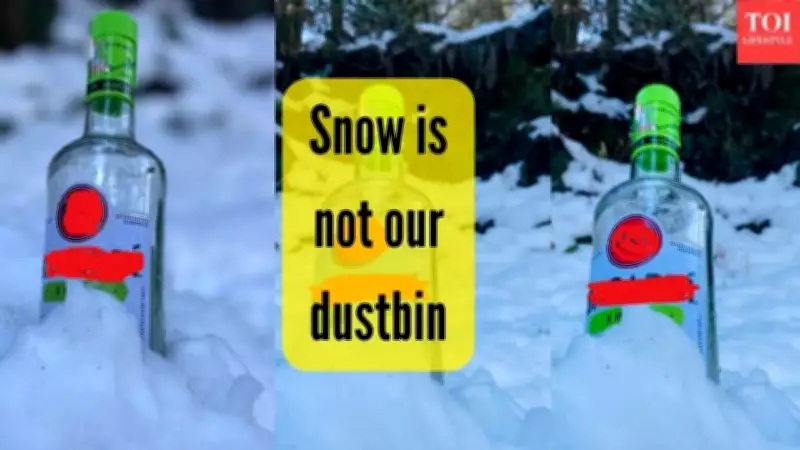
But my enchantment was short-lived. Amidst the beauty, I spotted a green and white glass bottle poking out of the snow near a roadside walking path. Initially, I thought it might be a snow formation, but upon closer inspection, it was an alcohol bottle, half-buried and frozen into the snow as if it belonged there. Looking around, I noticed families with young children nearby, and my heart sank. Soon, I couldn't stop seeing more beer bottles—some deeply embedded in the snow, others carelessly tossed aside.
It became painfully clear that snow does not erase bad behavior; it merely conceals it temporarily. This realization was underscored when I observed a little boy, around eight or nine years old, bundled in an oversized jacket, struggling to pull a dark brown beer bottle from the snow with his parents' help. Once successful, he looked up at passersby and declared, "Let's remove all these glass bottles. It's bad. We can't play in the snow because of these bottles. Someone might get hurt."
A Collective Effort and a Sobering Lesson
The irony was stark: children were paying for adults' misbehavior. This boy had traveled to play in the snow and build a snowman, yet he was instead cleaning up someone else's mess. Feeling ashamed, I joined a quiet collective effort as other travelers, photographers, and snow lovers paused to help remove the bottles. We managed to clear a small patch, making the snow safer, but I couldn't help wondering how many more bottles lay hidden across the vast landscape.
Later, scrolling through Instagram, I saw reels and pictures from snowy destinations showing paan spit, gutkha stains, and liquor bottles littering the scenery. It's a troubling trend where mountains and snow become dumping grounds, as if responsibility takes a vacation in these pristine places. We've somehow normalized zero civic sense, but perhaps it's time to reverse this by making civic responsibility cool again. If a young child can understand that glass doesn't belong in the snow, why can't adults?
Reflections on Travel and Responsibility
Lansdowne gifted me my first snowfall experience, but it also imparted an unexpected lesson. As travelers, we often say "leave only footprints," but it's crucial to truly embody this ethos. Let's stop hiding our mess under snow, sand, or sea. Instead, let's champion the idea that "civic sense is cool"—a trend truly worth following for the sake of our environment and future generations.