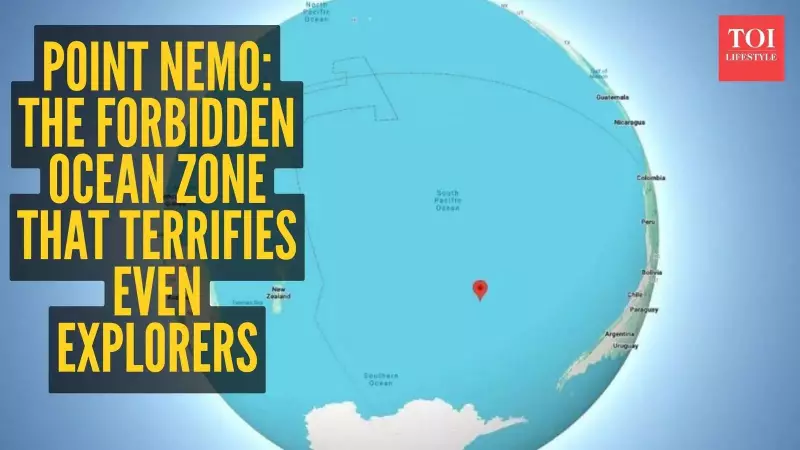
Our planet is dotted with bizarre and awe-inspiring locations. From Turkmenistan's perpetually burning 'Door to Hell' to the fiercely guarded North Sentinel Island in India's Andaman & Nicobar archipelago, Earth never ceases to amaze. Another such extreme locale, the notoriously rough Drake Passage, is back in the spotlight, not for storms, but for its profound isolation. Thanks to a viral moment on Instagram, the world is rediscovering Point Nemo, the most isolated spot in the ocean.
The Ultimate Middle of Nowhere
Interest in Point Nemo, as tracked by Google Trends, has simmered for years. Long before it became social media trivia, this unique coordinate captivated scientists, sailors, and geography buffs for one compelling reason: it represents the pinnacle of solitude. Located at approximately 48°52.6′S 123°23.6′W in the vast South Pacific, Point Nemo holds the official title of the oceanic pole of inaccessibility. This means it is the point in the ocean farthest from any piece of land.
You cannot physically stand at Point Nemo; it is merely a set of coordinates in the middle of an immense watery desert. The scale of its remoteness is staggering. When positioned at Point Nemo, the astronauts aboard the International Space Station, orbiting roughly 400 kilometers above Earth, are often closer to you than any other human on the planet's surface.

The three nearest landmasses are all uninhabited and each lies roughly 2,600 to 2,700 kilometers away. To the north lies Ducie Island, to the northeast is Motu Nui, and to the south sits Maher Island in Antarctica. With no permanent settlements for thousands of kilometers and virtually no commercial shipping routes, the area is also one of the quietest and most lifeless places acoustically on Earth.
Why Is It Called Point Nemo and Why Do Scientists Value It?
The name was bestowed in 1992 by Croatian survey engineer Hrvoje Lukatela. While it cleverly references Captain Nemo from Jules Verne's classic '20,000 Leagues Under the Sea,' the Latin word 'nemo' itself means 'no one' – a perfectly fitting name for a place so utterly devoid of human presence.
This extreme isolation is precisely what makes Point Nemo valuable for science. Researchers prize it as a natural laboratory for studying ocean currents and marine environments with minimal human interference. The waters here are known to be exceptionally nutrient-poor, resulting in low biodiversity. The ecosystem is dominated by simple microorganisms, with larger, more complex marine life being a rare sight.
Earth's Official Spacecraft Cemetery
Point Nemo's profound emptiness has led to a unique and practical application: it serves as a controlled re-entry zone or a 'spacecraft cemetery' for decommissioned space hardware. Space agencies like NASA and Roscosmos frequently guide defunct satellites, cargo ships, and other orbital debris to re-enter Earth's atmosphere over this region. The objects burn up upon re-entry, and any surviving fragments fall into this remote part of the South Pacific, far from any human activity or shipping lanes.
In a planned monumental event, the International Space Station (ISS) is currently scheduled to be deorbited and directed to this same remote area around 2030–2031. It's important to note that this timeline is projected and may be adjusted as mission plans evolve.
From a viral social media trend to a crucial zone for space exploration's end-of-life logistics, Point Nemo continues to capture our imagination. It stands as a powerful reminder of our planet's vast, untouched frontiers and the innovative ways humanity navigates them.