Journey to Jamali Kamali: Beyond the Ghost Stories
Long before my visit, the tales of Jamali Kamali Mosque and Tomb had already woven their way into my consciousness. Whispers of jinns haunting its ancient corridors circulated widely. Accounts described people feeling invisible hands pushing them unexpectedly. Stories told of security guards refusing solitary night duty due to phantom slaps and eerie whispers. The internet amplified these narratives with dramatic thumbnails, ominous background scores, and exaggerated testimonies.
As an experienced travel writer, I understand that rumors often outpace facts. Yet curiosity possesses a unique power to override reason. One pale winter afternoon in Delhi, I found myself walking through Mehrauli Archaeological Park, determined to confront either the jinns or the truth behind the legends.
The Unusual Silence of Mehrauli Archaeological Park
The park maintained an unusual quietness that afternoon. While Delhi's traffic roared somewhere in the distance, within the complex boundaries, time seemed suspended. The eerie stillness felt distinctly strange. Dry leaves crackled beneath my shoes as I walked. No tourist groups crowded the pathways. No school children embarked on educational excursions. The only visitors appeared to be myself, a disinterested guard, four squirrels, a solitary peafowl, and the pervasive winter chill.

Constructed during the 16th century under Sikandar Lodi's reign and later associated with the Mughal period, the mosque and tomb bear the names of Sufi saint Jamali and a mysterious figure called Kamali. Historical records present several theories about Kamali's identity—perhaps a disciple, a companion, or a beloved. Whatever the relationship, history has kept these secrets politely folded within its pages. The real mystery, however, belongs to modern times.
Inside the Legendary Jamali Kamali Complex
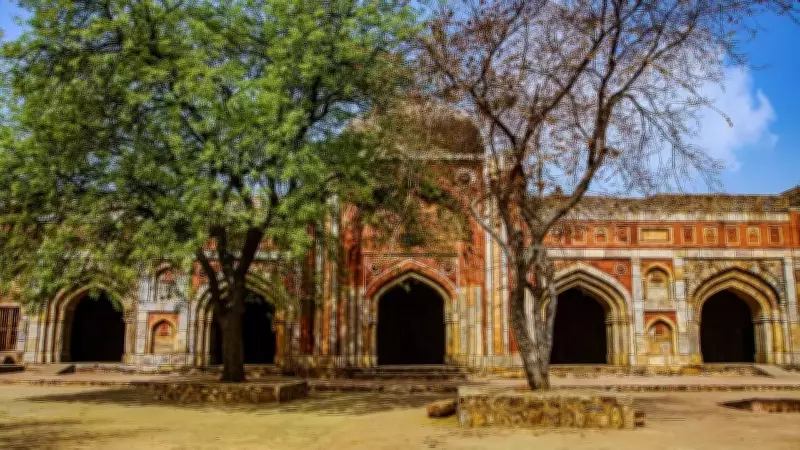
Stepping inside the famous "haunted" Jamali Kamali, I half-expected something dramatic to occur. Would a sudden gust of wind materialize? We'll never know. Instead, I encountered profound stillness. The mosque courtyard lay open beneath the sky, elegantly framed by graceful arches. Red sandstone glowed warmly in the afternoon light, displaying traces of intricate carvings here and there.
Yet some walls appeared strangely blackened, almost charred in appearance. Had someone lit a bonfire within these sacred walls? I shook my head disapprovingly at nobody in particular—perhaps the universe itself. Suddenly, I heard a sound, a distinct movement. I stood completely still, not frozen with fear, but because two squirrels revealed themselves as the source of that sudden noise. If jinns were present that day, they demonstrated extreme subtlety.
The Tomb Chamber's Different Silence
Further within the complex, the tomb chamber held a different quality of silence—thicker, heavier, yet not menacing. The air felt noticeably cool. My footsteps echoed more than anticipated, making me suddenly conscious of my solitude. No visitors whispered in awe. No cameras clicked incessantly. Just an expansive quiet that allowed the smallest sounds to grow disproportionately large.
I settled onto the cool stone floor and allowed the silence to permeate my being. The centuries-old walls bore visible scars. Names scratched into plaster. Hearts pierced with arrows. Crude declarations of love carved into stone that had survived multiple empires. I had arrived searching for jinns, but discovered a different, disappointing kind of haunting.
The Real Haunting: Human Stories Etched in Stone
Tracing one inscription with my fingers, I felt the uneven grooves. Lovers had left behind proclamations of devotion that would likely outlast their relationships. The irony struck me profoundly: people feared supernatural entities in a place where the real vandalism originated from the living.
I must admit, part of me continued waiting. Waiting for the urban legend to manifest and play out. Yet nothing frightening occurred that day. The longer I remained, the more the place revealed itself—not as haunted, but as heartbreakingly beautiful. Something profoundly human characterized Jamali Kamali. Originally built for prayer, reflection, and love—whether spiritual or otherwise—it had witnessed devotion, conquest, neglect, and now, superstition.

If jinns truly exist, I contemplated, perhaps they simply represent memories. This ancient monument had been reduced to clickbait material, its silence misinterpreted as menace. I will never uncover the complete truth behind the tales. Folklore maintains its own independent life. Perhaps someone once experienced something inexplicable. Perhaps imagination filled the remaining gaps.
On that particular winter afternoon, Jamali Kamali was not haunted. It was serene, and honestly, quite unremarkable yet undeniably beautiful—a testament to human history rather than supernatural phenomena.