India's Tourism Map Redrawn: From Goa to Ayodhya, Faith and Culture Drive New Travel Boom
For decades, planning a holiday in India was a simple choice between two classic options: the sun-kissed beaches of Goa or the snowy peaks of Manali. Sand or snow. That familiar binary has now been completely upended. Today, the most searched destinations on travel platforms are as likely to be Ayodhya as Alibaug, Varanasi as Vagator, and Ujjain as Udaipur.
A generation that once posted sunset selfies from beach shacks is now booking flights to ancient temple towns, sacred river ghats, and historic heritage streets. India’s tourism geography is changing—quietly, steadily, and at a pace faster than many anticipated.
The New Tourism Hubs: From Periphery to Center
Across the nation, locations once considered peripheral to mainstream tourism are emerging as year-round destinations. Cities like Ayodhya, Varanasi, Ujjain, Prayagraj, Dwarka, Puri, Hampi, Madurai, and Maheshwar are no longer niche pilgrimage stops. They have become central nodes in India’s travel economy, attracting millions of visitors who are not just devotees but also explorers, photographers, students, influencers, backpackers, and international tourists.

This seismic shift is driven by a powerful convergence of factors: a nationwide religious revival, massive infrastructure investment, the discovery power of social media, evolving generational travel habits, and a fundamental redefinition of what "travel" means in contemporary India.
Religious Tourism: From Margins to Mainstream Engine
The most decisive force reshaping the map is the scale and transformation of religious travel. India has always been a land of pilgrimage, but post-liberalization, this segment often remained disconnected from mainstream leisure tourism. Pilgrims traveled briefly, focused on rituals, and rarely engaged with destinations beyond their sacred purpose.
That distinction has now collapsed. Data from the Union Ministry of Tourism and state governments reveals that religious tourism accounts for over half of all domestic tourist visits in India. In several states, pilgrimage-led travel has overtaken conventional leisure tourism as the primary driver of footfall.
Uttar Pradesh exemplifies this transformation most starkly. The state reported over 130 crore domestic tourist visits in a recent year, making it India’s most visited state. This surge is overwhelmingly powered by pilgrimage and heritage circuits connecting Ayodhya, Prayagraj, Varanasi, and Mathura-Vrindavan.
Ayodhya, once a modest religious town, has undergone a dramatic metamorphosis since the inauguration of the Ram Temple. Annual visitor numbers now run into millions, outpacing several long-established heritage sites. The city's airport, railway station, road network, and public spaces have been comprehensively redeveloped to handle a volume of travel previously unimaginable.
The Maha Kumbh in Prayagraj, a once-in-144-years event, drew footfalls on a scale rarely seen globally, forming the largest religious congregation—so vast it was visible from space. Varanasi, long considered a once-in-a-lifetime destination, is now one of India’s fastest-growing cultural hubs. State figures show tourist visits crossing 10 crore annually, with foreign arrivals rising sharply.
Similar stories unfold nationwide. Tamil Nadu’s temple circuits, Maharashtra’s Shirdi-Pandharpur belt, Odisha’s Puri, Madhya Pradesh’s Ujjain and Maheshwar, and Gujarat’s Dwarka and Somnath now function as high-volume, year-round tourism economies.
"Faith has become infrastructure-led," noted a senior employee at a tech-savvy Delhi travel agency. "Once access improved, demand exploded. The jump in visit plans to cities like Varanasi and Kedarnath has increased manyfold." Interestingly, this crowd increasingly includes youth, reflecting a significant shift from assumed travel preferences.

The Power of Religious Events: Scale, Spectacle, and Sustained Travel
If religious tourism is the backbone of the new travel map, major religious events are its powerful accelerators. India’s dense religious calendar features gatherings that combine faith, spectacle, and culture on an unmatched global scale. These are no longer just spiritual congregations; they are major tourism drivers with significant economic impact.
The Maha Kumbh Mela at Prayagraj remains the prime example. The most recent edition drew hundreds of millions of visits over weeks. Beyond ritual bathing, it now attracts cultural tourists, photographers, researchers, and international visitors. The festival generated approximately 1.2 million jobs in tourism, transportation, healthcare, and retail, providing a massive boost to state and national economies. Post-event data showed trade in daily essentials reached Rs 17,310 crore, with the hotel and travel sectors at Rs 2,800 crore.
Similarly, the Puri Rath Yatra in Odisha turns the coastal town into a global focal point, with hotel occupancy peaking across the state. Events like Dev Deepawali in Varanasi, Durga Puja in Kolkata (now a UNESCO-recognized event), Deepotsav in Ayodhya, and Thrissur Pooram in Kerala function as major tourism magnets, blending religion, art, music, and food.
"The festivals are no longer spikes; they are anchors," said Naveen Singh, a Varanasi hotelier. "They fill rooms, generate repeat visits, and stabilize demand." State tourism boards now actively integrate these events into annual calendars, aligning transport and accommodation planning.
From Pilgrimage to Experience: The Reimagining of Sacred Cities
The transformation is not just about numbers; it's about experience. Cities like Varanasi, Ujjain, and Dwarka are no longer framed merely as sites of ritual. They are being reimagined as layered cultural spaces for experiential travel.
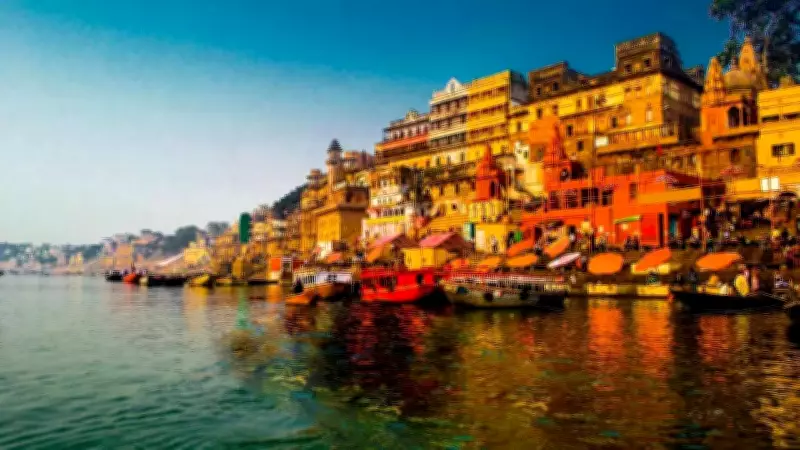
Morning boat rides on the Ganga, evening aartis at restored ghats, heritage walks through ancient neighborhoods, classical music performances, local food trails, and café culture in centuries-old lanes are now integral to itineraries. The sacred and the everyday coexist, and travelers engage with both.
This shift is enabled by sustained infrastructure investment: expanded airports, redeveloped railway stations, improved roads, pedestrian corridors, and riverfront developments. Government schemes like PRASHAD and Swadesh Darshan have focused on enhancing tourist facilities around religious and heritage sites.
Leading travel companies are facilitating this new category of travel—blending faith, culture, leisure, and storytelling. "Spiritual tourism in India is witnessing significant growth as more travellers seek meaningful experiences," said Rikant Pittie, Co-Founder of EaseMyTrip. "In 2024, India’s religious tourism market was valued at US$ 202.8 billion and is expected to grow to US$ 441.2 billion by 2032."
Youth and the New Travel Ethos
Perhaps the most consequential shift is generational. India’s Gen Z and young millennials are redefining travel. For them, travel is experiential, social, and performative.
- Cafés, street food, and local neighborhoods often matter more than monuments.
- Travel is as much about content creation as consumption.
- Short, frequent getaways are preferred over long vacations.
- A city’s "vibe" and authenticity are paramount.
Travel platforms report a sharp rise in bookings to spiritual and heritage destinations among travelers under 35, often combining pilgrimage with leisure, photography, and food exploration. Social media influencers play a key role in this discovery.
"While travelling, I see unexplored places of surreal beauty," said content creator Suchna Yadav. "I want people to see this, and social media storytelling is the best option." For many, travel is not an escape but an extension of identity—curated and shared through digital content.
Economic Ripple Effects and Sustainability Challenges
The tourism shift has tangible economic benefits. Hospitality players report higher year-round occupancy. Local economies—transport operators, guides, artisans, food vendors—benefit from sustained demand rather than seasonal spikes.
However, significant challenges are mounting. Overcrowding, waste management, environmental stress, and infrastructure capacity pose real risks. Experts warn that without heritage-sensitive planning and robust sustainability measures, the very qualities drawing travelers could be severely compromised.
A Tourism Map Still in Motion
India’s tourism geography is no longer static or metro-centric. It is being dynamically reshaped by faith and culture, digital discovery, younger travelers redefining value, and destinations once overlooked now stepping into the national and global imagination.
The shift underway is not about discovering new places, but about seeing familiar ones through a new lens. In that profound reframing, India’s tourism future is being quietly, yet powerfully, rewritten. The most compelling travel stories now lie far beyond the familiar shores of Goa and the hills of Manali.