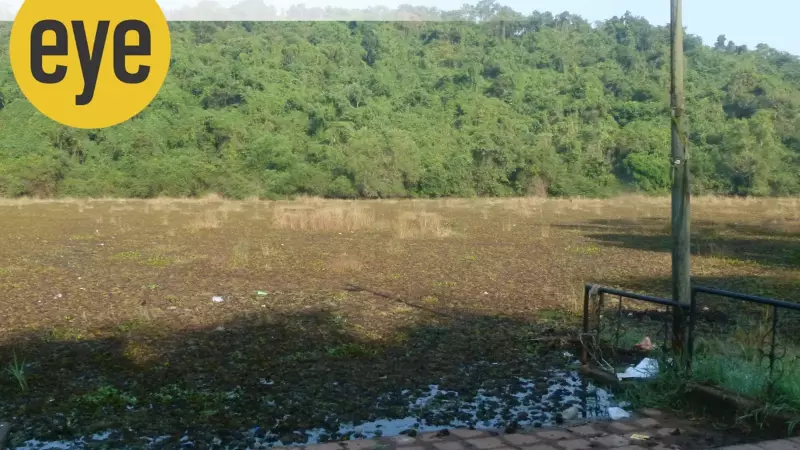
Nestled near a village in North Goa, Pilerne Lake presents a stark contradiction. Online reviews paint two very different pictures: a serene birdwatcher's paradise or a trash-filled disappointment. A recent morning visit in early December 2025 confirmed that, sadly, both views hold truth, revealing an ecosystem under strain.
A Lake Struggling to Breathe
The journey to the lake, about a half-hour drive through winding roads past tightly packed homes, ends at a designated birdwatching spot. The promise of water, however, is immediately broken. The surface is almost entirely covered by a thick mat of unidentified aquatic plants, glittering with dew but choking the life beneath. What truly captures the eye, however, is the human footprint—ubiquitous beer bottles, cans, and snack packets litter the edges, mixed with votive flower offerings.
While the notorious stench mentioned by other visitors was absent that morning, the visual pollution was overwhelming. Locals are rightfully angry at tourists who leave behind bottles after drinking cheap beer by the water. However, not all garbage is tourist-sourced. Reports indicate a small industrial estate built on the hills opposite the lake to boost the local economy has also contributed significantly to dumping in the area.

Glimmers of Avian Life Amidst the Decay
Despite the dismal setting, patient observation rewards the keen eye. The dark green, teak and sal-wooded hills across the lake form a silent backdrop for Brahminy kites wheeling in the crisp blue sky. On the water, a pond heron blends perfectly with the flora, and a slender cormorant makes a sudden splashy landing.
The stars of the show, however, are a pair of bronze-winged jacanas. These stumpy, swamp-dwelling birds, with their distinctive white eyebrows and spidery toes, are known as 'lily-trotters' for their ability to walk on floating vegetation. On this November morning, they were engaged in an agitated chase, squeaking and charging at each other across the green carpet.
The Fascinating Family Dynamics of Jacanas
The jacana clan boasts one of the most intriguing role reversals in the avian world. Here, it is the father who is the primary caregiver. After the breeding season (June to September), the female settles her mate on a nest of floating leaves to incubate the eggs. She then leaves to seek other mates, fiercely defending a large territory from rival females. The male, meanwhile, guards a smaller territory and raises the brood, sheltering the chicks under his wings from predators. Despite this care, sources indicate a grim reality: up to 84% of jacana chicks fall prey to predators.
The observed pair's conflict raised questions. With the breeding season over, were they two females disputing territory over scarce food resources? Their intense squabbles, punctuated by high-pitched 'see-see-seek' calls, highlighted the struggle for survival in a diminishing habitat. The lack of open water also meant other species, like whistling teals seen in online pictures, were conspicuously absent.
The lake holds undeniable promise as a biodiversity spot. Yet, until the dual threats of invasive vegetation and human-generated waste are addressed, Pilerne risks becoming known not as a haven, but simply as 'The Lake That Wasn't'. The morning spent there was a poignant reminder of what we stand to lose when natural spaces are not cherished and protected.