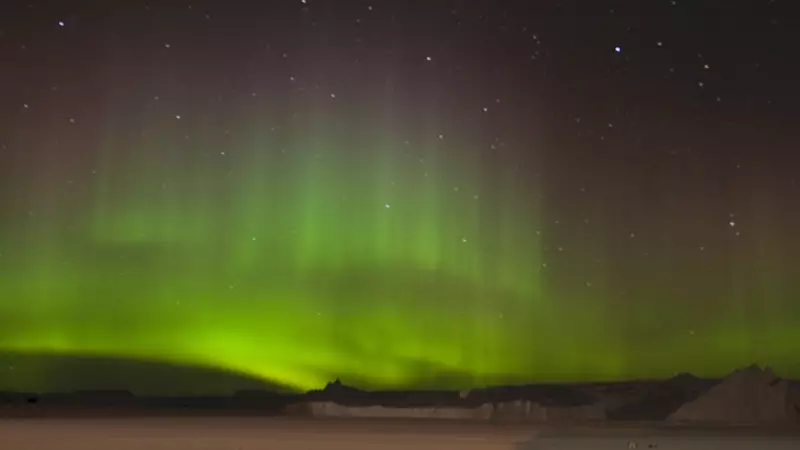
While the Northern Lights, or Aurora Borealis, captivate travellers' imaginations globally, their southern counterpart remains a lesser-known marvel. The Southern Lights, scientifically termed Aurora Australis, offer an equally breathtaking celestial display in the Earth's southern hemisphere. This guide delves into everything you need to know about this phenomenon, from the science behind it to the practicalities of witnessing its glow, especially for curious skywatchers in India.
The Science Behind the Celestial Glow: What Are Auroras?
The dazzling dance of the auroras, both north and south, is a direct result of activity on our Sun. Charged particles like electrons and protons are ejected from the Sun via solar wind. When this stream of particles reaches Earth, it interacts with our planet's magnetic field and is funneled toward the poles. There, they collide with atoms and molecules—primarily oxygen and nitrogen—in the upper atmosphere, at altitudes between 80 km and 250 km.
These collisions excite the atmospheric atoms. As they return to their normal state, they release energy in the form of light, or photons. This process creates the shimmering, multi-coloured curtains and rays that define an aurora. The specific colour depends on the gas involved and the altitude of the collision: green and red hues come from oxygen, while nitrogen produces blue and purplish-red tones.

Chasing the Southern Lights: Prime Viewing Locations and Timing
Mirroring the Aurora Borealis but with its own unique patterns shaped by Earth's magnetic field, the Aurora Australis is best viewed from high southern latitudes. The spectacle concentrates around the Antarctic Circle, but several accessible landmasses offer fantastic opportunities.
The most reliable and iconic region is Antarctica, which encircles the South Magnetic Pole. However, for most travellers, the following destinations are more practical:
- Tasmania, Australia: Widely considered one of the best and most accessible locations for viewing the Southern Lights, especially during periods of high solar activity.
- South Island, New Zealand: Its dark skies, minimal light pollution, and favourable latitude make it a haven for aurora hunters.
- Patagonia (Southern Chile & Argentina): The southernmost reaches of South America occasionally transform into a dramatic backdrop for the auroral display.
Timing is crucial for a successful sighting. The ideal 'aurora season' in the Southern Hemisphere spans the autumn and winter months (March to September), when longer nights provide a darker canvas. The weeks around the March and September equinoxes often see increased activity. For the best view, seek clear, dark skies away from city lights, with peak visibility typically around local midnight.
The Million-Dollar Question: Can You See the Southern Lights from India?
For residents of India, the prospect of seeing the Southern Lights from home is, unfortunately, extremely slim under normal conditions. The primary reason is geography. Auroras are typically visible within the 'auroral zones,' which are located around 67 degrees latitude north or south. India lies between approximately 8° and 37° north latitude, placing it far outside this magical belt.
Furthermore, pervasive light and atmospheric pollution in Indian cities further diminish any theoretical chance. However, science leaves a tiny window of possibility open. During exceptional, extreme geomagnetic storms triggered by massive solar eruptions, the auroral oval can expand significantly beyond its usual boundaries. In such rare historical events, auroras have been spotted at much lower latitudes.
While this means it is not completely impossible, any sighting from India would be an extraordinarily rare event. The lights would likely be very faint and visible only from extremely dark locations, and such occurrences are often debated. For a guaranteed and vivid experience, travelling to the high southern latitudes mentioned above remains the only practical option.

In conclusion, the Aurora Australis stands as a stunning natural wonder waiting to be explored. While Indian skywatchers may need to embark on a journey south to witness its full glory, understanding this phenomenon brings us closer to the magnificent interplay between our Sun and Earth that paints the polar skies with light.