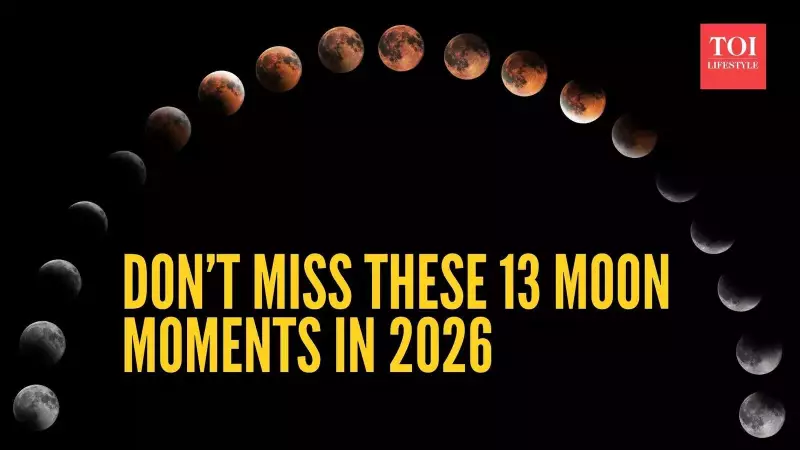
In a world filled with digital noise, a quiet revolution is taking place. More and more people are rediscovering the simple joy of looking up. A moment on the balcony, a post-dinner stroll, or a few quiet minutes on the terrace are increasingly dedicated to observing the night sky. This peaceful hobby is set to become even more captivating in 2026, which promises a packed calendar of celestial spectacles centred around our closest cosmic neighbour, the moon.
A Year Packed with Lunar Spectacles
The coming year will treat sky enthusiasts to a series of remarkable events, from dramatic eclipses to rare meetings between the moon and bright planets. The best part is that most of these sights require no special equipment—just a clear sky and knowing when to look up. Here is a detailed guide to the 13 major lunar events lighting up the skies through 2026.
Eclipses, Supermoons, and Planetary Encounters
The year kicks off with a celestial highlight on January 3 evening. The first full moon of 2026 will be a supermoon, appearing slightly larger and brighter as it swings closer to Earth. This is the first of three supermoons expected during the year.

A stunning annular solar eclipse will occur on February 17 during daytime. The moon will pass in front of the sun, creating a breathtaking "ring of fire" effect. The full annular phase will primarily be visible from research stations in Antarctica, while a partial eclipse can be seen from parts of southern Africa and Argentina.
The very next evening, on February 18, about 45 minutes after sunset, skywatchers can spot a delicate, 2 percent lit crescent moon positioned near Mercury in the western sky. Venus will shine below, and Saturn will be located higher up.
One of the most dramatic events will be a total lunar eclipse on the night of March 2 into the early hours of March 3. During this eclipse, the full Worm Moon will take on a reddish-orange hue—often called a "blood moon"—for approximately 58 minutes. This spectacle will be visible from parts of western North America, Australia, New Zealand, East Asia, and over the Pacific.
As spring progresses, look west after sunset on March 20 to find a slim, 5 percent lit waxing crescent moon positioned above the brilliant planet Venus. Then, on April 19, a slightly larger 9 percent lit crescent will appear near the beautiful Pleiades star cluster (Seven Sisters), with Venus glowing below in the western twilight.
Mid-Year Highlights and the Great American Eclipse
The astronomical highlight of August will be a total solar eclipse on the 12th. For up to 2 minutes and 18 seconds, the moon will completely block the sun along a narrow path crossing eastern Greenland, western Iceland, and northern Spain. A deep partial eclipse will be visible across Europe, with a smaller partial eclipse seen from North America.
Later in the month, on August 27-28 after dark, a partial lunar eclipse will occur. During this event, most of the moon will turn a reddish colour, with about 4 percent of it remaining outside Earth's darkest shadow. This eclipse will be observable from North America, South America, Europe, and Africa.
In the pre-dawn sky of September 8, about 45 minutes before sunrise, a 9 percent lit waning crescent moon will sit just below the Beehive Cluster (M44). Using binoculars will provide a clearer view of this star cluster.
As autumn sets in, Saturn will cozy up to the moon in the eastern sky on September 26 after sunset, just before the moon reaches its full phase. A particularly close and rare conjunction will happen on October 6 before sunrise, when the moon and Jupiter will appear exceptionally near each other in the east. The moon will be about 20 percent lit, with the faint glow of Earthshine visible on its dark side.
On November 2 before sunrise, a 43 percent lit waning crescent moon will be seen near Mars, with Jupiter shining just below this pairing.

The year's lunar show will conclude with a bang on December 23 evening. The final supermoon of 2026 will be the closest full moon to Earth since 2019, making it an exceptionally bright and large sight. This will be the third supermoon of the year, following the ones on January 3 and November 24.
Your Guide to a Year of Celestial Wonder
From the intense brightness of supermoons to the eerie beauty of eclipses and the delicate dance of planetary conjunctions, 2026 is shaping up to be an extraordinary year for moon watchers. A majority of these events are perfectly suited for naked-eye observation, requiring only clear weather and correct timing.
For anyone seeking a moment of peace or a connection to the cosmos, the coming year offers numerous opportunities. It serves as a perfect reminder to simply pause, look upwards, and enjoy the ever-changing spectacle overhead.
Disclaimer: This celestial calendar has been assembled using publicly available data from reliable astronomical sources. The details have not been independently verified, and the accuracy of the event timings is as per published predictions.