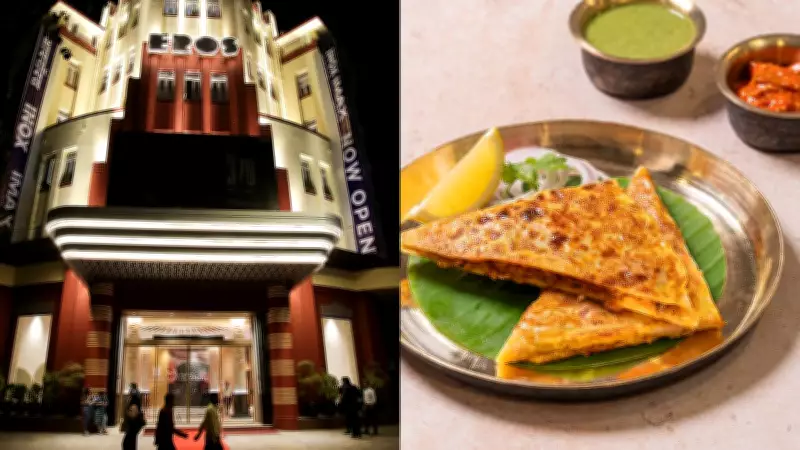
Eros Building's Resurgence in South Mumbai's Culinary Landscape
Originally inaugurated as Eros Cinema in 1938, the iconic Eros Building has experienced a significant decline over the decades. However, its recent restoration has sparked widespread public affection, underscoring its deep-rooted significance to Mumbai residents. This revival is not just about architectural preservation but also about reclaiming its position on the city's dynamic food and cultural map.
A New Chapter for a Historic Landmark
Bengaluru's renowned The Rameshwaram Cafe is poised to make its Mumbai debut next month, establishing its first outpost at the Cumbata Building, commonly known as the Eros Building. This addition joins a growing roster of restaurants and cultural venues that have recently moved into this South Mumbai landmark. In January, Pali Bhavan relocated from Bandra's Pali Hill, while November witnessed the opening of Hearth, a progressive barbecue restaurant. These developments signal a renewed attraction to this pocket of South Mumbai, blending familiarity with newfound vibrancy.
The Heart of the Transformation
At the core of this shift is the Cumbata Building itself. Long associated with cinema halls, college crowds, and post-movie meals, this Art Deco structure is now being reimagined as a multifaceted urban destination. It integrates food, retail, and cultural spaces that prioritize heritage alongside foot traffic. Commissioned by Parsi businessman Shiavax Cawasji Cambata in 1935 and designed by architect Sohrabji Bhedwar, the building opened as Eros Cinema on February 10, 1938. Inspired by a statue of Eros in London, it was celebrated as Bombay's most glamorous cinema, screening English films and drawing students from nearby colleges.

Decline and Emotional Restoration
Akshat Gupta of Metro Realty Group, who, along with partner Atul Rawat, secured a 30-year lease with the Cumbata family, notes that the building's decline began in the 1990s with the fall of single-screen theatres and piecemeal changes. When a green curtain was erected for restoration a few years ago, it triggered an unexpected emotional response from Mumbaikars. Many feared not change, but erasure. Gupta recalls being inundated with calls and messages, even from ministers' offices, necessitating clarifications that the building was being restored, not demolished. This episode highlighted the collective ownership felt towards landmarks like Eros, emphasizing that such structures belong to the entire city.
Restoration and Vision
Metro Realty Group initiated restoration work in 2019 with conservation architect Kirtida Unwalla, guided by extensive photographic documentation. Gupta explains that any replacements or additions were carefully designed to stay within the Art Deco language, from lighting to detailing. The broader vision was to revive the site as an entertainment hub. Today, with an estimated 1.7 to 2 million people crossing the junction daily, the building sits at one of South Mumbai's busiest intersections. Gupta observes that the building is slowly unveiling itself, with Swadesh setting the tone and subsequent additions enhancing its appeal. Residents often express joy at seeing the building illuminated again, especially at night.
Re-entering Public Life
Eros reopened to the public in February 2024, transforming the original 1,200-seater single-screen theatre into a 305-seater IMAX cinema operated by PVR Inox on the second floor. Gradually, the building has filled out, repositioning itself as an "entertainment magnet" that attracts cinema-goers alongside diverse food, retail, and cultural spaces. Early last year saw the opening of Swadesh, offering curated handcrafted luxury products by Nita Ambani, and the intimate NMACC Theatre Cafe. In July, Wagamama made its India debut in the building, followed by Poetry by Love & Cheesecake and Coffee Island, steadily building footfall.

New Additions and Strategic Choices
In February, The Rameshwaram Cafe will occupy nearly 8,000 sq ft across a ground-floor quick-service restaurant and a first-floor family dining space. Raghavendra Rao, co-founder with his wife Divya, shares that after a two-year search across Mumbai, the Eros Building felt like the perfect fit. He emphasizes that South Indian culture and heritage align well with the building's heritage status, creating mutual value. Location played a crucial role, with proximity to Mantralaya, Marine Drive, and Swadesh making it a tourist and local hotspot. The cafe plans to operate from 5 am to 2–3 am.
Chefs' Perspectives and Accessibility
Chefs Dhriti Mankame and Mehul 'Sabby' Sabharwal chose the building for Hearth after a year-long search, primarily in Bandra. They were drawn to the space's strong character and heritage, opting to embrace rather than redefine it. The restaurant retains original elements like the curved layout and exposed iron bars. Improved connectivity, such as the Coastal Road, has made South Mumbai more accessible, benefiting both guests and staff. Mankame notes that Churchgate station, the metro, and the Coastal Road enhance accessibility, making this part of the city more inviting than ever.
Cultural Anchors and Brand Appeal
Inside Swadesh, the 23-seater NMACC Theatre Cafe, designed by architect Ashiesh Shah, serves as a quieter cultural anchor. A spokesperson describes Churchgate as "the city's true nostalgia centre and keeper of old Mumbai's cultural memory," making the neighbourhood an instinctive choice for expansion. The cafe's Art Deco legacy and old-world charm align with its vision of showcasing India's diverse tastes. Within a month, it built a loyal following for comfort dishes.
For K Hospitality Corp, which introduced Wagamama to India, Churchgate was an obvious flagship location. Vivek Raghunath, business head of Wagamama India, highlights the building's recognition, history, visibility, and charm. South Bombay's demography, with well-travelled residents, reinforces its appeal. The building's renaissance, supported by brands like Swadesh, elevates Churchgate as a prestigious destination, enhancing brand stature.
Future Developments and Architectural Value
Upcoming is a 3,500 sq ft fine-dining restaurant on the second floor by the team behind Poetry by Love and Cheesecake. Chef and co-founder Amit Sharma confirms it will be a 40-seater, expected to open by April, with details still being finalized. Architect Nikhil Mahasur of Walkitecture praises the building as one of Mumbai's most beautiful Art Deco structures, with immense architectural value. Its light cream facade, offset with red sandstone and a stepped ziggurat tower, creates a towering appearance. Mahasur recalls its former glory as the city's fanciest cinema, even hosting Alfred Hitchcock in the 1950s, and notes that its resurrection was long overdue.
A Gradual Re-entry into Public Life
What is unfolding at the Cumbata Building is not a dramatic reinvention but a gradual re-entry into public life, marked by movies, meals, and evenings out. As lights illuminate the building each night and footpaths fill once more, Eros is not just reclaiming its place but quietly resuming its role as a neighborhood anchor—familiar yet open to future possibilities.