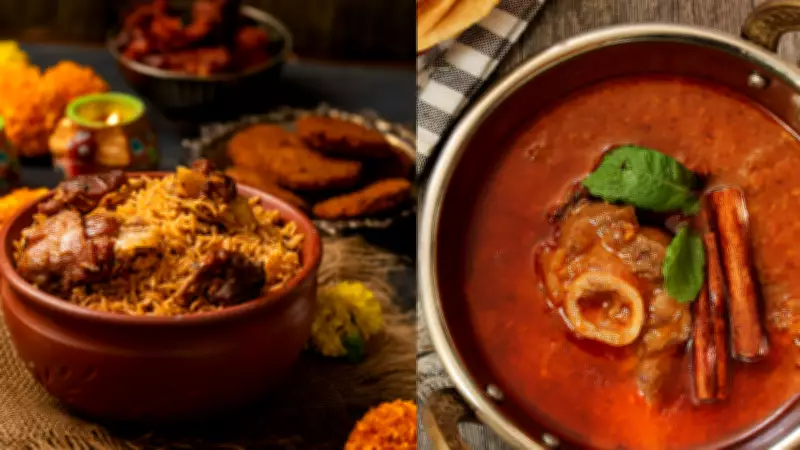
Food history is rarely tidy. Dishes rarely arrive fully formed; they travel, adapt and absorb the tastes of the people who cook them. Mughal food is no exception. What the Mughal era really left behind was not a single fixed cuisine, but a rich courtly style that shaped North Indian cooking for generations, with slow-cooked meats, fragrant rice, saffron, nuts, yogurt and layered gravies influenced by Persian and Central Asian traditions, then transformed by Indian spices and local ingredients. Here are six dishes that carry that Mughal-era imprint most clearly.
Biryani
Few dishes wear history as gracefully as biryani. Often described as a family of elaborate rice dishes, its best-known Indian versions are closely associated with the royal kitchens of the Mughal courts and later the Nizams of Hyderabad. Food historians widely trace the dish's deeper roots to Persia, where fragrant rice and meat preparations were common, before it evolved in India during the Mughal era. That makes biryani less a single recipe than a living archive: rice layered with meat, yogurt, onion and spices, then cooked slowly until every grain absorbs the same deep, aromatic story.
Kebabs
If biryani was the Mughal table's grand statement, kebabs were its smoky signature. Mughal court cooking placed strong emphasis on roasted and fire-cooked meats, especially lamb, seasoned generously and prepared over open heat. The philosophy was simple but refined: start with good meat, marinate it well, cook it with patience, and let fire build the flavour. Over time, the Indian subcontinent adapted and expanded the idea, giving rise to countless variations, from robust seekh kebabs grilled on skewers to the delicate, melt-in-the-mouth styles perfected in the royal kitchens of Lucknow.

Nihari
Nihari is one of the most atmospheric dishes associated with the Mughal culinary world. The slow-cooked meat stew is widely believed to have taken shape in the royal kitchens of the Mughal Empire, where rich, long-simmered dishes were a hallmark of courtly cooking. Traditionally prepared overnight with meat, bones and warming flavourful spices, nihari was often eaten early in the morning, especially after the first prayers of the day. The dish feels almost architectural in its depth, thick, aromatic and deeply comforting. Over time it travelled from royal and elite tables to bustling street stalls, yet it has retained the same slow, brooding richness that defines it.
Korma
Korma belongs to that royal category of dishes that seem designed to linger on the tongue. It is typically prepared as a slow-cooked meat curry enriched with yogurt, ground nuts and carefully layered spices, creating a sauce that is thick, aromatic and gently complex. That creamy, restrained profile fits naturally into the culinary world shaped by the Mughal courts, where richness was prized but excess heat was rarely the goal. The emphasis was on balance, flavours unfolding gradually rather than overwhelming the palate. In royal kitchens, that kind of quiet luxury mattered.
Shahi Tukda
Shahi tukda may be one of the most literal expressions of Mughal-era indulgence. The dessert is closely associated with the royal kitchens of Mughal and later Awadhi courts, where richness and presentation were part of the culinary language. It is made by frying slices of bread in ghee until crisp, then soaking them in thickened milk sweetened with sugar and scented with cardamom or saffron for flavour. The result is lush and fragrant, the bread softened into a custard-like texture while still holding its shape. Whatever its exact origin, the spirit of the dish is unmistakably royal: something humble turned extravagant through patience, dairy and spice.
Sheermal
Sheermal is the bread that shows how deeply Mughal cooking valued elegance as much as flavour. Historians generally trace its roots to Persian-style breads that travelled into North India through Mughal courts and later flourished in the royal kitchens of Awadh. Soft, slightly sweet and scented with saffron, the bread is enriched with milk and ghee, giving it a tender crumb and a golden hue. It was meant to accompany rich dishes like kebabs, qorma and nihari without overpowering them. In other words, sheermal was bread with unmistakably courtly manners.